



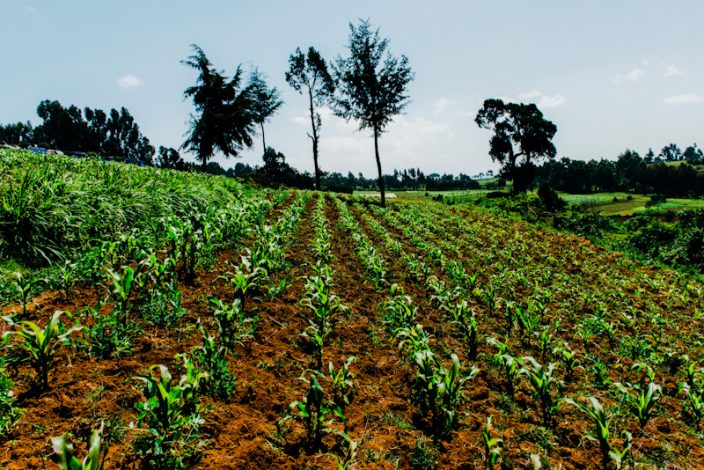
Kenya will import 25 million 90kg bags of maize to bridge a widening national deficit and shield the country from a shortage brought on by drought and climate related disruptions in major growing regions.
Agriculture Cabinet Secretary Mutahi Kagwe announced the figure on August 19 at the Fifth Joint Consultative Meeting of County Executive Committee Members, saying the government has already arranged the imports.
“We will import maize. We have already made arrangements for that. We will manage the country. The country is not going to go hungry,” Kagwe said.
The announcement marks a sharp escalation from August 11, when Kagwe told Members of Parliament the government would import one million bags to replenish the National Strategic Food Reserve after a dry spell cut yields across the grain belt. At that point, officials projected a deficit of 5.4 million bags by the end of September. Eight days later, that projection had grown roughly fivefold to nearly 25 million bags, prompting the government to scale up its response accordingly.
From Strong Harvest Outlook To Widening Shortfall
Kenya consumes approximately 75 million bags of maize annually. Reduced harvests across several producing regions now threaten to leave a shortfall of nearly 25 million bags, close to a third of national demand.
Early rains arrived on schedule and gave farmers a normal planting window. Then the rains stopped. A prolonged dry spell followed, striking crops in the North Rift, the country’s main grain basket, just as maize plants needed moisture to fill out their cobs. Kagwe told lawmakers that yields could fall by as much as 40 percent this season. Uasin Gishu and Trans Nzoia counties, both leading producers, recorded some of the heaviest damage, with assessments in parts of these areas pointing to losses topping 30 percent.
Government data shows maize production climbing steadily in the years before this season’s reversal. Output rose from 36.7 million bags in 2021 to 34.2 million in 2022, then jumped to 47.6 million bags in 2023 and held near that level through 2024 at 44.8 million bags. Provisional figures put 2025 production at 45.8 million bags, the strongest showing in that five year run, a gain the Ministry of Agriculture and Livestock Development attributes to a fertiliser subsidy programme that helped farmers raise yields year after year. Beans, potatoes, sorghum and millet followed a similar upward trend through 2023 and 2024 before easing slightly heading into 2025, suggesting the dry conditions squeezing maize this season may be affecting other staple crops too.
Officials carried that momentum into 2026, forecasting further gains on favourable early rains and expanded planting in the North Rift. Those forecasts have not held. It is worth noting that Kagwe’s own account of the 2025 harvest, cited in some reporting as roughly 67 million bags, sits well above the Ministry’s provisional figure of 45.8 million bags for that year, a discrepancy worth watching as final numbers come in since it affects how steep this year’s decline actually looks.
Government Considers Direct Import Route
Kagwe told lawmakers on August 11 that “the projected depressed yields risk widening the maize deficit in the country, requiring contingency imports or release of strategic reserves to stabilize the domestic demand situation.” He said the government may pursue the imports through a government to government arrangement, a route that can speed up procurement and bypass private trading intermediaries.
By August 19, that contingency plan had hardened into a full import programme covering the entire projected deficit. Kagwe said the imports are intended to stabilise supplies and protect consumers from potential price fluctuations as the shortfall widens.
Irrigation And Tax Reform Anchor Longer Term Response
Kagwe stressed that while imports offer an immediate solution to the projected shortage, the government is pursuing longer term measures to strengthen local food production and reduce Kenya’s vulnerability to climate shocks.
Chief among these is the expansion of irrigation projects such as the Galana Kulalu scheme, which officials expect will boost agricultural productivity, build resilience against drought and cut the country’s reliance on rain fed farming. The government will also work with the National Treasury to streamline taxes and clear bureaucratic bottlenecks affecting farmers and agribusinesses, part of a broader effort to make the sector more competitive and profitable.
AgriConnect Compact Moves Into Consultation Phase
Youth employment featured prominently at the CECM meeting, where the Ministry officially launched consultations for the AgriConnect Compact Programme. Kagwe said the programme could create thousands of jobs as the government works to shift agriculture from a subsistence activity into a modern, technology driven and commercially viable sector.
The meeting brought together leaders from the national government, county governments and the World Bank to review progress under the Food Systems Resilience Program and the National Agricultural Value Chain Development Project, both of which will transition into AgriConnect.
Kagwe said the programme rests on three pillars: increasing agricultural productivity, promoting value addition and creating sustainable employment through agribusiness. He said agriculture should no longer be viewed as a last resort for survival but as an engine for wealth creation, investment and job generation, particularly for young people.
The programme will also push the digitisation of agriculture, adoption of artificial intelligence and integration of modern farming technologies to improve productivity and draw the next generation into the sector.
The consultative meeting gave stakeholders a platform to share their views and help shape a roadmap that will guide the programme’s implementation and inform future agricultural policy.
Editor’s note: This article has been updated. It originally reported, on August 11, 2026, that the government planned to import one million bags of maize against a projected deficit of 5.4 million bags. On August 19, 2026, Agriculture Cabinet Secretary Mutahi Kagwe revised those figures, announcing plans to import 25 million bags against a deficit now projected at nearly 25 million bags. This version incorporates both sets of figures and reflects the latest government statements.
