



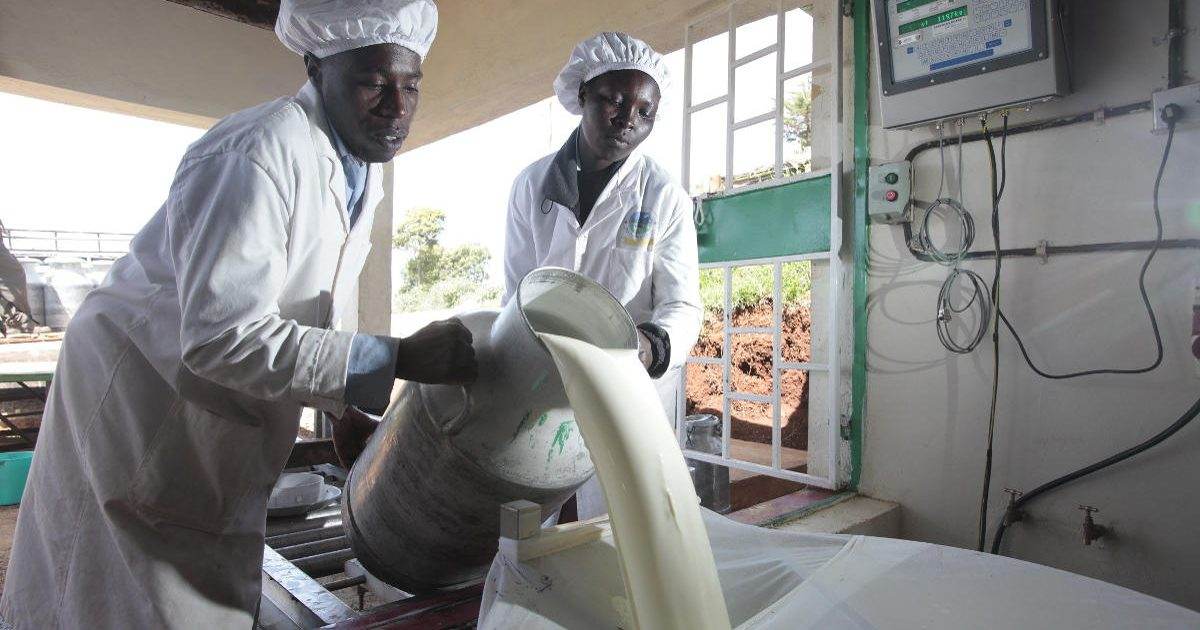
Milk shortages on supermarket shelves now show up in Kenya’s official figures. Deliveries to processors have dropped for three months in a row through July as drought, scarce fodder and costly feed cut output.
What the Kenya Dairy Board data shows
Formal milk intake fell to 81.32 million litres in July 2026, according to Kenya Dairy Board (KDB) data. That is 3.7 percent below June’s 84.44 million litres and 5.8 percent below July 2025.
The slide began after deliveries peaked at 90.27 million litres in April. Intake has since dropped 9.9 percent in three months.
In a September 1 statement, KDB said preliminary August data points to a further fall. Market checks by the Board found low stocks, fewer brands and pack sizes on offer, and slow restocking at some outlets.
Year to date reverses a record 2025
Processors received 594.64 million litres in the first seven months of 2026, 2.3 percent less than the 608.90 million litres received in the same period last year.
The drop follows a strong 2025. Formal intake rose 12.3 percent from 2024 and crossed 1 billion litres for the first time in the available series. July’s volume sits about 4 percent below the 2026 monthly average of roughly 85 million litres.
Pasteurised milk hit hardest, prices disputed
Pasteurised milk is the most affected. Extended shelf life and UHT milk remain easier to find.
KDB says retail prices have held broadly steady nationally, with rises in areas where supply is tightest. The Consumers Federation of Kenya (Cofek) reports a sharper move. It says fresh milk prices have risen from KSh 70 to KSh 80 a litre and it objects to rationing at retailers.
Cofek also argues the shortage was “foreseeable, and in material part, avoidable.” The group says New KCC and KDB did not absorb last year’s milk surplus. Powder made from that surplus, it says, could have been reconstituted into liquid milk during the dry spell. KDB managing director William Maritim told the BBC the constraint is temporary and that milk remains available.
Drought and feed costs drive the fall
KDB blames dry and cold conditions in main dairy areas, which have thinned pasture and fodder. High commercial feed prices add to the strain, especially for farmers who keep cows indoors and buy dairy meal, hay and silage.
Agriculture Cabinet Secretary Mutahi Kagwe told the Senate on September 16 that milk processing is down 5.18 percent. He described the shortfall as “only about 5 per cent less than the usual production.” The July figure against a year earlier, at 5.8 percent, is slightly wider.
Kagwe said hoarding worsened the position. Households that usually hold one or two packets stocked six or so after supermarkets capped purchases at two or three.
Margins leave little room
Kagwe cited a KDB study putting the cost of producing a litre at KSh 39.50 for zero grazing farmers, KSh 37.30 for semi zero grazing and KSh 24.50 for open grazing. The average is KSh 36.20, and the average profit is about KSh 9.90 a litre.
Some companies now pay farmers KSh 55 to 60 a litre, he said. Kagwe added that other farmers sell direct to consumers because some cooperatives and processors have not passed on higher market prices. He urged cooperatives to pay on time and share the premium.
KNBS data in the 2025 Economic Survey shows farmgate prices rose 29.8 percent, from KSh 5,083 to KSh 6,600 per 100 litres, between 2023 and 2024, as reported by Khusoko. Feed costs have taken much of that gain back.
A small share of milk passes through processors
Diversion to informal buyers means part of the drop in formal intake may reflect where milk is sold, not only how much is produced.
Informal trade is large. KNBS estimates Kenya produced 5.5 billion litres of milk in 2025, yet only about 1 billion litres, roughly 18 percent, passed through formal channels.
The National Dairy Master Plan, printed in 2010, set out to change that. It put formal handling at 1.316 billion litres of 4.5 billion produced, about 29 percent. It aimed to cut the informal share of marketed milk from 55 percent to 35 percent by 2030 and projected demand of 12.76 billion litres. Measured against KNBS output, the formal share has moved down, not up, though the two sources define their bases differently.
The plan also listed remedies that match today’s gaps. They include processing surplus milk into powder for use in dry periods, a national milk reserve to absorb gluts and steady prices, national strategic feed reserves, and early warnings to farmers on drought and feed prices.
Government response and outlook
The government is rolling out milk coolers to improve collection and preservation, subsidised sexed semen to raise herd quality, and programmes to expand fodder supply. Kagwe said Kenya needs more large scale fodder production that includes small farmers, and research is under way on disease resistant varieties for semi arid areas.
KDB expects the October to December rains to restore pasture, fodder and output. Until then, falling processor intake remains the clearest statistical proof of the shortages shoppers already see.
