


Kenya has taken a decisive step toward closing one of its most persistent health gaps.
Aga Khan University’s Brain and Mind Institute (BMI) and Newcastle University, working alongside the Ministry of Health, have begun building a national roadmap to confront the stigma surrounding epilepsy, Parkinson’s disease and other neurological conditions.
The scale of the problem is stark. Kenyan children experience neurodevelopmental disorders at a rate of up to 9 percent, and epilepsy alone drives nearly 40 percent of neurological disability adjusted life years in rural populations. Behind those numbers sits a health system stretched thin: the country has just 17 practising neurologists, and not one of them works in a rural area. Twenty child neurologists cover the entire nation. There is a single public specialist neurology and neurosurgery ward, and one matching clinic, serving every age group across Kenya.
That mismatch between need and capacity is exactly what the new roadmap sets out to address, starting with the barrier that keeps people from seeking help in the first place: stigma.
A Policy Grounded in Constitutional Right
The initiative draws together policymakers, researchers, healthcare professionals, advocacy organisations, caregivers and people living with neurological conditions to co develop a shared plan for reducing stigma nationwide. It forms part of Kenya’s commitment to the World Health Organization’s Intersectoral Global Action Plan (IGAP) on Epilepsy and Other Neurological Disorders, which pushes countries to establish national awareness and advocacy programmes by 2031.
Dr Mercy Karanja, Director of the Division of Mental Health at the Ministry of Health, said stigma sits at the root of Kenya’s brain health challenge because fear of judgement keeps people away from care.
“This is not just a health policy goal, it is a constitutional right under Article 43(1)(a) of our Constitution,” she said, describing the roadmap as a vehicle for the multisectoral collaboration needed to ensure people with neurological conditions are understood and supported.
Kenya’s Mental Health Policy (2015 to 2030) already folds epilepsy into its scope, and the Mental Health Act was updated in 2022 and 2023 to protect people with neurological conditions from coercive treatment and discrimination. Yet the country still has no dedicated budget line for neurological disorders, and most families pay more than half the cost of care out of pocket. Policy protection on paper has not yet translated into funded, accessible services on the ground, which is precisely the gap this roadmap aims to close.
What the Canvas for Change Research Found
The roadmap builds directly on the British Academy funded Canvas for Change project, led by BMI in partnership with Newcastle University. Researchers used participatory theatre, documentary storytelling and community dialogue across rural Kenya to understand how stigma shapes the lives of people with neurological conditions. The team conducted 31 interviews, spanning people living with epilepsy and Parkinson’s disease, their caregivers, community members and policymakers.
The findings expose how deeply stigma is woven into everyday belief systems. One woman recalled being told her epilepsy came from a difficult pregnancy, despite having no history of the condition beforehand. Others described being blamed for witchcraft or possession, with one participant saying people assume “the person is bewitched” once a diagnosis emerges. A community member put the social cost plainly, saying people with epilepsy are treated as outcasts because their neighbours refuse to accept the condition as an illness at all.
Religious explanations compound the problem. One participant said a preacher attributed her symptoms to a curse rather than a medical condition. These beliefs do not stay abstract. They shape who eats together, who gets left out of family decisions, and who is left to manage a seizure alone because neighbours, in the words of one caregiver, “mind their business” when someone falls ill.
The consequences run deep, from strained family relationships to profound psychological distress. One participant described the isolation as so severe it brought thoughts of self harm, only interrupted by a chance encounter on the way to the well. These are not isolated accounts. They point to a pattern the roadmap is now trying to break.
The Global Framework Behind the Effort
Kenya’s roadmap sits inside a much larger WHO push. The Intersectoral Global Action Plan on Epilepsy and Other Neurological Disorders won unanimous approval from all 194 WHO member states at the World Health Assembly in 2022, making it the first global action plan built specifically around neurological health. It runs through 2031 and rests on five strategic objectives: strengthening leadership and governance, improving surveillance and research, expanding access to quality care, raising public awareness, and reducing stigma through cross sector partnerships.
| IGAP Objective | Key 2031 Target |
|---|---|
| Policy and governance | 75% of countries update national policies to include neurological disorders |
| Awareness and advocacy | 100% of countries run at least one functioning advocacy programme |
| Diagnosis, treatment and care | 75% of countries include neurological disorders in universal health coverage |
| Access to medicines | 80% of countries provide essential medicines in primary care |
| Research and data systems | Global research output on neurological disorders doubles |
| Epilepsy service coverage | Coverage increases 50% from 2021 levels |
Since 2020, the Kenya Association for the Welfare of People with Epilepsy (KAWE), founded in 1982, has run its Komesha Kifafa campaign, using community dialogues, stigma benches, school outreach and healthcare worker training to spread one core message: epilepsy is a treatable medical condition, not a curse. The campaign has reached counties including Nairobi, Tharaka Nithi, Garissa, Homa Bay, Kisii, Busia and Kajiado. Newer organisations have joined the effort too, among them the Kiserem Epilepsy Foundation, providing free medication and vocational training in Kiambu County since 2018, and the Alzheimer’s and Dementia Organisation Kenya, established in 2016.
From Evidence to Implementation
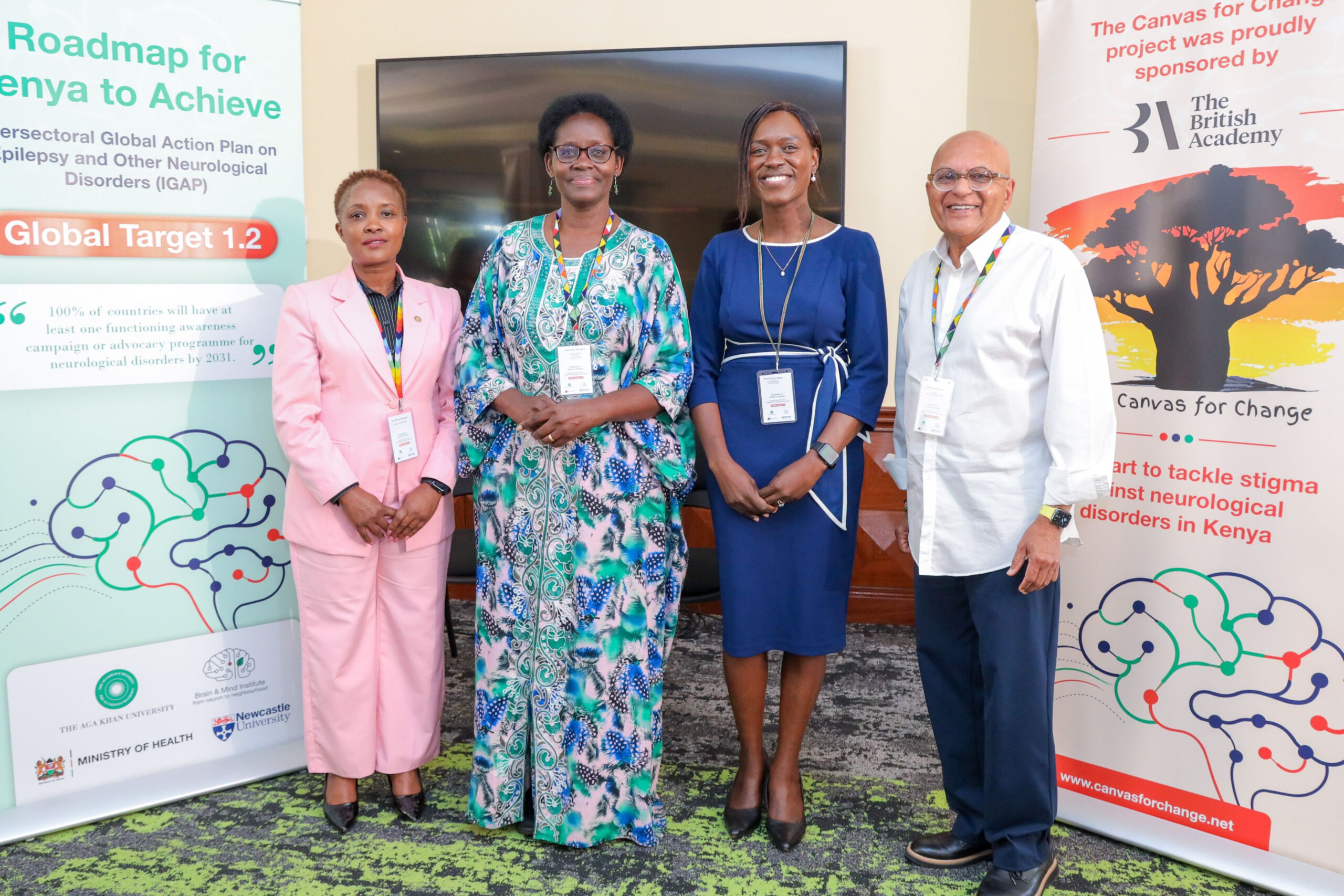
Since 2024, the Ministry of Health has convened national consultations under IGAP, and a second consultative meeting in March 2026 consolidated priorities across policy, advocacy, stigma reduction and access to medicines. The most recent step in that process, a retreat held on 16 and 17 July 2026 at the Great Rift Valley Lodge in Naivasha, brought the Canvas for Change evidence together with that prior groundwork to draft a National Partnership Roadmap aimed squarely at IGAP’s Target 1.2, which calls for every country to run a functioning awareness or advocacy programme by 2031.
Rather than reopening old debates, the retreat treated the 2024 and March 2026 priorities as its starting point and used them to structure two focused days. Day one generated evidence and mapped stakeholders through facilitated discussion. Day two converted that material into draft roadmap sections, covering objectives, actions, owners, timelines and resourcing, validated in plenary before facilitators consolidated everything into a polished document.
The room reflected the scale of collaboration the roadmap demands: representatives from the Ministry of Health’s Division of Mental Health, NCDs, Healthy Ageing, Health Promotion and Communications units sat alongside clinical partners, advocacy bodies including KAWE, EAPNA and AMREF, people with lived experience of epilepsy and Parkinson’s disease, and the Canvas for Change research team. Kisumu County’s First Lady joined as a keynote guest on the second day.
Aga Khan University Brain and Mind Institute Director Professor Merali said bringing researchers, government, healthcare professionals, communities and people with lived experience into the same room creates the best chance for evidence to shape decisions that improve lives.
“Research should not end in academic journals. Its greatest value is realised when it informs policy and improves people’s lives,” he said.
Dr Mary Bitta, BMI Implementation Scientist and Canvas for Change Principal Investigator, said the stories gathered through the research revealed how stigma can limit a person’s life as much as the underlying condition itself.
“Seeing those experiences shape national policy is exactly what this project set out to achieve,” she said.
What Comes Next
The retreat produced four concrete outputs: a validated map of stakeholders and existing programmes tied to Target 1.2, draft roadmap sections spelling out objectives, actions, owners and timelines, an agreed governance mechanism to carry the work forward, and a named set of owners responsible for finalising and launching the document. The facilitation team will now consolidate the working group outputs into a single draft, circulate it for written comment, secure sign off from the Ministry of Health and partners, and produce a policy brief to guide dissemination.
Neurological conditions remain among the leading causes of disability worldwide, and stigma continues to be one of the sharpest barriers to early diagnosis and treatment. What Kenya’s roadmap represents is a bet that evidence gathered directly from affected communities, paired with sustained political commitment, can start to close that gap.
With the country’s specialist workforce stretched to just a handful of practitioners and financing still resting overwhelmingly on families themselves, the roadmap’s success will depend on whether its commitments translate into funded programmes reaching the rural communities where the burden falls hardest.
