



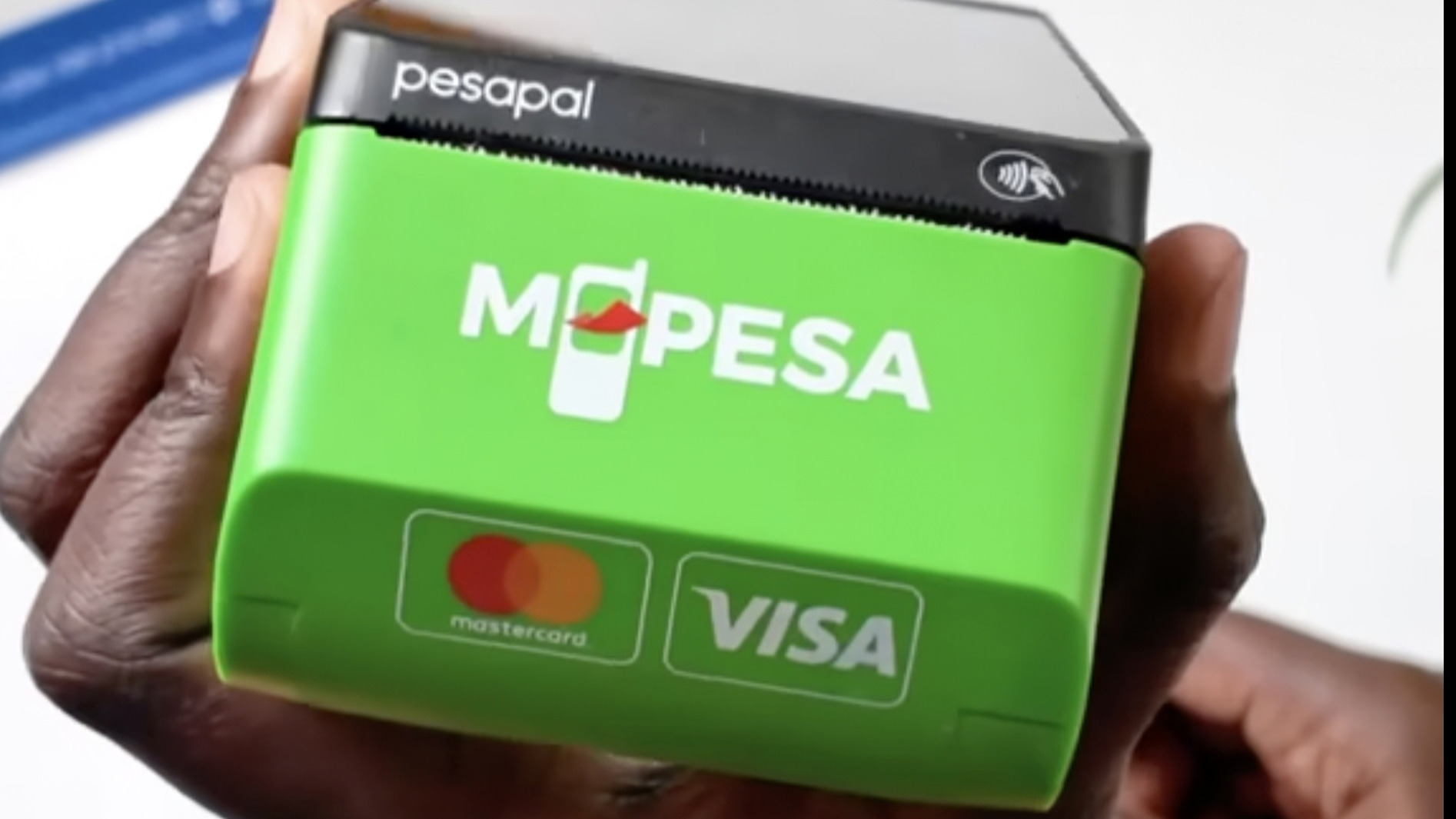
Safaricom and payments firm Pesapal on Thursday began rolling out two M-PESA checkout options in Kenya: Dynamic Scan-to-Pay and Tap-to-Pay. Both run on Pesapal’s point of sale (POS) devices. Safaricom also announced AI Pay, a feature in its My OneApp that reads payment details from a receipt.
Pesapal describes Tap-to-Pay as the world’s first mobile money NFC payment solution.
The partnership joins Safaricom’s M-PESA payment services to Pesapal’s merchant payment infrastructure. It follows Safaricom’s effort to move M-PESA beyond transfers and into checkout.
How the new payment options work
Dynamic Scan-to-Pay. The customer scans a QR code shown on the Pesapal POS. The merchant details and the amount fill in automatically. The customer checks the transaction and completes the payment.
Tap-to-Pay. A customer with an NFC enabled smartphone taps it on the Pesapal POS, checks the transaction details and pays. Pesapal says customers confirm with a PIN or fingerprint.
AI Pay. The customer scans a printed or handwritten receipt in My OneApp. The app identifies the Till or PayBill details and the payment amount, and fills them in where the receipt shows the information. The feature reduces manual entry. My OneApp has more than 7 million downloads.
Pesapal says its QR infrastructure follows the Central Bank of Kenya KE-QR standard. Under that standard, a single merchant QR code can be paid by customers of different banks, telcos and fintechs. The company says this widens acceptance and lowers processing costs for merchants. It did not publish figures.

Safaricom’s case: fewer steps at checkout
James Maitai, Safaricom PLC’s Group Chief Technology Officer, said the aim goes beyond enabling payments.
“As the way Kenyans shop and transact continues to evolve, we are focused on ensuring that M-PESA evolves with them,” he said. “This means moving beyond simply enabling payments to reimagining the payment experience itself.”
Boniface Mungania, Acting Chief Financial Services Officer at Safaricom, framed the change around the customer at the till. “You don’t really want the payment itself to be an event. You just want to pay and move on,” he said. He noted that, depending on how a customer pays, several steps can still separate “I’m ready to pay” from “payment done.”
Mungania said the launch carries Scan-to-Pay onto the POS and adds a second route for customers with NFC phones. He also pointed to the cost to merchants of slow or faulty checkout.
“Every unnecessary step at checkout is time, and every incorrectly entered payment detail can become a problem for both the customer and the business,” he said.
Pesapal says the change removes common input errors, such as mistyped Paybill numbers, wrong Till digits and mismatched account references. It also expects faster checkouts to shorten queues at peak hours, so merchants can process more transactions.
Merchant numbers and targets
Scan-to-Pay is available at more than 60,000 merchant outlets. Safaricom aims to reach 500,000 within the next year. Mungania said close to 1,000 Pesapal POS devices are already in the market, which gives Safaricom “another important route” to businesses and their customers.
Pesapal said the services are rolling out across thousands of businesses in Kenya. Founder Agosta Liko said the features cut friction for businesses on its platform.
“Tap-to-Pay and Scan-to-Pay on the Pesapal POS represent the biggest leap in Kenya’s checkout experience in years,” he said. “Thousands of businesses trust our platform, and by teaming up with Safaricom, we are delivering the faster, error-free transactions their customers expect.”
Pesapal says combining QR codes with NFC is meant to serve merchants of every size, from retail chains to neighbourhood micro-enterprises.
Why payments matter to Safaricom’s results
Payments carry weight in Safaricom’s earnings. M-PESA earned KES 182.7 billion in the year to March 2026, up 13.4 per cent, and supplied 45.6 per cent of Kenya service revenue.
Khusoko’s report on the FY2026 results shows payments made up 74.4 per cent of M-PESA revenue, and Lipa na M-PESA revenue grew 21.7 per cent. At about KES 129 to the dollar, M-PESA revenue equals roughly $1.4 billion.
Pesapal provides payment and business management tools to merchants, from small traders to larger firms. It works in Kenya, Tanzania, Uganda, Rwanda and Zambia.
KCB’s Pesapal Stake Surfaces in Tanzanian Regulatory Filing, Confirming 22.23% Deal
