



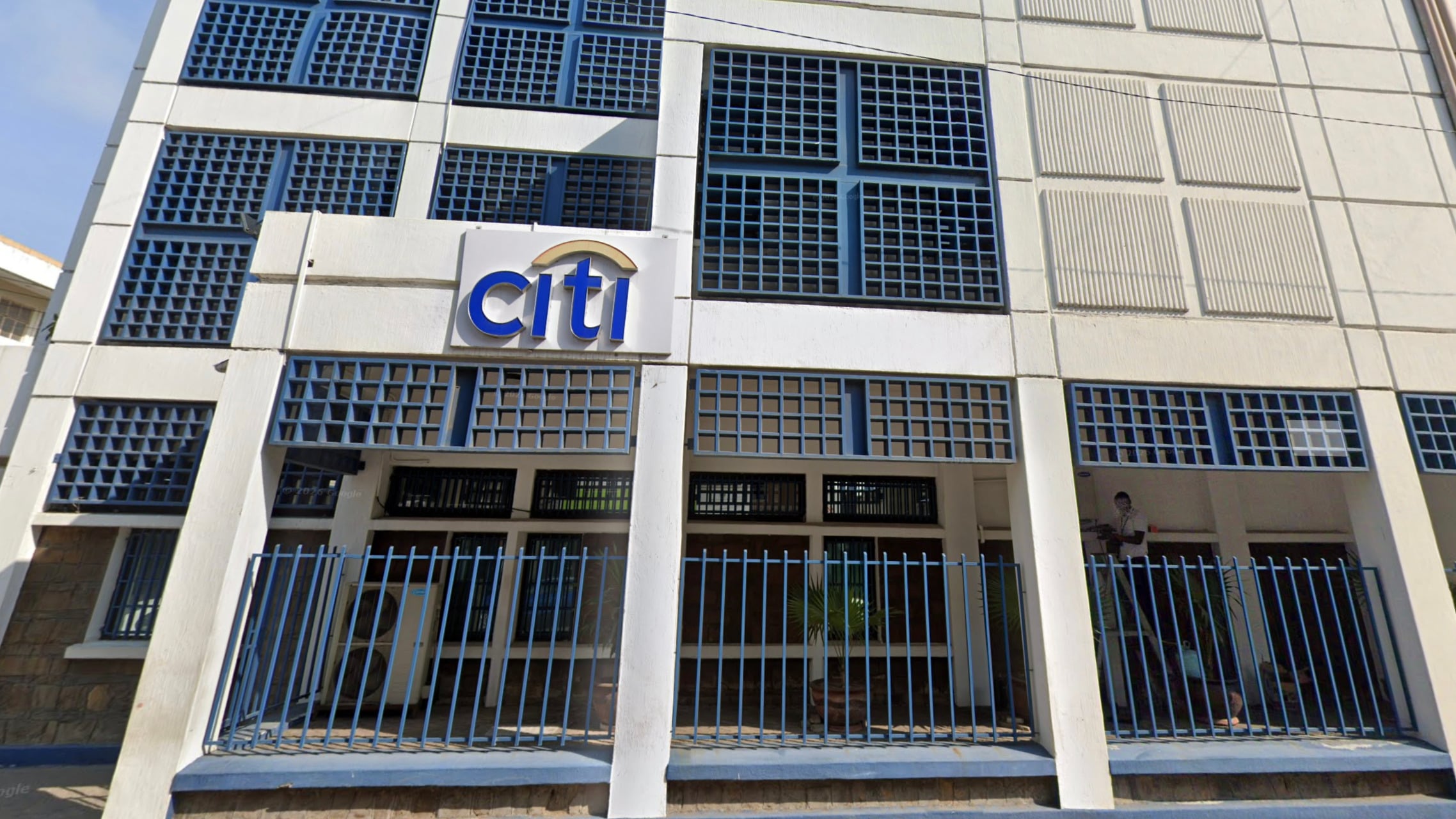
Citibank Kenya will close its Mombasa branch on November 30, ending a coastal presence that began in 1989, as the bank moves to run all corporate banking services out of its Nairobi headquarters.
The lender confirmed the move in a public notice, framing it as digital modernization rather than retreat.
“This strategic optimization of our corporate banking network is part of Citi Kenya’s ongoing commitment to modernizing and digitizing banking services and has received all required regulatory approvals,” the bank said in the notice.
It added that clients will keep full access to CitiDirect and other digital platforms, and that relationship managers will remain available throughout the transition.
Citibank has operated in Kenya since 1974, serving corporate, financial institution, and public sector clients.
From Grand Opening to Quiet Exit
The Mombasa branch’s story spans nearly four decades. When Citibank opened its doors on Nyerere Avenue’s Ralli House in October 1989, the bank ran newspaper advertisements promising the coast “unsurpassed banking services from the smallest needs to the biggest transactions,” including a then novel real time data link between Nairobi and Mombasa. The branch later relocated to Citibank House on Nkurumah Road, where it has operated since.
Citibank Kenya will close its Mombasa branch and continue serving its corporate clients through digital banking services from Nairobi. It opened its first branch in Mombasa in 1989. pic.twitter.com/ZgtGKikD8S
— Bankelele (@bankelele) August 26, 2026
That history matters because Citibank built its Kenyan identity around a two branch, corporate only model, a structure that made it unusual among Kenyan lenders, most of which run retail networks.
Mombasa gave Citibank a direct line into the trade finance and import export business that flows through the port city. Folding that function into Nairobi signals the bank sees enough capacity in digital banking to serve coastal clients without a physical desk.
A Closure That Coincides With a Weak Half Year
The branch closure lands alongside a difficult set of first half results for Citibank N.A. Kenya. Net interest income fell 20.0 percent year on year to KES 4.44 billion, and non interest income dropped even further, down 36.6 percent to KES 2.73 billion. Together, those declines pulled total operating income down 27.2 percent to KES 7.16 billion.
Profit fell sharply as a result. Profit before tax dropped 51.2 percent to KES 2.99 billion, and profit after tax fell 53.5 percent to KES 1.92 billion, more than halving the bank’s bottom line compared to the same period last year.
The balance sheet shrank too. Total assets fell 13.5 percent to KES 158.77 billion, net loans and advances dropped 26.0 percent to KES 31.92 billion, and customer deposits declined 16.1 percent to KES 121.47 billion. Gross non performing loans fell 8.4 percent to KES 2.00 billion, and loan loss provisions collapsed 92.9 percent to just KES 49.67 million, a sign the bank pulled back sharply on new lending risk rather than absorbing fresh losses.
Capital strength held up despite the shrinking balance sheet. Core capital rose 5.2 percent to KES 28.92 billion, total capital grew 7.3 percent to KES 29.70 billion, and shareholders’ funds edged up 2.5 percent to KES 31.57 billion.
Citibank N.A. Kenya H1 2026 Results at a Glance
| Metric | H1 2026 | Change YoY |
|---|---|---|
| Net Interest Income | KES 4.44B | -20.0% |
| Non Interest Income | KES 2.73B | -36.6% |
| Total Operating Income | KES 7.16B | -27.2% |
| Profit Before Tax | KES 2.99B | -51.2% |
| Profit After Tax | KES 1.92B | -53.5% |
| Total Assets | KES 158.77B | -13.5% |
| Net Loans and Advances | KES 31.92B | -26.0% |
| Customer Deposits | KES 121.47B | -16.1% |
| Gross NPLs | KES 2.00B | -8.4% |
| Loan Loss Provisions | KES 49.67M | -92.9% |
| Core Capital | KES 28.92B | +5.2% |
| Total Capital | KES 29.70B | +7.3% |
| Shareholders’ Funds | KES 31.57B | +2.5% |
A Contrast With the Rest of the Sector
Citibank’s contraction stands apart from the growth other Kenyan lenders have reported this earnings season. I&M Group posted profit after tax growth of 22.4 percent, with both net interest income and non funded income expanding by more than 20 percent, and DTB grew profit 37 percent on strength in digital lending. Where those banks expanded lending and income together, Citibank pulled back on both, a pattern more consistent with a bank narrowing its footprint than one competing for market share.
The financial statements, signed by Managing Director Martin Mugambi and Chief Financial Officer John Kebu, describe results that are unaudited extracts from the bank’s books, prepared for the period ended June 30, 2026.
Standard Chartered Kenya Lists Chiromo Headquarters for Sale at KShs 1.41 Billion
What the Closure Signals
Taken together, the branch closure and the earnings decline point toward the same conclusion: Citibank Kenya is choosing to run leaner.
The bank remains a licensed, capitalized institution with room above its regulatory minimums, its liquidity ratio stood at 85.7 percent against a 20 percent requirement, but its shrinking loan book and falling income suggest a deliberate narrowing of scope rather than a business fighting to hold ground. Whether that strategy pays off will depend on how much of its corporate client base stays loyal once the Mombasa desk goes dark for good.
