


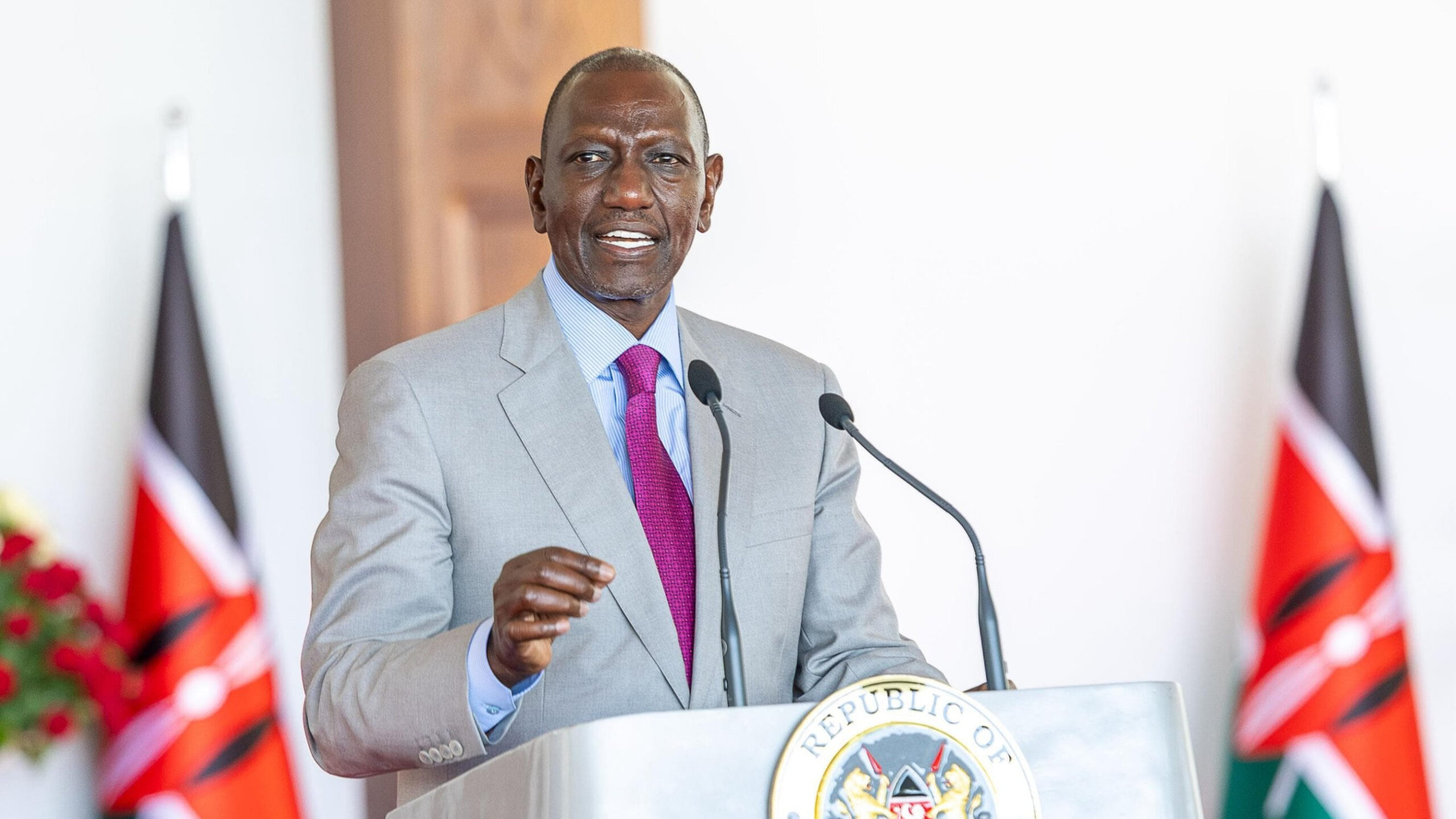
President William Ruto has called on Kenyans to confront an uncomfortable question: why has a country that stood shoulder to shoulder with South Korea in 1965 fallen so far behind it today.
In a special national address from State House Nairobi on Wednesday evening, Ruto announced that Kenya will formally launch a National Conversation on Kenya’s Future Beyond Vision 2030 on August 12, describing it as the most consequential exercise in public participation since the 2010 Constitution.
The Gap Ruto Wants Kenya To Reckon With
Ruto opened with a comparison designed to sting. In 1965, he said, Kenya and South Korea each had a GDP per capita of roughly $110. Six decades later, South Korea’s stands above $36,000 while Kenya’s sits at $2,400, a gap of fifteen times. He drew similar lines against China, whose economy overtook Kenya’s after 1980 and now sits six times larger per capita, and against Vietnam, which started reforms in the early 1990s from half of Kenya’s income level and has since doubled it.
Closer to home, the comparison stung more. Ghana’s GDP per capita now runs about 30% higher than Kenya’s, Ruto said, and Zimbabwe, despite years of economic hardship, has edged slightly past Kenya as well.
“The question we must ask ourselves candidly and honestly is why other nations have fulfilled so much of their potential while we have repeatedly fallen short,” Ruto said, framing the exercise not as blame but as preparation for what comes next.
Why Ruto Says This Is Kenya’s Moment
The president built his case for urgency on four grounds. First, he argued that Kenya has spent the past four years stabilising the economy rather than planning its next chapter, and that the job is now largely done: foreign exchange reserves have climbed above $15 billion, covering six and a half months of imports, inflation has fallen, and foreign direct investment hit a record $3.2 billion last year, more than double the 2022 figure.
He also pointed to Kenya’s debut appearance in the IMD World Competitiveness Ranking. The Lausanne based institute placed Kenya 56th out of 69 economies worldwide in its 2025 index and first among the six African countries that qualified, ahead of Botswana, Ghana, South Africa and Nigeria. Ruto cited the ranking as evidence that recent reforms have restored investor confidence.
Second, Vision 2030 itself is running out of road. Launched in 2008 under President Mwai Kibaki, it set out to make Kenya an upper middle income, globally competitive, industrialised nation by 2030. Ruto acknowledged plainly that the target will be missed. “This is not a criticism of Vision 2030,” he said. “Nor is it a reason for disappointment.”
Third, he argued that global economic momentum is shifting toward Africa, citing forecasts that nine of the world’s fastest growing economies are on the continent and that one in four people on Earth will be African by 2050. Fourth, he tied the exercise to unfinished constitutional business, arguing that Article 43’s guarantees on health, housing, food, water, social security and education remain aspirations rather than lived outcomes, and that Kenya has never defined the measurable standards needed to know whether it is meeting them.
A Blueprint Already In Hand
On July 21, Ruto received a report titled Developing a New Vision for Kenya: Towards a First World Nation, produced by a team led by Kisumu Governor Anyang’ Nyong’o and Japanese economist Hiroyuki Hino, alongside professors Michael Chege, Karuti Kanyinga and Peter Wanyande. The report argues Kenya could reach developed nation status within one generation given policy consistency, strong institutions and sustained investment.
Ruto called the report “a thoughtful and valuable contribution” when he received it, adding that its value lay in “asking important questions, challenging our assumptions, broadening our thinking.” In Wednesday’s address he was careful to frame the document as a starting point rather than the final word.
“These proposals provide the foundation for a much broader national conversation,” he said, “a conversation that now belongs not to Government, nor to its authors, but to every Kenyan.”
What Happens On August 12
The national conversation launching next month is meant to run wider than a typical government consultation. Ruto said it would draw in political parties, the private sector, workers’ organisations, faith communities, universities, professional associations, civil society, the creative industries and, he stressed, young people, across every county.
He was explicit that the process should not produce another bureaucratic plan. “It is about forging a new national consensus on the country we intend to become and the standards by which we shall measure our progress,” he said, adding that once Kenyans agree on that framework, political competition should shift to a contest over “who has the best ideas, the soundest policies, and the best capability to take us there faster, more efficiently and more inclusively.”
He closed by invoking the generation that wrote Kenya’s Constitution in 2010. “In 2010, we gave ourselves a Constitution worthy of our dreams,” he said. “The task of our generation is to build a nation worthy of that Constitution.”
The Politics Behind The Timing
The push for a post 2030 vision lands roughly a year before Kenya’s 2027 general election, and coincides with a state of the nation address in November 2025 in which Ruto pitched a 5 trillion shilling infrastructure programme aimed at moving Kenya “from developing to developed.” Analysts have noted that anchoring a long term national vision now gives the ruling administration a framework that could outlast any single election cycle, though Ruto has repeatedly argued that is precisely the point: a shared vision, he says, should survive changes in government rather than being redrawn every five years.
Whether the new vision delivers where its predecessor fell short will depend on what emerges from the consultation Ruto has now set in motion, and on whether the institutions he has already built, including the National Infrastructure Fund and the Sovereign Wealth Fund, can convert consensus into results.
