


KenGen spent Ksh15.5 billion on power plants and equipment in the year to June 30, 2026, and paid its shareholders less for the year. The KenGen dividend approved at the 74th Annual General Meeting in Nairobi on Thursday, October 29, is Ksh0.75 a share, down from Ksh0.90.
Capital spending rose 14.3%. Borrowings fell by Ksh12.2 billion to Ksh97.1 billion. The spending on plants exceeded the fall in borrowings, and the fall in borrowings exceeded the dividend bill of about Ksh4.946 billion.
Electricity demand is outrunning supply
KenGen supplied 8,975 gigawatt hours (GWh) to the national grid during the year. The company says that met 57.2% of national electricity demand. The figure equals KenGen’s output divided by the 15,692.81 GWh of total generation recorded by the Energy and Petroleum Regulatory Authority (EPRA).
Peak demand, the highest load on the grid at one time, reached 2,514.28MW on June 29, 2026, according to EPRA. That was 8.55% above the previous year and the largest annual rise in five years. At the AGM, Managing Director and CEO Eng. Peter Njenga put the peak at 2,549MW. That matches the July reading in Kenya Power data reported by Business Daily.
Peak demand has risen in each of the past five years. Khusoko reported a peak of 2,051MW in May 2022, and EPRA’s figure of 2,316.2MW for the year to June 2025. The 2,549MW reading is 24% above the 2022 level. Supply has not kept pace. Business Daily reported that the reserve margin, the gap between available capacity and demand, narrowed to 3.34% in June. Kenya Power plans to lift imports from Ethiopia to 400MW at peak from December.
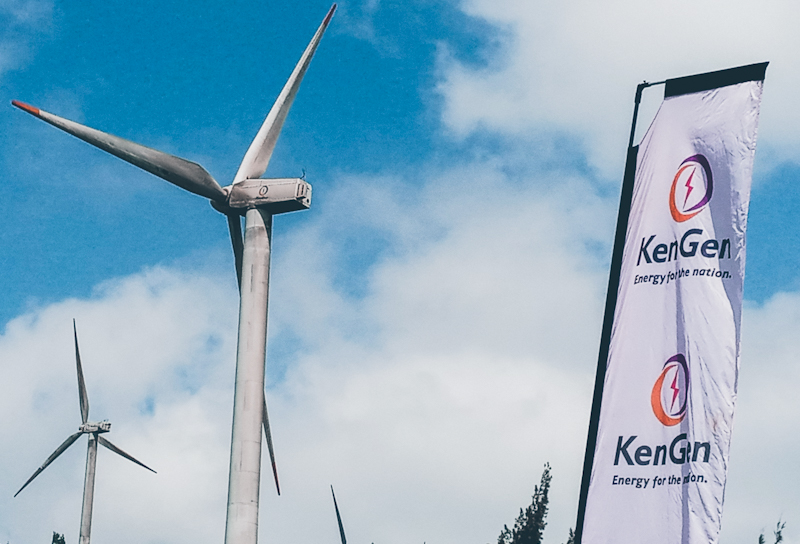
KenGen has 1,786MW of installed capacity. Hydro supplies 826MW, geothermal 754MW and wind 25.5MW, and thermal plants make up the rest. The company says more than 90% of the electricity it dispatched came from renewable sources.
Profit held near last year as finance income fell
Revenue rose 6.4% to Ksh59.7 billion from Ksh56.1 billion, and electricity supplied rose 5.8%, according to the results Khusoko reported in September. Operating expenses rose 6.8% to Ksh37.5 billion. Operating profit rose 4.1% to Ksh14.2 billion.
Profit after tax still slipped 1.2% to Ksh10.35 billion, within 1.2% of last year’s Ksh10.48 billion. The gap sits below the operating line. Finance income fell 30.4% to Ksh2.86 billion, which KenGen attributes to cash moving into capital projects. Finance costs fell 12.1% to Ksh1.98 billion. Profit before tax fell 2.7% to Ksh15.1 billion, and earnings per share were Ksh1.57. Cash and equivalents ended the year at Ksh26.7 billion, down from Ksh30.1 billion.
Profit after tax was Ksh5.02 billion in FY2023, when KenGen reported 48% growth. The latest result is double that.
Why the dividend fell faster than profit
Profit fell 1.2%. The dividend fell 16.7%. The Ksh0.75 payout equals 48% of earnings per share. On Khusoko’s figures, last year’s Ksh0.90 was about 57% of earnings per share. The board kept a larger share of earnings in the business.
At the share price of Ksh12.55 cited in September, the dividend gives a forward yield of 6.0%. The payout across 6,594,522,339 shares comes to about Ksh4.946 billion. The Government of Kenya held 69.99% of the shares at June 30, 2025, according to Business Today, which implies about Ksh3.46 billion for the Treasury. Payment is due on or about January 21, 2027, to holders on the register at the close of business on October 29.
KenGen last cut its payout in FY2019, to Ksh0.25 from Ksh0.40, Khusoko reported. Presiding chairman Eng. Frank Konuche told the press the board is balancing dividends, investment and financial strength.
Olkaria I returns after three years offline
KenGen shut the Olkaria I geothermal station in 2023 for rehabilitation. The work lifts its rating from 45MW to 63MW, with Toshiba ESS supplying the turbines and generators for Units 1 to 3, ThinkGeoEnergy reported. In 2025, Njenga said the first turbine would be commissioned by June 2026. At the AGM he said the rehabilitation is complete and the station awaits official commissioning, which he hopes will happen by the end of the year. KenGen puts its installed capacity at 1,848MW once the 63MW joins. Njenga said the capacity will reduce reliance on thermal generation and lower the levelised cost of electricity for retail and industrial consumers.
The development list also includes the proposed 42.5MW Seven Forks solar plant, the redevelopment of Gogo hydropower station, battery storage and the proposed raising of Masinga dam, which KenGen links to water management for hydropower. They sit under the G2G 2034 Strategy, with a development ambition of 5,540MW across geothermal, hydro, wind, solar and nuclear, according to Konuche. The Standard reported in July that KenGen had raised the 2034 goal from 1,500MW.
Green Energy Park and consultancy aim to widen revenue
The Olkaria area in Naivasha has been declared a special economic zone covering about 8,292 acres, and the Green Energy Park sits inside it. The park was gazetted as a customs controlled area on June 5, 2026, which activates the tax and customs incentives under the Special Economic Zones Act, 2015. The Kenya News Agency reported five investors across data centres, green fertiliser, electric mobility, steel fabrication, logistics and manufacturing. KenGen’s stated targets at the AGM were manufacturing, food processing and data centres.
Consultancy is the second route. Services under G2G 2034 include geothermal drilling, resource assessment, engineering, and plant operation and maintenance. Konuche named engagements in Tanzania, Djibouti, Eswatini and Bhutan. Neither the press release nor the statements gave a revenue figure for the park or for consultancy, so their effect on earnings cannot yet be measured.
Governance and leadership change
Shareholders approved revised Articles of Association. Class A shareholders directly elected their two representative directors for the first time since the Government Owned Enterprises Act, 2025 took effect. KenGen held a virtual briefing on the process on April 15, 2026. After the retirement of the previous chairman, the reconstituted board will elect a substantive chairman from among its members. Konuche presided at the AGM.
The board announced on October 24 that Ronoh Kibet Charles, General Manager for Commercial Services, will succeed Njenga as Managing Director and CEO on February 1, 2027. Kibet oversees energy markets, investments, new business, partnerships, marketing and sustainability.
