


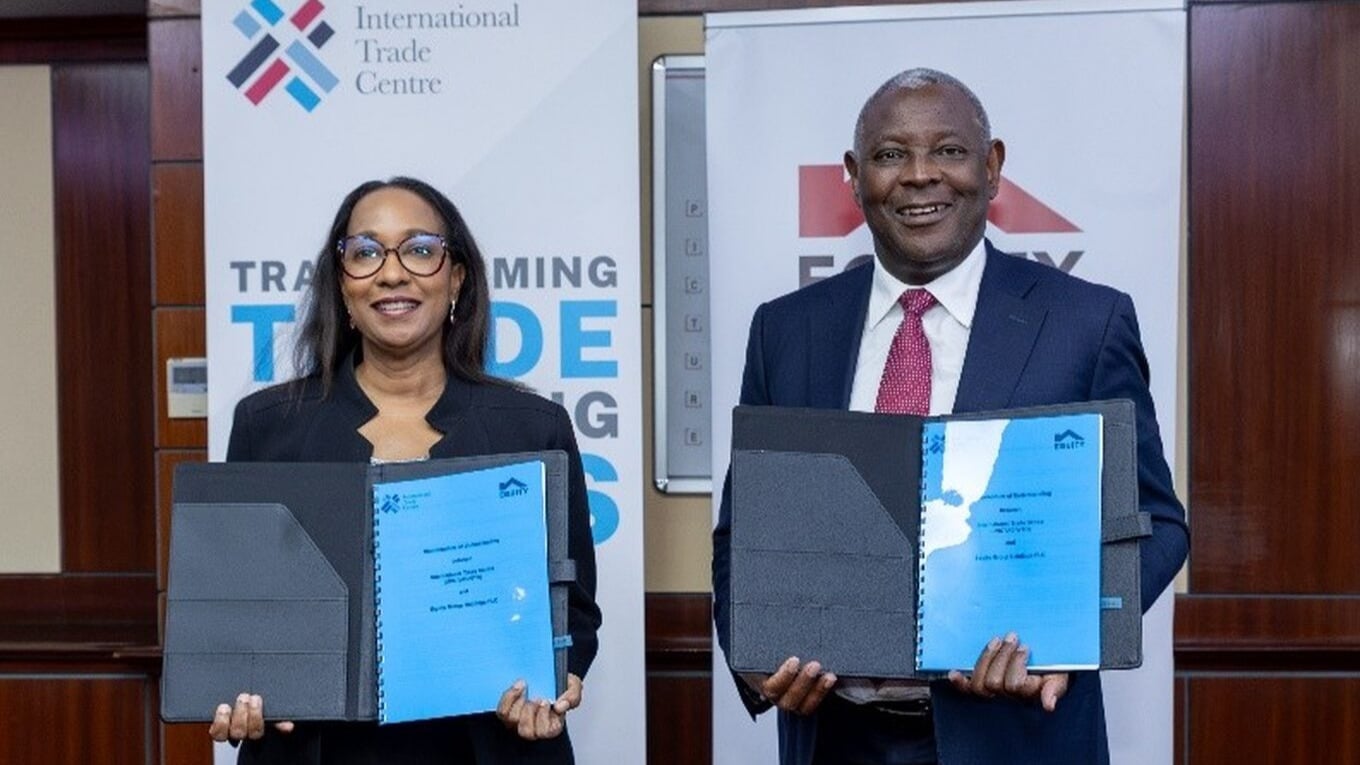
The International Trade Centre and Equity Group Holdings have signed a memorandum of understanding to build commercially viable trade ecosystems across East Africa, starting in Kenya with three sectors that punch below their weight: coffee, leather and the creative industries.
The partnership pairs ITC’s global trade development expertise with Equity Group’s pan-African financial reach across Kenya, the Democratic Republic of Congo, Rwanda, South Sudan, Uganda and Tanzania. It runs through a Kenya pilot until December 2026, with a broader East African rollout planned from 2027.
Why These Three Sectors
Each sector carries unrealised export potential that better financing, skills and market access could unlock.
Kenya produced 40,500 metric tonnes of coffee in the 2024 to 2025 season and remains one of the world’s most respected origins, yet smallholder farmers capture a fraction of the final cup price. In leather, Kenya slaughters millions of livestock annually but exports mostly raw hides rather than finished goods, forfeiting the value that tanneries and manufacturers would otherwise add. The creative economy — music, film, gaming, fashion and crafts — generated an estimated US$4.2 billion across Africa in 2023 according to UNCTAD, but most practitioners lack access to the financing and distribution channels that would let them compete internationally.
What ITC Brings to the Table
Between June and September 2026, ITC will deliver practical training in the coffee sector covering export logistics, price risk management and speciality processing techniques. The training builds on the EU-funded Market Access Upgrade Programme II within the East African Community.
Both organisations will also support producers and exporters in meeting the requirements of the EU Deforestation Regulation, which took effect in stages from 2024 and requires coffee and leather exporters to prove their products did not contribute to deforestation. For many Kenyan smallholders and leather businesses, compliance documentation remains a significant barrier to accessing European markets.
In leather, ITC will support the midterm review of the EAC Leather and Leather Products Strategy 2020 to 2030, coach footwear MSMEs on product design, and work toward standards harmonisation across EAC partner states. E-commerce market access through platforms such as Etsy, eBay and Shopify forms part of the plan — a practical route to buyers that many artisans have never used.
The creative industries component starts with sector mapping and market assessments before introducing business development support and tailored financing.
Across all three sectors, participating businesses gain access to ITC’s trade market intelligence tools and the SME Trade Academy, its online learning platform for small businesses.

What Equity Group Brings
Equity Group’s contribution centres on its Africa Recovery and Resilience Plan, a six-pillar regional growth strategy that spans food and agriculture, manufacturing, MSMEs, technology and social impact investments. The bank channels that into financing, market linkages and trade intelligence for businesses that ITC identifies and trains.
“By combining access to finance, trade intelligence, capacity building and market linkages, we are building an ecosystem that enables MSMEs in coffee, leather and the creative economy to scale sustainably and compete globally,” said Dr James Mwangi, Equity Group’s Managing Director and CEO. “Our ambition is to ensure that MSMEs are not merely participants in trade, but competitive actors capable of shaping global markets through quality, scale and innovation.”
ITC Executive Director Pamela Coke-Hamilton put it as: “We know that access to finance is critical for small businesses — but it has to be matched with the right skills to use it effectively.”
The Larger Bet
Kenya’s export economy has long concentrated around a narrow band of commodities sold in raw or semi-processed form. This partnership makes an explicit argument against that model — that value addition, standards compliance and market access tools, delivered together, can shift where in the value chain Kenyan producers capture returns.
