



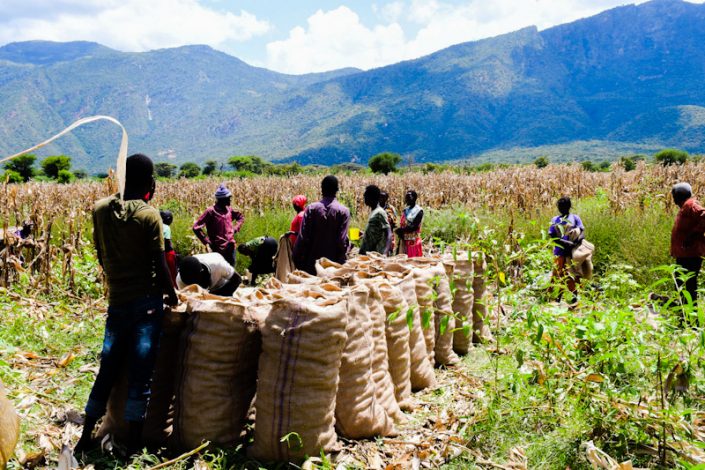
Kenya’s maize harvest has taken its steepest hit in years. The United States Department of Agriculture has slashed its forecast for the 2026/27 marketing year by 51 percent, down to 2.2 million metric tons, after a punishing dry spell scorched the country’s main grain producing counties between June and July.
The shortfall leaves the government facing a stark arithmetic problem: to keep bread and ugali on the table, Kenya will need to bring in a record 2.3 million metric tons of corn, according to the latest Grain and Feed report from the USDA’s Foreign Agricultural Service in Nairobi, dated August 28.
Wheat has not fared any better. The forecast for that crop was cut by more than half, to 130,000 tons, driven by the same drought that hollowed out the Rift Valley’s wheat belt. Rice is the lone bright spot, with irrigation at the Mwea scheme expected to hold milled production steady at 225,000 tons, even though the country will still need to import 750,000 tons to close the gap between what it grows and what it eats.
A dry spell unlike any in decades
The numbers behind the downgrade are stark. Rainfall across much of western Kenya fell to its lowest levels since 1980, and in some areas monthly precipitation ran more than 200 millimeters below normal through June and July. Rain finally returned in the last days of July, but by then the damage to standing crops was already done.
Counties that normally anchor the nation’s grain basket bore the brunt. Uasin Gishu, Trans Nzoia and Nakuru, long relied on for a surplus that feeds the rest of the country, instead recorded some of the worst crop losses. Field visits by USDA staff in late July found close to half the planted area wiped out in parts of the North Rift and western regions, with surviving fields expected to yield up to 35 percent less than normal.
Farmers on the ground describe a season of second guessing. Kipkorir Menjo, director of the Kenya Farmers Association, told the Daily Nation that growers whose crops failed are now reluctant to replant, caught between unpredictable weather and loans they still have to repay.
“Farmers are not sure whether to plant or wait until the next season.”Kipkorir Menjo, Kenya Farmers Association, via Daily Nation
The damage is visible from space as much as from the ground. Satellite analysis cited in the USDA report shows cropland failure concentrated in a band running from West Pokot and Trans Nzoia down through Uasin Gishu, Kericho and Narok, while much of eastern and central Kenya, which depends more on the short rains, was largely spared this round.
Where will the corn come from?
The government has already signalled its intent to import, but specific supply lines remain undecided. That matters because Kenya’s usual regional partners are themselves stretched thin this season.
Uganda’s output has slipped after its own weather troubles, and Tanzania’s exportable surplus has narrowed to roughly 800,000 tons, a fraction of what Kenya now needs. Zambia stands out as the exception, having posted a bumper harvest that leaves it with a net exportable surplus of about 1.47 million tons of corn. Even so, the USDA cautions that Zambian export volumes could be curtailed if the coming El Niño season drags down its own outlook for the next planting cycle.
| Crop | Original production forecast | Revised production forecast | Change | Revised import forecast |
|---|---|---|---|---|
| Corn | 4.5 million MT | 2.2 million MT | down 51% | 2.3 million MT |
| Wheat | 280,000 MT | 130,000 MT | down 54% | 2.6 million MT |
| Rice, milled | 180,000 MT | 225,000 MT | up 25%* | 750,000 MT |
Sourcing the shortfall is complicated further by Kenya’s ban on genetically modified imports, which rules out large volumes of cheap corn from Argentina, Brazil and the United States, all of which carry steep tariffs into the Kenyan market on top of the GMO restriction. South Africa can supply non GMO white and yellow corn, but its own exportable surplus is comparatively small next to the size of Kenya’s deficit.
| Country | Forecast exports (million MT) | Notes |
|---|---|---|
| Zambia | 0.60 | Non GM white corn; duty free access; bumper 2026/27 crop |
| Tanzania | 0.70 | Non GM white corn; duty free; sourcing limited by permits |
| South Africa | 2.50 | Non GM available but supply constrained by GMO screening |
| Uganda | 0.30 | Non GM white corn; duty free; output down this season |
| United States | 83.19 | Mostly GM yellow corn; 50% tariff applies |
| Brazil | 43.00 | Mostly GM yellow corn; 50% tariff applies |
| Argentina | 40.00 | Mostly GM yellow corn; 50% tariff applies |
Some relief may still come through policy changes rather than new harvests. Officials have floated a duty free window that could allow in up to three million tons of white corn, and a separate allocation of 360,000 tons of yellow corn earmarked for animal feed, according to reporting picked up by industry outlet Milling Middle East and Africa. The idea is to keep white corn on household plates while steering feed millers toward the yellow variety instead.
Trade analysts see a structural problem behind the scramble. Writing on his blog, agricultural economist Wandile Sihlobo has noted that Kenya’s typical suppliers in times of need, Tanzania and Uganda, are the ones the country leans on first, a pattern this season’s shortfall may strain harder than usual given that both countries are themselves short.
Wheat gap unlikely to be filled by Black Sea grain soon
Kenya’s wheat problem is smaller in absolute volume but arguably harder to solve quickly. The area harvested is expected to fall to 70,000 hectares from a prior estimate of 100,000, and yields are projected to drop to 1.8 tons per hectare, a decline of nearly 36 percent from the original forecast. Millers are also bracing for lower quality grain, with low test weights and shrunken kernels expected from crops that never finished developing properly.
Since domestic wheat has historically covered less than 15 percent of Kenya’s needs even in good years, the country was always going to import the bulk of its wheat. What has changed is the scale, with the USDA now projecting 2.6 million tons of imports for the year. Kenyan millers traditionally draw on the Black Sea region, Argentina and Australia, and a new requirement for destination inspection on US wheat, following the end of a pre export inspection arrangement, adds friction to that particular supply line just as the country needs speed.
El Niño threatens a whiplash from drought to floods
Just as Kenya works out how to plug this year’s gap, forecasters are warning of a very different problem taking shape. An emerging El Niño, paired with a strongly positive Indian Ocean Dipole, carries an 80 to 82 percent probability of tipping the region into an intense, unusually wet season by October, the USDA report says. Kenyan meteorologists have compared the current setup to the pattern that preceded the catastrophic East African floods of 1997.
That whiplash from parched to sodden ground brings its own risks to food supply. Flash flooding could wash away newly planted crops, while grain that does get harvested may not dry properly, raising the risk of post harvest spoilage. The short rain growing areas of eastern and central Kenya, largely spared by this year’s drought, are the ones expected to feel the El Niño impact most.
Aid agencies are already treating the shift as a serious risk rather than a distant possibility. The World Food Programme’s Carl Skau has described El Niño as posing a serious danger to food security for already vulnerable populations, according to reporting by trade outlet Streamline Feed, underscoring that this is not a Kenya only story but one playing out across a region where several countries are watching the same rain patterns with concern.
What it means for households and millers
For Kenyan consumers, the practical effect shows up first at the market stall. Local corn prices have already climbed past 50,000 shillings, or roughly 388 dollars, per metric ton at buying centers, and the Cereal Millers Association has described this season’s decline as among the steepest in years, with only a handful of counties expected to produce more than a million bags of maize. Central Bank surveys of businesses, reported by Kenyan business outlet Khusoko, have shown weather increasingly cited as a driver of food price pressure in recent readings, a trend this year’s drought is likely to reinforce.
The feed sector faces its own squeeze. Because Kenya’s GMO ban limits access to cheaper imported corn for animal feed, millers may lean more heavily on non GMO sorghum as a substitute, the USDA notes, a shift that could ripple through poultry and dairy production costs later in the year.
Human demand for corn, by contrast, is not expected to soften. Post retains its consumption forecast of 4.5 million tons, reflecting how deeply white corn is embedded in the Kenyan diet through ugali and githeri. That inelastic demand is exactly why the shortfall cannot simply be absorbed through belt tightening. It has to be imported, and quickly.
Kenya’s grain crisis is not happening in isolation. Across the region, the same weather system that scorched the Rift Valley is squeezing the neighbours Kenya would normally lean on, and the same system is now forecast to swing hard in the opposite direction. For a country whose food security still hinges on rain it cannot control and imports it has yet to fully arrange, the months ahead will test both its supply chains and its patience.
