


Kenya’s largest power producer just put a number on seven decades of work. In its inaugural standalone Sustainability Report, Kenya Electricity Generating Company PLC (KenGen) revealed that it dispatched 95% of its electricity from renewable sources during the financial year ending June 30, 2025, while holding its carbon emission intensity to 0.06089 tonnes of CO2 equivalent per megawatt hour. The company now wants to push that intensity down further, to 0.05115 tCO2e/MWh, by 2030.
KenGen reported its sustainability data inside its annual financial statements since 2015 and joined the UN Global Compact in 2019. This year, for the first time, the company split sustainability reporting into its own document, built around the Global Reporting Initiative’s 2021 standards and the Nairobi Securities Exchange’s ESG disclosure guidance.
Umuro Wario, who chairs KenGen’s Board Committee on Finance and Investment, called it “a defining moment in our seventy-year journey, the point at which we move from embedding sustainability within our operations to formally disclosing, measuring, and being held accountable for it before our shareholders, regulators and the communities we serve.”
A Fleet Built Mostly on Steam and Water
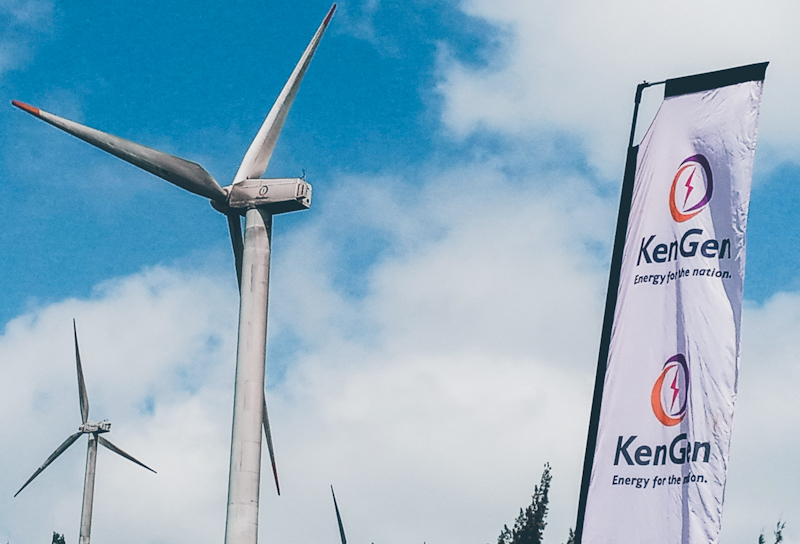
KenGen runs 1,786 megawatts of installed capacity across hydro (826MW), geothermal (754MW), thermal (180MW), and wind (26MW). More than 90% of that fleet draws on renewable sources, and geothermal has become the backbone of the company’s growth strategy precisely because it doesn’t depend on rainfall. Hydropower, by contrast, sits exposed to the kind of erratic weather that climate change has made more common across East Africa.
That vulnerability shows up in the numbers. Average plant availability swung from 82.91% in September 2024 down to 67.42% in February 2025, before climbing back above 83% by June. Dam levels at Masinga dipped notably in March before recovering. It’s the clearest illustration in the report of why KenGen keeps describing geothermal as its “cornerstone” technology, even as it pursues solar, wind, and battery storage in parallel.
The company’s growth blueprint, branded the G2G 2034 Strategy, sets out to add 1,500MW of new renewable capacity, including 840MW from geothermal, alongside 500MWh of battery storage. The price tag: $4.3 billion, to be raised through a mix of concessional finance, public private partnerships, and bond or equity issuance.
Eng. Peter Njenga, KenGen’s Managing Director and CEO, framed the ambition plainly: “We fully support Kenya’s transition to 100 percent renewable energy by 2030 and the achievement of global net-zero emissions by 2050.”
Trees, Water, and a Reservoir That Needs Replenishing
Beyond the grid, KenGen has leaned into reforestation as a climate strategy with a direct link to its own infrastructure. Forests around hydro dams hold soil in place and regulate water flow into reservoirs, so planting trees is also asset protection. This year the company grew and issued 887,220 tree seedlings, beating its 830,000 target, and restored roughly 850 hectares of degraded land across catchments including the Tana River Basin, Mount Elgon, and the Mau Complex.
The company estimates that the 924,220 trees it planted across all initiatives, including community partnerships, could sequester between 55,000 and 65,000 tonnes of CO2 equivalent over the next decade. One example: in Narasha Forest, Baringo County, KenGen worked with the Kenya Forest Service and the Lembus Narasha Community Forest Association to grow 250,000 trees through a livelihoods scheme that ties conservation to local income.
Water use tells a similar story of stewardship paired with self-interest. KenGen abstracted 13,390 million cubic metres of water for hydropower generation, all of it non-consumptive, meaning every drop returned to the river after passing through the turbines. At its geothermal fields in Olkaria and Eburru, the company reused 268,000 cubic metres of geothermal fluid for drilling, cutting demand on fresh water supplies. Specific steam consumption at its geothermal plants has fallen sharply over four decades, from 9.5 tonnes per hour per megawatt at Olkaria I in 1981 to as low as 6.2 at the newer Olkaria units, a function of better turbine design rather than policy alone.
Governance Gets a Scorecard
KenGen’s governance numbers scored a perfect 100% in public accountability, with full marks in both complaints resolution (65 out of 65) and access to information (35 out of 35), a result that earned recognition from Kenya’s Commission on Administrative Justice. Six corruption cases were reported during the year; all six were investigated and closed, with three dismissals and three formal warnings, inside an average of 30 working days.
The company has also restructured how it oversees sustainability internally. Fifteen “Sustainability Champions” now sit across departments, reporting up through a Sustainable Development Manager to an Executive Management Committee and ultimately to the Board’s Finance and Investment Committee, which met four times during the year specifically to review ESG performance.
Where the Money Went
KenGen generated KShs 56.1 billion in total economic value during the year, a marginal 0.35% dip from the previous year’s KShs 56.3 billion. Profit after tax, however, jumped by roughly 54%, from KShs 6.80 billion to KShs 10.48 billion, helped by improved operational efficiency and expanded geothermal output. Dividend payments to the government, which holds a 70% stake in the company, more than doubled, rising from KShs 3.00 billion to roughly KShs 4.155 billion.
On procurement, 69% of total spend, worth KShs 10.01 billion, went to local suppliers, supporting the government’s “Buy Kenya, Build Kenya” agenda. The company also registered 5,743 suppliers from women, youth, and disability-owned enterprises through Kenya’s Access to Government Procurement Opportunities framework, up between 11% and 17% across those categories compared with the prior year.
Safety, Workforce, and the People Behind the Plants
Behind the megawatts are roughly 28% female employees against a 30% internal target, and an Organisational Health Index score of 72%, alongside a staff attrition rate of just 1%. Top management signed a formal “Safety Pledge” in August 2024 to reinforce accountability after the year recorded two work-related fatalities and fifteen high-consequence injuries.
Through its scholarship and mentorship programmes, the KenGen Foundation supported 237 students, spending more than KShs 17 million on education and skills initiatives. Among the 2021 high school cohort it sponsored, 79% transitioned into university, a figure the Foundation says outpaces the national average.
What Comes Next
The picture that emerges from KenGen’s first standalone sustainability report is of a state-owned utility trying to professionalise its environmental and social disclosures while pursuing an aggressive renewable buildout. The 1,500MW expansion target and the $4.3 billion financing requirement will be the real test of whether the ambitions in this report translate into delivered capacity. For now, the numbers, on emissions, reforestation, water reuse, and governance, give KenGen a baseline against which it has committed to be measured every year going forward.
