




Most Africans still reach for the radio when they want news. That is the finding of a survey by Afrobarometer, which interviewed 50,961 people across 38 countries in 2024 and 2025 and found that six in ten Africans, 59%, tune into radio for news at least a few times a week.
The survey, published in April 2026, paints a detailed picture of a continent where the tools people use to stay informed are shifting, but the total number who regularly follow the news has barely moved in a decade.
Radio Leads, But Its Grip Is Loosening
Radio remains the most widely accessed news medium across Africa, but its dominance has declined by 10 percentage points over the past decade, based on surveys conducted consistently in 28 countries since 2014. Television ranks second at 53%, followed closely by social media at 50% and other internet sources at 38%. Newspapers trail far behind at 13%, though the report notes that figure likely understates print media’s reach, since many newspaper stories circulate through radio, television, and social media before reaching their final audience.
Radio’s durability comes down to access. It reaches women, rural residents, poorer respondents, and less educated adults at higher rates than any other medium. Where electricity is unreliable, data is expensive, and smartphones remain out of reach for many households, a battery-powered radio still delivers the news. That explains why its audience, though shrinking, covers the broadest cross-section of African society.

Digital News Growth Has Stalled
The rise of social media and online news was the defining media story of the 2010s across Africa. That rise has not reversed, but it has slowed considerably. In 2014/2015, only about one in five respondents said they regularly used social media or the internet for news. Those figures climbed rapidly through the latter half of the decade before levelling off, with other internet news sources peaking at 42% in 2021/2023 before declining by 5 percentage points.
The survey points to structural barriers holding back further growth. These include a lack of digital literacy, the highest mobile data costs of any continent, limited access to internet-enabled handsets, and government-imposed restrictions on digital media. For millions of Africans, getting online is not simply a matter of preference. It remains a question of cost and infrastructure.
The variation across the continent is striking. Digital news consumption ranges from just 13% of Malagasy citizens to more than three quarters of Moroccans, Gabonese, and Mauritians who consume at least one form of digital media a few times a week or more. Francophone countries recorded the largest increases over the decade, with Senegal, Gabon, Cameroon, and Mauritius all posting gains of more than 40 percentage points in social media news use since 2014.
Digital Is Replacing Radio, Not Recruiting New Readers
The most pointed finding in the survey is also the most counterintuitive. Despite a decade of rapid digital expansion, the share of Africans who regularly consume news through any channel has stayed almost perfectly flat. While 84% reported frequently consuming news via one or more media channels a decade ago, 85% say the same in 2024/2025. Digital media, it turns out, has largely pulled audiences away from radio and newspapers rather than drawing people into news consumption who previously had none.
The report is careful not to read too much into this. People who once read newspapers cover to cover may now scroll headlines on social media. Someone who listened to an hour of radio news each morning may now catch updates throughout the day via WhatsApp. The frequency looks similar; the depth of engagement may not be.
There is also the question of information quality. As audiences shift toward sources that spread large amounts of misinformation and disinformation, the normative implications of news access may have shifted from positive to negative.
Who Gets Left Behind
The survey reveals sharp gaps in who stays informed. More men than women frequently consume news, at 88% versus 79%, with the gap likely reflecting social norms around women’s participation in public life, access to literacy, and economic resources. The consequences reach beyond media: a population segment that follows the news less closely is also less equipped to participate in democratic processes.
Geography and wealth compound the divide. Well-off citizens and urban residents consume news at rates of 94% and 92% respectively, compared to 75% among the poorest respondents and rural residents. Education tells a similar story, with 97% of post-secondary graduates following the news regularly against just 68% of those with no formal schooling. Age, by contrast, barely matters. News consumption rates hold steady across all age groups, which challenges the assumption that older Africans are less engaged with current affairs.
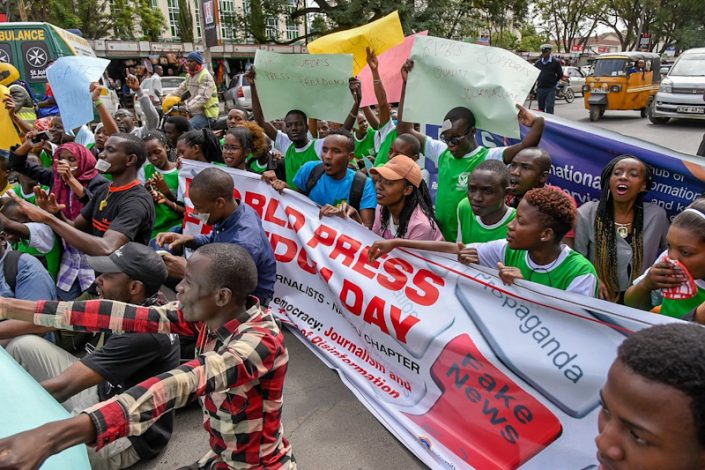
Africans Back a Watchdog Press, But With Conditions
The survey moves beyond media habits to ask what Africans actually want from their press. The answer, broadly, is accountability. On average, 72% of Africans say the media should constantly investigate and report on government mistakes and corruption, with that view commanding majority support in every surveyed country. Support runs highest in Mauritius at 86%, Nigeria at 83%, Uganda and Ghana both at 82%.
But press freedom is a more complicated question. A slim majority of 53% describe their media as somewhat or completely free of government interference, while 43% consider it less than free. The range is wide. More than three quarters of citizens in Tanzania and Liberia describe their media as at least somewhat free, while fewer than one in three do so in Congo-Brazzaville, Comoros, Cameroon, and Eswatini.
Some of the sharpest recent shifts reflect political events on the ground. Guinea recorded a 34 percentage point drop in perceived press freedom, a decline that may reflect the rapid deterioration following the 2021 coup led by Mamadi Doumbouya. Liberia moved in the opposite direction, recording a 58-point jump in perceived press freedom over the same period, the largest gain of any country surveyed.
Support for Press Freedom Comes With a Twist
Nearly two thirds of Africans, 65%, say the media should have the right to publish freely without government control. But the data contains a finding that complicates that headline figure. Africans who see the media in their country as largely free are somewhat less likely to support media freedom than those who see it as restricted, at 63% versus 69%.
The report does not treat this as a paradox but as a signal. When people live with a free press, they also live with its downsides: misinformation, divisive content, and material some regard as harmful to children or social cohesion. That lived experience, rather than abstract principle, appears to soften their enthusiasm for an unconstrained media environment. Mali sits at the extreme end of this pattern, where just 27% support media freedom, a figure the report links to years of military rhetoric blaming foreign and independent media for instability.
What Comes Next
Africa continues to see significant changes in its media environments as digital news sources challenge the long-term dominance of broadcast media. But after growing rapidly in the 2010s, digital media use appears to be slowing, pointing to structural limits on broader accessibility.
Radio will not disappear. It reaches the people that every other medium misses: the rural poor, women with limited formal education, communities without reliable electricity or affordable data. As long as those structural gaps persist, radio persists with them. The real question is whether digital growth can resume, and whether that growth, when it comes, will expand the news audience or simply continue reshaping the one that already exists.
News Consumption by Medium | 38 Countries | 2024/2025
| Medium | Daily or Several Times a Week |
|---|---|
| Radio | 59% |
| Television | 53% |
| Social media | 50% |
| Other internet sources | 38% |
| Newspapers | 13% |
Change in Frequent News Consumption | 28 Countries | 2014 to 2025
| Medium | 2014/2015 | 2024/2025 | Change |
|---|---|---|---|
| Radio | 71% | 61% | −10pp |
| Television | 54% | 53% | −1pp |
| Social media | 22% | 50% | +28pp |
| Internet (other) | 22% | 37% | +15pp |
| Newspapers | 23% | 13% | −10pp |
Overall News Consumption by Demographic Group | 38 Countries | 2024/2025
| Group | Frequently Consume News |
|---|---|
| 38-country average | 84% |
| Men | 88% |
| Women | 79% |
| Urban residents | 92% |
| Rural residents | 75% |
| No lived poverty | 94% |
| High lived poverty | 75% |
| Post-secondary education | 97% |
| No formal education | 68% |
Perceived Media Freedom | Selected Countries | 2024/2025
| Country | Media Seen as Free |
|---|---|
| Tanzania | 81% |
| Liberia | 77% |
| Kenya | 65% |
| 38-country average | 53% |
| Comoros | 28% |
| Congo-Brazzaville | 16% |
pp = percentage points. Source: Afrobarometer Dispatch No. 1173, April 2026. Based on 50,961 interviews across 38 African countries.
