



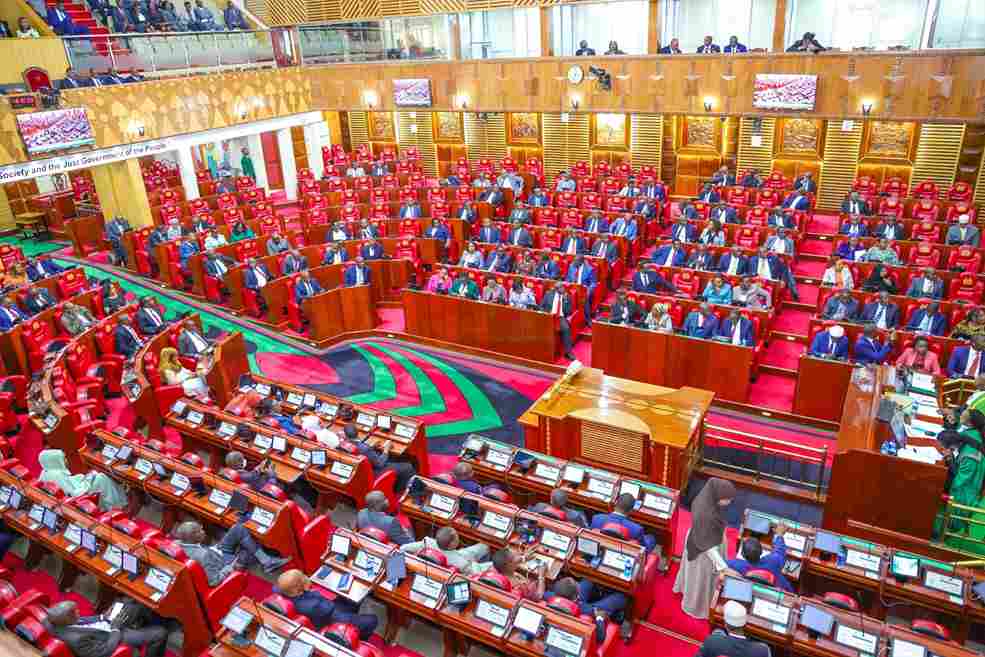
Kenya’s National Assembly has approved the 2026/27 Budget Policy Statement (BPS), laying the foundation for the national budget and defining government spending priorities for the year ahead.
The framework, valued at Sh4.7 trillion, provides the fiscal blueprint for national, county, and sectoral allocations.
The approval followed deliberations by the Budget and Appropriations Committee, which recommended ceilings aligned with fiscal responsibility principles.
Key Budget Allocations
| Category | Allocation (KES) | Notes |
|---|---|---|
| National Government Ceiling | 2,878,426,500,000 | Majority allocated to Executive (Sh2.7 trillion) |
| Auditor General | 9,030,000,000 | Oversight and accountability |
| Parliament | 50,780,000,000 | Legislative functions |
| Judiciary | 30,440,000,000 | Judicial services |
| County Equitable Share | 420,000,000,000 | Core county funding |
| Equalisation Fund | 9,602,170,425 | Targeted support for marginalized areas |
| Additional County Allocations | 75,692,700,182 | Conditional grants and special projects |
| Public Participation Initiatives | 4,000,000,000 | Citizen involvement in budget process |
| Fiscal Deficit | 5.3% of GDP | Equivalent to Sh1.15 trillion |
Revenue Projections
Total projected revenue for FY 2026/27, including Appropriations‑in‑Aid, stands at Sh3.59 trillion, equivalent to 17.1% of GDP. This represents an increase of Sh219.5 billion from the previous year.
| Revenue Source | Projected Growth (KES) | Drivers |
|---|---|---|
| Ordinary Revenue | +147,000,000,000 | Income tax, import duties, excise duties |
| Appropriations-in-Aid | +72,500,000,000 | Fees, levies, and other non-tax revenues |
Despite these projections, the Committee flagged a Sh148 billion shortfall in actual revenue collection as of December 2025, warning of fiscal pressure if spending is not tightly managed.
The deficit, including grants, is projected at Sh1.15 trillion (5.5% of GDP), financed through:
- Sh225.5 billion in external loans
- Sh924 billion in domestic borrowing
Expenditure Breakdown
Total expenditure and net lending are projected at Sh4.738 trillion, up Sh435.7 billion from the previous year.
| Expenditure Type | Increase (KES) | Key Notes |
|---|---|---|
| Recurrent Expenditure | +322,800,000,000 | Salaries, interest payments, operations |
| Development Spending | +102,200,000,000 | Infrastructure, education, housing |
| County Transfers | +10,700,000,000 | Strengthening devolution |
Recurrent costs include:
- Sh137 billion for operations and maintenance
- Sh105 billion for domestic interest payments
- Sh63 billion for salaries and wages
Sectoral Highlights
- Education: +Sh64.2 billion to support teacher resource management and university education under Competency‑Based Education reforms.
- Infrastructure: +Sh59.9 billion for rail, road, housing, and metropolitan development projects.
Risks and Warnings
The Committee cautioned that rising interest payments — now consuming more than 25% of the budget — continue to squeeze resources for essential services. Heavy reliance on domestic borrowing could crowd out private sector credit, limiting financing for MSMEs and job creation.
Low absorption rates of development funds remain a persistent challenge, raising concerns that higher allocations may not translate into faster project delivery.
The approved BPS sets ambitious spending and revenue targets for FY 2026/27. While allocations reflect government priorities in education, infrastructure, and devolution, the Committee’s warnings highlight the need for disciplined fiscal management to avoid widening deficits and ensure funds deliver tangible results for citizens.
Fiscal Deficit Widens to 5.3% of GDP in Kenya’s Draft 2026 Budget Policy Statement
