



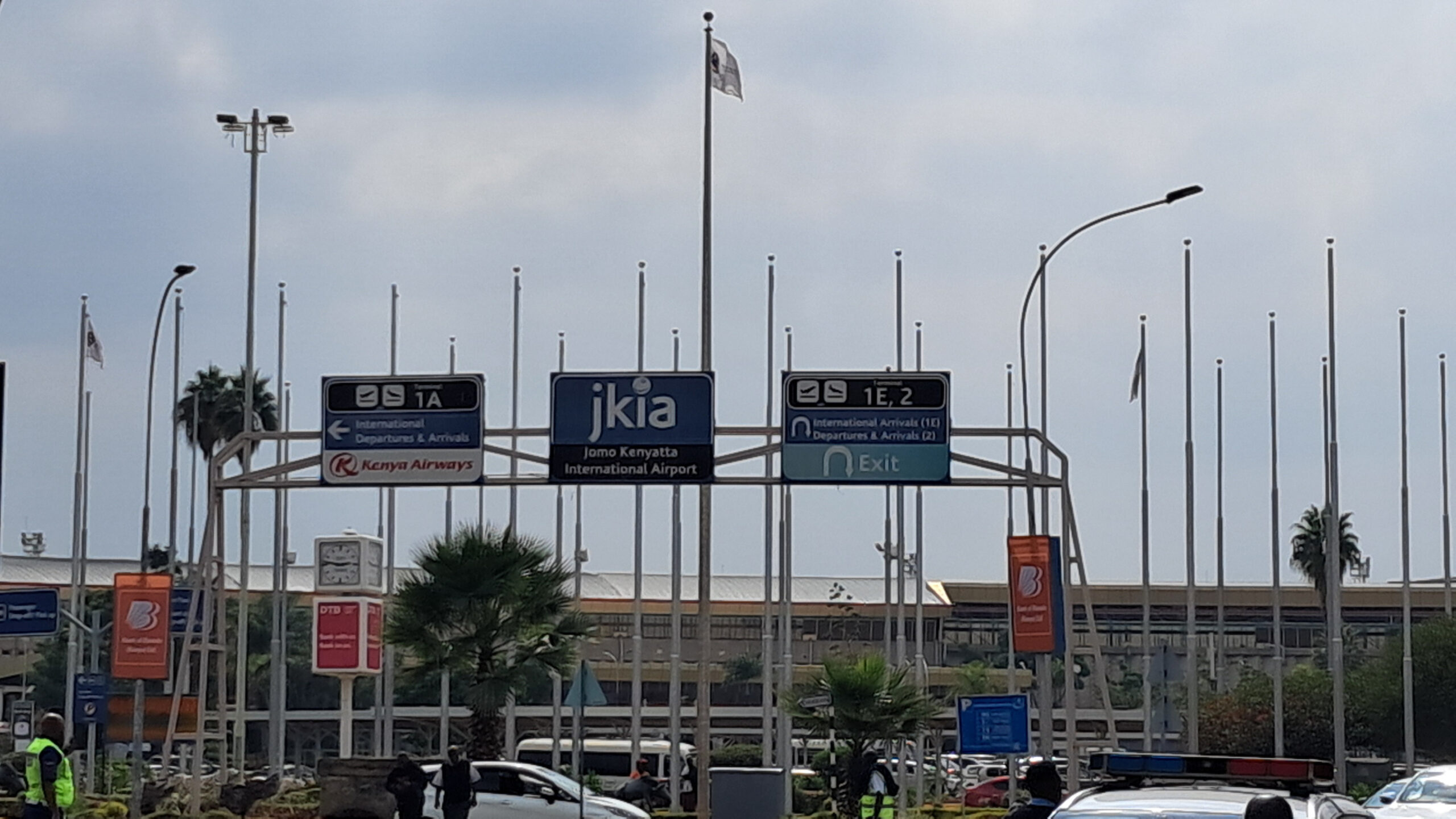
Kenya Airports Authority (KAA) has proposed commercial charges that would reach taxi and ride hailing operators, motorists, importers, exporters and businesses that rent space at its airports. The proposals sit in the draft Kenya Airports Authority PLC Commercial Charges Order, 2026, an updated version dated 17 November 2026. The charges are not in force.
The Order replaces a framework that rests on the 1996 Concession Order. KAA says the review aligns charges with market conditions and with rising airport operating, maintenance and infrastructure costs.
Under the Order, commencement happens “on such date as may be approved and formally communicated by the Authority”. KAA is taking public comment before the framework goes through approval.
KAA commercial charges apply across six airport bands
The Order groups airports into bands, and the band sets the rate. Band A is Jomo Kenyatta International Airport (JKIA). Band B is Moi International Airport in Mombasa. Band C is Wilson Airport. Band D holds Eldoret and Kisumu international airports. Band E covers Malindi, Ukunda, Wajir, Isiolo, Manda, Nanyuki and Lokichogio. Band F covers all other airports and airstrips KAA manages.
The Order does not replace charges that a separate law or regulation governs. It also does not override existing agreements unless an approved variation allows it.
Taxi and ride hailing drivers would pay per completed airport trip
The access fee applies to taxis and ride hailing vehicles that enter an airport to complete a passenger journey. KAA says operators pay it, and it is not an automatic entry fee on each passenger. It is separate from parking charges. Taxi and ride hailing firms could still add the cost to fares.
| Band | Airport | Access fee per completed trip (KSh) | Annual taxi permit per vehicle (KSh) |
|---|---|---|---|
| A | JKIA | 150 to 250 | 120,000 to 260,000 |
| B | Moi International | 150 | 120,000 to 200,000 |
| C | Wilson | 100 | 60,000 |
| D | Kisumu and Eldoret | 100 | 60,000 to 100,000 |
| E | Malindi, Ukunda, Wajir, Isiolo, Manda, Nanyuki, Lokichogio | 100 | 60,000 |
| F | Other airports and airstrips | 25 | 60,000 |
A JKIA driver who completes ten airport trips in a day would owe KSh 1,500 to KSh 2,500 at the proposed fee.
JKIA parking would rise at every tier of the silo tariff
Charges at the JKIA parking silo for saloons, minivans and pick ups would rise from the first half hour onward. The first tier carries the largest percentage rise.
| Parking duration | Current (KSh) | Proposed (KSh) | Change |
|---|---|---|---|
| Up to 30 minutes | 100 | 150 | +50% |
| Over 30 minutes to 1 hour | 150 | 200 | +33% |
| Over 1 to 2 hours | 300 | 400 | +33% |
| Over 2 to 4 hours | 400 | 500 | +25% |
| Over 4 to 6 hours | 600 | 750 | +25% |
| Over 6 to 8 hours | 800 | 1,000 | +25% |
| Over 8 to 12 hours | 1,200 | 1,500 | +25% |
| Over 12 to 24 hours | 1,800 | 2,250 | +25% |
| Each additional 24 hours | 2,000 | 2,500 | +25% |
A motorist who collects a passenger within one hour would pay KSh 200 where the tariff now charges KSh 150.
The draft also sets penalties of KSh 1,000 for a lost ticket, KSh 8,000 for parking in an undesignated area and KSh 20,000 for tailgating. These are proposed rates, not charges KAA collects today.
Six month parking packages rise by 44 to 98 per cent at JKIA
Staff, tenants, taxi operators and shuttle firms buy six month parking packages. The Order raises each one.
| Package holder | Vehicle | Current (KSh) | Proposed (KSh) | Change |
|---|---|---|---|---|
| Staff and tenants | Saloon or SUV | 9,000 | 15,000 | +67% |
| Staff and tenants | Pick up, van or minibus | 12,608 | 20,000 | +59% |
| Staff and tenants | Truck, lorry or bus | 15,132 | 25,000 | +65% |
| Staff and tenants | Articulated trailer | 20,176 | 40,000 | +98% |
| Yellow taxi operators | Saloon or SUV | 10,440 | 15,000 | +44% |
| Yellow taxi operators | Pick up, van or minibus | 10,440 | 20,000 | +92% |
| Commuter services | Shuttle, up to 25 passengers | 25,056 | 40,000 | +60% |
Importers and exporters would pay by weight instead of KSh 250 a waybill
KAA proposes to drop the flat KSh 250 charge on each air waybill, the document that travels with a consignment. In its place, a dollar tariff applies to imports and exports by weight. The same tariff appears in the schedules for all six bands.
The tariff starts at a minimum of US$8 for up to 500 kilogrammes. It adds US$0.05 per kilogramme from 501 to 1,000 kilogrammes, and US$0.01 per kilogramme above 1,000 kilogrammes.
| Consignment weight | Calculation | Proposed charge (US$) | Approximate KSh at 130 per dollar |
|---|---|---|---|
| 500 kg | Minimum charge | 8.00 | 1,040 |
| 600 kg | 8.00 + (100 × 0.05) | 13.00 | 1,690 |
| 1,500 kg | 8.00 + (500 × 0.05) + (500 × 0.01) | 38.00 | 4,940 |
| 5,000 kg | 8.00 + (500 × 0.05) + (4,000 × 0.01) | 73.00 | 9,490 |
| 10,000 kg | 8.00 + (500 × 0.05) + (9,000 × 0.01) | 123.00 | 15,990 |
Every weight in the Order’s own illustration costs more than the current KSh 250. A trader who ships 600 kilogrammes would pay about KSh 1,690. The Order adds a note that the structure rewards higher throughput, because the rate per kilogramme falls above 1,000 kilogrammes. Importers and exporters may pass part of the cost into prices.
Tour vans, staff buses and coaches face annual permits
The Order sets or revises annual permits for vehicles that operate inside airports. The amount depends on the airport and the vehicle.
| Vehicle permit per year | JKIA (KSh) | Moi International (KSh) | Other bands B to F (KSh) |
|---|---|---|---|
| Staff transport van | 120,000 to 260,000 | 72,000 | 72,000 |
| Staff transport bus | 240,000 | 180,000 | 180,000 |
| 4×4 Safari Land Cruiser | 120,000 to 260,000 | 120,000 | See band schedules |
| Coach or shuttle operator | 250,000 | 150,000 | Band schedules: 100,000 at Wilson |
These are costs for businesses. They are not charges on all airport passengers.
Airline suppliers and airport tenants face changes in fees and rent
The review extends to the businesses that serve airlines and passengers. At JKIA, the Order moves several concession fees. A concession is KAA’s grant of the right to run a business on airport premises. Two terms recur in the schedules. Gross turnover (GTO) is total gross revenue before costs. A minimum annual guarantee (MAG) is the least a concessionaire pays each year, whatever its turnover. Where an agreement carries both, the Order says the higher amount is payable.
| JKIA item | Current | Proposed |
|---|---|---|
| Aircraft fuel uplift, throughput fee | KSh 0.35 per litre | KSh 1.5 per litre |
| In flight catering | MAG KSh 45 million; 3% to 10% of GTO | 10% of GTO; MAG set by tender |
| Ground handling | MAG KSh 4 million; 7% to 12% of GTO | 9% to 12% of GTO; MAG from KSh 10 million |
| Pubs and cafes | 8% to 10% of GTO | 10% to 15% of GTO; tender floor MAG KSh 5 million to 10 million |
| Quick service restaurant | 10% of GTO | 10% to 15% of GTO; tender floor MAG KSh 2 million to 5 million |
| Master duty free retailer | 20% of GTO | 20% of GTO |
The fuel fee rises by more than four times. The Order does not say who bears the cost.
Rents also move. The Order says KAA last reviewed rental rates in the 2015/2016 financial year and asked the Ministry of Lands, Public Works and Urban Development in October 2023 to review rates for key airports. That work produced a 2026 draft report. Once the Order applies, minimum annual guarantees, rent and other charges rise automatically by 5 per cent a year. KAA keeps the right to review terms on market valuation, infrastructure improvements or regulatory changes. On a rent of KSh 1 million, the first 5 per cent step adds KSh 50,000.
Existing leases stay in force until a lawful variation applies
The Order’s transitional clause protects current contracts. Leases, concession agreements and licences “shall remain in force” under their own terms unless lawfully varied or ended. The new charges apply to new arrangements. For existing ones, they take effect through contract terms, approved variations and legal requirements. KAA says it will communicate applicable charges to tenants and concessionaires.
