


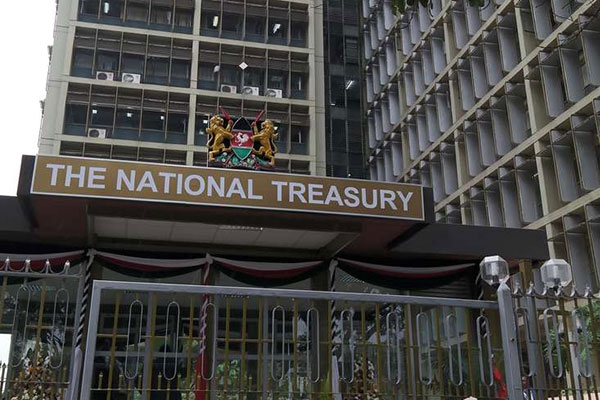
Kenya’s National Treasury has cut the 2027/28 budget to KSh 5.236 trillion, according to the updated 2027 Budget Policy Statement. The figure equals 22.8 per cent of gross domestic product (GDP). It sits KSh 181 billion below the draft print and below the KSh 5.323 trillion in the Budget Review and Outlook Paper (BROP).
The statement matters to anyone who pays tax, saves in treasury bills or bonds, or invests on the Nairobi Securities Exchange (NSE). It lands as the NSE extends trading hours from 2027, the first extension in about two decades.
The 2027/28 budget falls KSh 181 billion from the draft
The Treasury cut recurrent spending, the money that pays salaries, pensions and running costs, and raised development spending slightly. Development spending funds roads, water, power and other projects.
| Item, 2027/28 | Final statement | Draft print | BROP |
|---|---|---|---|
| Total spending and net lending | KSh 5.236 trillion (22.8% of GDP) | KSh 5.417 trillion* | KSh 5.323 trillion |
| Recurrent spending | KSh 3.81 trillion (16.6% of GDP) | KSh 4.021 trillion | KSh 3.887 trillion |
| Development spending | KSh 917.1 billion (4.0% of GDP) | KSh 915.8 billion | KSh 958.0 billion |
*Draft total is the final figure plus the KSh 181 billion cut, my arithmetic.
Recurrent spending falls by KSh 211 billion from the draft. It lands below the BROP figure as well. Development spending rises KSh 1.3 billion from the draft and stays KSh 40.9 billion below the BROP level. The Treasury also sets aside KSh 506.5 billion for county governments and KSh 2.0 billion for the Contingency Fund.
Revenue falls KSh 81 billion because agency collections drop
The Treasury projects total revenue of KSh 3.923 trillion, or 17.1 per cent of GDP. That is KSh 81 billion below the last print and slightly under the KSh 3.943 trillion in the BROP.
Ordinary revenue does not move. It stays at KSh 3.249 trillion, or 14.2 per cent of GDP. The cut comes from Appropriation in Aid (AIA), the money ministries and agencies collect and keep. The Treasury lowered AIA by KSh 80.7 billion to KSh 673.8 billion.
So the tax projection holds, and the Kenya Revenue Authority carries the same target as before.
The deficit narrows to KSh 1.229 trillion
The fiscal deficit, the gap between spending and revenue, is projected at KSh 1.229 trillion, or 5.4 per cent of GDP. That is KSh 124 billion below the draft and KSh 92 billion below the BROP. The Treasury projects the deficit at KSh 1.145 trillion, or 5.5 per cent of GDP, for 2026/27. The statement shows it declining to 3.6 per cent of GDP by 2030/31.
Borrowing shifts from Kenyan lenders to foreign lenders
The Treasury lowers its domestic borrowing target and raises its external target. Domestic borrowing is money raised from lenders inside Kenya, mainly through treasury bills and bonds.
| Borrowing, 2027/28 | Final statement | Draft print | Change |
|---|---|---|---|
| Domestic (net) | KSh 658.9 billion (2.9% of GDP) | KSh 929.1 billion | Down KSh 270.2 billion |
| External (net) | KSh 570.0 billion (2.5% of GDP) | KSh 423.8 billion | Up KSh 146.2 billion |
The statement says external money will come mainly from concessional and semi concessional loans and grants from development partners. A concessional loan carries lower interest or longer repayment than commercial debt. The Treasury limits non concessional borrowing to projects with viable returns and to the ceiling in its Medium Term Debt Management Strategy.
For a saver, a pension scheme or a bank that buys government paper, the Treasury plans to ask for KSh 270 billion less from the local market than the draft showed. Whether that changes yields depends on auctions that have not happened yet.
Debt claims more than half of every shilling of ordinary revenue
The statement’s Article 203 table sets public debt at KSh 1.739 trillion against ordinary revenue of KSh 3.249 trillion. That works out to about KSh 53.5 of every KSh 100 of ordinary revenue. The same table lists KSh 965.8 billion for other national obligations, such as pensions, Parliament and the Judiciary. It leaves a balance for the national government of negative KSh 107.2 billion before AIA and borrowing.
The NSE extends trading hours for the first time in about two decades
The NSE will extend trading hours from 2027, the first change in about two decades. The supplied material gives no new opening or closing times and no start date. Add them from the NSE notice before publishing.
The Treasury’s statement describes a market with more ordinary participants. The NSE 20 Share Index stood at 4,098 points in October 2026, up 31.5 per cent from 3,117 a year earlier. Market capitalisation stood at KSh 3.997 trillion in October 2026, after peaking at KSh 4.2 trillion on 28 August. Equity turnover rose 242.6 per cent to KSh 381.9 billion in the first seven months of 2026.
More Kenyans now trade from their phones. Over 70,000 Kenyans took part in the Kenya Pipeline Company e-IPO. The Treasury says removing the 100 share minimum and launching the Ziidi Trader platform lowered entry barriers for small investors. Ziidi Trader connects to M-Pesa and lets users buy and sell securities by phone. Individual bond accounts nearly quadrupled in the first quarter of 2026.
Questions remain on how the cuts will reach services and markets
The statement does not show which ministries lose from the KSh 211 billion cut to recurrent spending in the text supplied here. The Treasury has not said how the lower AIA target squares with agency revenue plans. Investors will watch the first domestic auctions of 2027/28 to see how the borrowing shift affects yields.
