



Glovo Kenya grew the value of goods sold on its platform by about 40% a year and its order volume by 33%, Country Managing Director Caroline Mutuku told merchants at the company’s first Future of Commerce Summit in Kenya.
Mutuku spoke at the Radisson Blu in Upper Hill, Nairobi. The summit followed two editions in Lagos, Nigeria, the second in April 2026. It brought together small and medium businesses, digital payments companies, retailers and real estate operators.
“We are building the largest marketplace in Kenya to give you access to anything in minutes,” Mutuku said.

Glovo Kenya at a glance
| Measure | Figure | |
|---|---|---|
| Merchants | More than 6,000 | |
| Riders | More than 3,000 | |
| Riders active each day | More than 2,200 | |
| Direct jobs | 600 now, 1,200 targeted by end of 2027 | |
| Towns and cities | 12 | |
| Growth in gross merchandise value | About 40% a year | |
| Growth in order volume | 33% | |
| Sales generated for businesses since 2019 | KSh 20 billion, about 80% to small and medium businesses | |
| Planned investment in Kenya | KSh 10 billion by 2030 |
Glovo grew from a courier app in Barcelona into a marketplace
Mutuku traced the company to Barcelona, where Oscar Pierre and Sacha Michaud launched it in early 2015. The first app had two buttons, one to order something and one to send something. Customers who asked riders to collect food from McDonald’s and KFC turned the courier service into a platform that now covers food, groceries, shops, pharmacy, electronics, beauty, pets and parcels.
Khusoko covered the Glovo launch in Nairobi in 2019. Delivery Hero, the German group that took a majority stake in Glovo, has owned 94% of the business since 2022.
Globally, Glovo operates in 21 countries and more than 1,800 cities. It has more than 3,000 employees, about 150,000 stores and restaurants taking orders each day, more than 190,000 active riders, more than 600 advertising brands and more than 30 million customers.
In Kenya, Mutuku said, Glovo covers more cities than in any other market it runs. She named Nairobi and its surrounds of Ngong, Rongai, Karen, Syokimau and Thika, then Nakuru, Naivasha, Nanyuki, Kisumu, Eldoret, Machakos and Mombasa. She added Diani and Nanyuki as holiday destinations, where demand rises in school holidays and over summer.
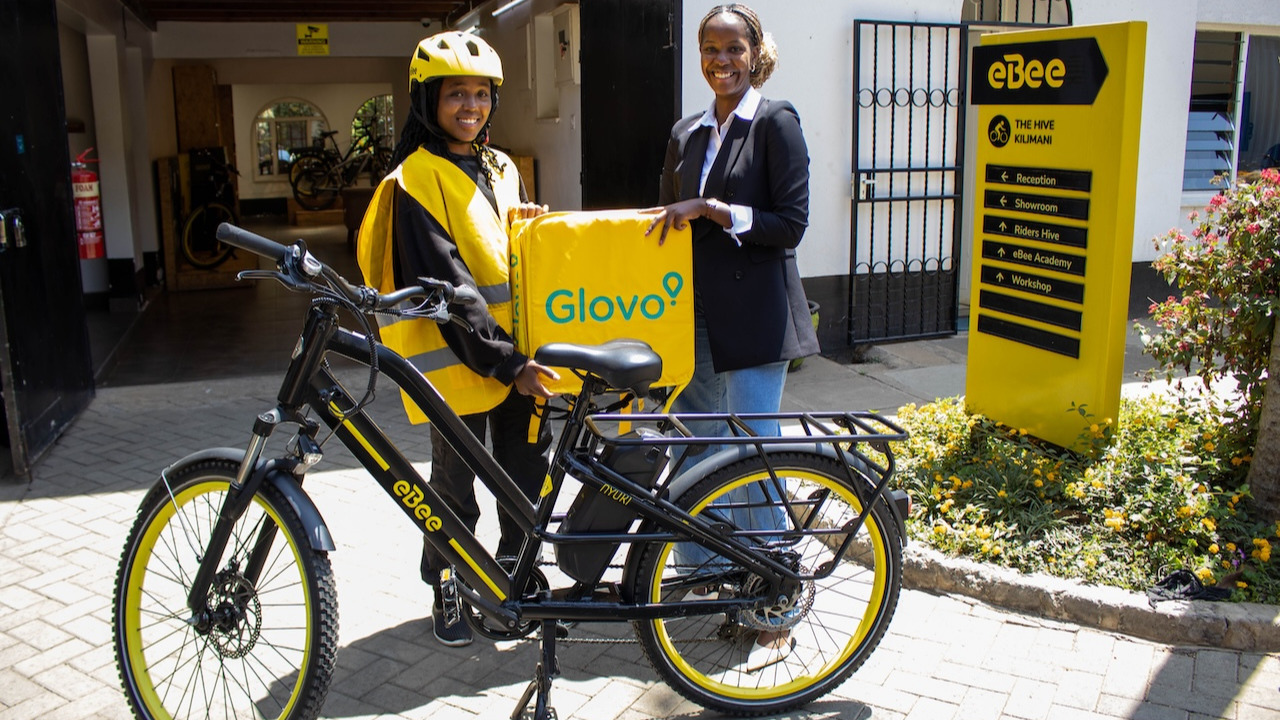
Outside Spain, Kenya is one of Glovo’s biggest hubs, she said. It houses the company’s customer service hub for Africa, and a second office opened recently for hub support staff. Mutuku said the jobs total may pass the 1,200 target. Both founders have visited Kenya in the past 12 months, she said. Pierre came last year, and Michaud opened the Nairobi office in May 2026 and returns in November. Earlier this year Glovo announced a KSh 10 billion investment in Kenya by 2030.
Orders are worth more and Glovo wants restaurants open earlier
Gross merchandise value rose about 40% a year against 33% for order volume. Customers are placing orders worth more, and Mutuku said they are growing more confident doing so on the platform.
Breakfast and lunch grew fastest among meal occasions. Mutuku said customers start searching the app from 6:30 in the morning for ready breakfast, milk, bread and spreads. She asked restaurant partners to open earlier: a restaurant that opens at nine should open at eight, and one that opens at eight should open at seven. Glovo account managers will share occasion data with partners, and she suggested testing an earlier opening in December 2026, when many households are without domestic help.
Demand grows in estates outside Westlands
Glovo began in higher income parts of Nairobi. Its fastest growth now comes from outer estates, according to the year on year figures Mutuku showed:
- Utawala: up 135%
- Kikuyu and Kinoo: up about 100%
- Ruiru and Juja: up about 85%
- Syokimau and Kitengela, where Glovo already has more customers: up 33%
Glovo entered Kitengela in 2019 alongside Nakuru. Mutuku said Utawala has a shortage of good restaurants for the number of people who live there, and the road from Mountain View towards Kikuyu, which is growing at about 100%, needs grocery partners. Some retailers at the summit are already scouting locations in these estates, she said, and Glovo wants more of them.
The company’s reasoning is that a marketplace grows by adding supply. More restaurant and grocery partners in a neighbourhood give customers more choice, which lifts checkouts and draws the next partner.
Searches for baby products, beauty and electronics rise
Between January and September 2026, searches grew fastest for baby products (up 48%), beauty and personal care (45%), small electronics and accessories (42%) and large electronics and appliances (40%). Customers are searching for televisions, fridges and microwaves on an app many Kenyans still associate with food delivery.
Mutuku said this search data has shaped partner recruitment over the past 12 months and is feeding into 2027 plans on which vendors to add, how many, in which neighbourhoods and through which channel.
Glovo’s summit statement named oraimo, a consumer electronics brand, as an example of a business outside food gaining visibility through search.
“Our partnership with Glovo represents a critical shift in how consumer electronics are accessed in Kenya,” said Saixu Fan, Regional Manager at oraimo. “It is no longer just about traditional retail; it is about meeting the modern consumer exactly where they are in the digital space, on demand.”
Mutuku made the same point in the statement. “The way Kenyans shop is changing, and businesses must adapt to these new consumer expectations,” she said. “Today, a customer wants convenience, choice, and the ability to access everyday products seamlessly without necessarily visiting a physical store.”
Orders that start in ChatGPT or Claude convert at 41%
Glovo launched a Shopping Assistant for ChatGPT and Claude in July 2026. A user links a Glovo account to either assistant, types a request in natural language and receives up to five products. Payment and order confirmation take place in the Glovo app, according to the company’s announcement.
Mutuku said orders that begin in an AI assistant convert at 41%, against 33% inside the Glovo app. That is a conversion rate 24% higher in relative terms. The integration launched in July 2026, so the data covers a short period.
She described her own use. When her nanny sends the shopping list, she photographs it and uploads it to Claude, which tells her which grocery stores on Glovo to buy from, taking promotions and delivery times into account.
About 4 million downloads and more than 1 million customers
Mutuku said 22% of urban Kenyans have downloaded the Glovo app and 7% have placed at least one order. She used a population of 58 million, of whom 19 to 20 million live in urban areas. On those figures Glovo has about 4 million downloads and more than 1 million customers who have ordered.
“So you can imagine the database that already exists,” she said. “But still, we are just at the beginning.”
Glovo’s own estimates of online food orders per person per year across the whole population put South Korea at 20, China at 12.4, the United Arab Emirates at 12, the United Kingdom at 9.4 and the United States at 7.2. European markets range from 1.7 to 3.8. Kenya stands at 0.05.
Mutuku cited William Gibson’s line that the future is already here but unevenly distributed, and said what has happened in Seoul and Shanghai shows the size of the Kenyan opportunity. She expects functional shopping, such as toiletries and detergents, to move to delivery, and malls to become places for experiences and gourmet choices instead of errands.
Partners will fund first order discounts from 2027
Since launch, Glovo has won new customers by waiving its delivery and service fees on first orders. From 2027 it will invite restaurant partners, and grocers once a current test ends, to fund a discount on one hero product they want a new customer to try. In return, partners receive performance marketing, access to Glovo’s CRM reach and premium placement in the app, under a programme partners know as Heat. Some partners have already joined the test. The change moves part of the cost of acquiring customers from Glovo to its partners.
Glovo will also open one more location in Kenya before the end of the first half of 2027, which Mutuku hinted will be a holiday destination. It hopes to open two more by the end of the year, subject to feasibility studies she asked the team not to preempt.
The Uber deal places the 2027 plan under possible new ownership
Uber agreed on July 16, 2026 to acquire Delivery Hero for $14.8 billion, at 41.50 euros a share in cash. Kenya is one of 50 markets that Uber would take over. Completion is expected in the second half of 2027, subject to shareholder and regulatory approvals.
Kenya’s Competition Authority is expected to review the deal, HapaKenya reported. Uber would own both Glovo and Uber Eats in Kenya. Until the deal closes, Glovo, Uber Eats and Bolt Food continue to operate as separate apps. The authority’s most recent market study put Glovo’s share at 33% of online food delivery and 46% of grocery delivery.
The targets Mutuku set, 1,200 jobs, new locations and partner funded incentives, will therefore be delivered by a company that may have a new owner before they are complete.
