


HFCB Group closed the first half of 2026 with its strongest six month performance on record, as profit, income, assets and deposits all reached new highs less than two months after the lender dropped the HF Group name it carried for decades.
Profit after tax climbed 58.3% to KSh 988.33 million, net interest income rose 29.4% to KSh 2.64 billion, and customer deposits surged 29.7% to KSh 68.08 billion. Profit before tax jumped 74.3% to KSh 1.23 billion from KSh 702.89 million, crossing the KSh 1 billion mark in a first half for the first time. Profit after tax came within KSh 12 million of that same threshold, comfortably beating the previous first half record of KSh 624.34 million set in 2025.
A Recovery Five Years in the Making
The result extends a turnaround from three straight first half losses between 2019 and 2021. HFCB, then still HF Group, returned to first half profit with KSh 50 million in 2022. Profit after tax then rose to KSh 182 million in 2023, KSh 266 million in 2024, KSh 624 million in 2025 and KSh 988 million this year, a near twentyfold increase in four years.
| Period | Profit After Tax | Profit Before Tax |
|---|---|---|
| H1 2022 | KSh 50Mn | — |
| H1 2023 | KSh 182Mn | — |
| H1 2024 | KSh 266Mn | — |
| H1 2025 | KSh 624Mn | KSh 702.89Mn |
| H1 2026 | KSh 988.33Mn | KSh 1.23Bn |
Total operating income rose 31.8% to a record KSh 3.81 billion from KSh 2.89 billion. Net interest income reached KSh 2.64 billion, more than double the KSh 1.27 billion posted in the first half of 2023, while non interest income grew to KSh 1.16 billion from KSh 844 million.
Balance Sheet Grows Well Beyond Its Old Scale
The lender’s balance sheet expanded just as quickly. Total assets rose 22.3% to a record KSh 94.04 billion, nearly six times the KSh 15.91 billion the group held in the first half of 2009. Customer deposits grew by KSh 15.58 billion over the year to KSh 68.08 billion, also roughly six times their 2009 level of KSh 11.26 billion.
Net loans and advances grew 11.5% to KSh 43.41 billion from KSh 38.94 billion, though the loan book still sits 18.8% below its first half 2016 peak of KSh 53.47 billion. That gap points to an unusual pattern: HFCB is now earning substantially more than it did at its previous mid 2010s peak without having rebuilt lending to the same scale, leaning instead on interest margins, fees and a broader balance sheet.
Asset quality improved modestly, even as problem loans remain higher than they were before the bank’s earlier troubles began. Gross non performing loans fell 2.1% to KSh 11.19 billion from KSh 11.43 billion and now sit 13.7% below their first half 2019 peak of KSh 12.97 billion. Net non performing loan exposure dropped 22.4% to KSh 2.18 billion from KSh 2.81 billion.
Capital Raise Set Up the Rebound
The current growth traces back to a rights issue the group closed in December 2024, which brought in KSh 6.38 billion against a KSh 4.6 billion target, an oversubscription of 38%. Then chief executive Robert Kibaara said at the time the proceeds would fund business growth and technology upgrades, and would also help the lender meet new Central Bank of Kenya rules requiring banks to lift core capital toward KSh 10 billion by 2028. The half year disclosures show core capital at KSh 10.50 billion against a statutory minimum of KSh 3 billion, with a core capital to risk weighted assets ratio of 22.2%, well above the 10.5% floor.
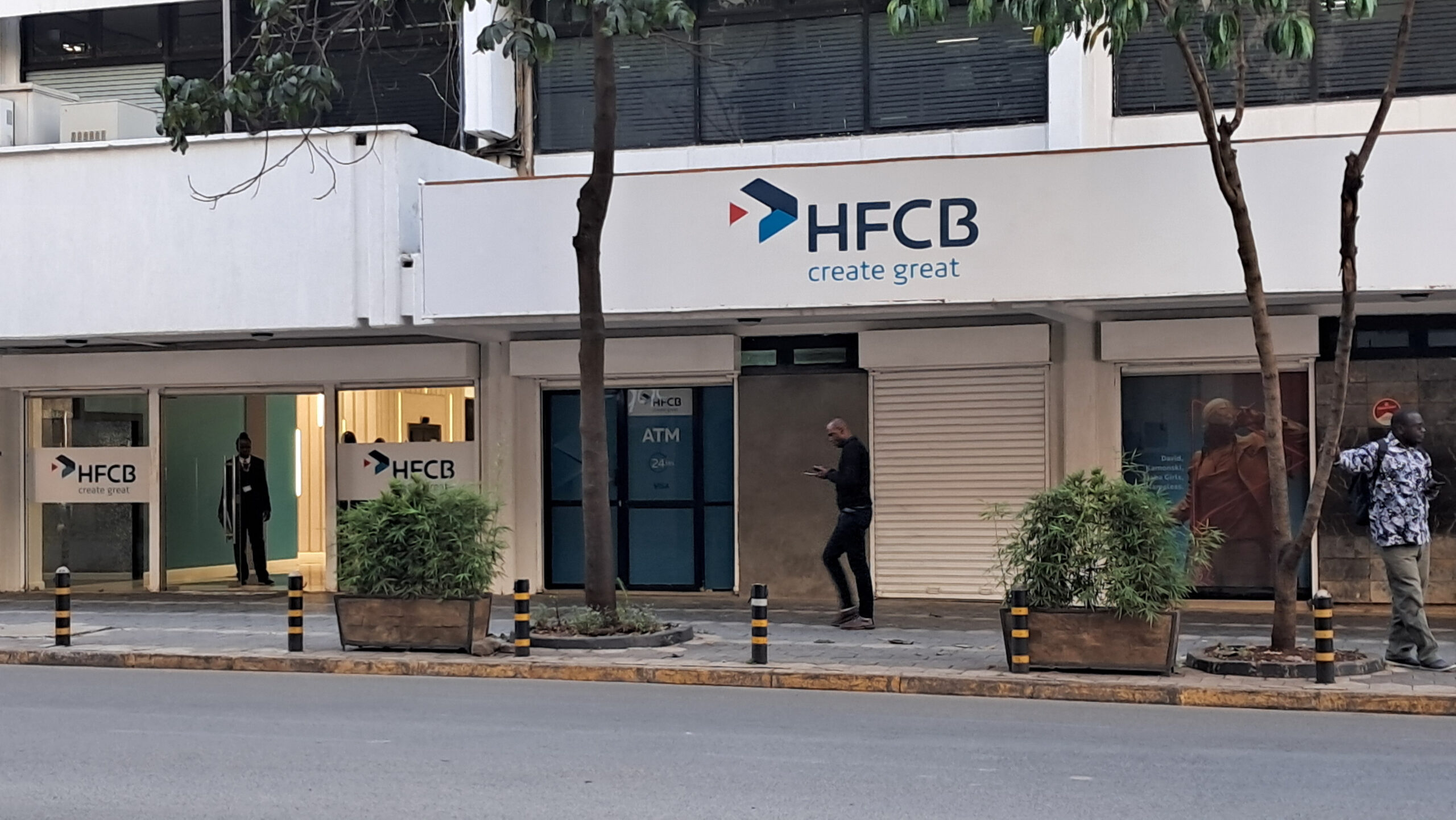
Shareholders had approved the underlying rebrand in September 2024, and it took formal effect on 22 May 2026, when HF Group Plc became HFCB Group Plc and its banking arm switched from HFC Limited to HFCB Bank Kenya. The move unified the group’s banking, property and insurance subsidiaries, which include HFCB Properties, HFCB Bancassurance and the HFCB Foundation, under a single brand nearly 61 years after the business began as the Housing Finance Company of Kenya in 1965.
“HFCB reflects who we are today, a strong, fully integrated financial services and property group, and positions us firmly for the future,” Kibaara said when the rebrand was announced.
What the Numbers Signal Next
HFCB’s half year results describe a lender that has converted a capital injection into faster growth across nearly every line, while keeping its loan book smaller than its historic peak. Whether that pattern holds, or whether HFCB starts pushing lending back toward its 2016 scale, will shape the next phase of a recovery that has already turned a business once defined by three consecutive losses into one setting profit records under a new name.
