


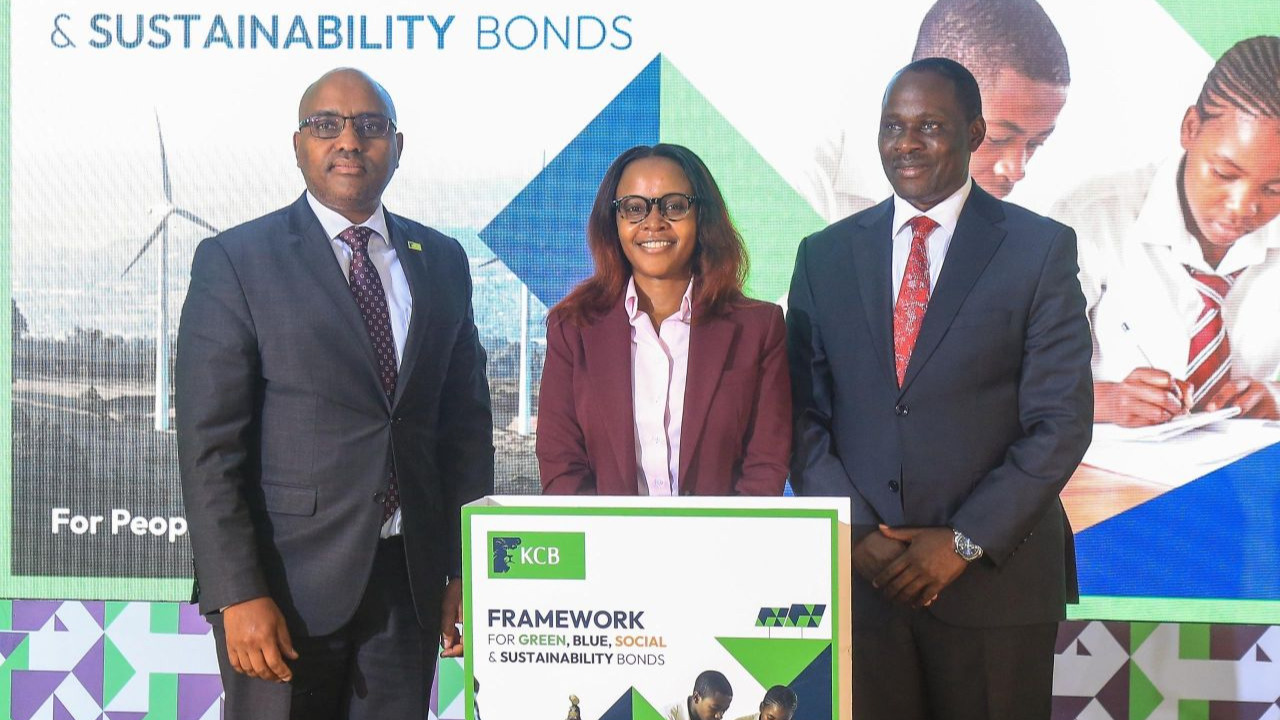
KCB Group has published its Sustainability Bond Framework, setting the stage for a five year Medium Term Note Programme worth up to KSh300 billion ($2.3 billion), with the first tranche capped at KSh100 billion.
The lender announced the framework on Wednesday at the KCB Leadership Centre in Karen, Nairobi. The bank says the document will guide how it selects, tracks and reports on projects funded through green, blue, social and sustainability linked bonds. The note programme itself still needs regulatory clearance before KCB can go to market.
Moody’s assessed the framework and awarded it a Sustainability Quality Score of SQS2, rated “Very Good.” The score places KCB alongside a small group of African issuers that have secured an external second opinion before entering the sustainable debt market.
Why KCB built the framework
Group Chief Executive Officer Paul Russo framed the launch as an attempt to push sustainability out of boardroom pledges and into actual lending decisions. “This is about bringing Capital, Purpose and Accountability, and using finance as a force for good while creating sustainable value for all our stakeholders,” Russo said at the launch.
He added that scale alone will not define success.
“The true measure of sustainable finance is not the size of the bond, but the scale of the impact it creates,” Russo told guests at the event.
Cyrell Wagunda Odede, Principal Secretary at the State Department for Public Investments and Asset Management, called sustainable bonds a critical tool for widening Kenya’s financing base. “As Kenya continues to deepen its capital markets and expand the pool of financing available for infrastructure, enterprise, climate action and other development priorities, innovative instruments such as sustainable bonds will be critical in attracting capital and unlocking new opportunities,” he said.
Betsy Njagi, Principal Secretary for the Blue Economy and Fisheries, linked the framework to the government’s push to diversify development financing.
“The publication of the Sustainability Bond Framework by KCB Group is a step in the right direction as it complements government’s broader commitment to diversifying Kenya’s sources of development financing,” she said.
Where the money will go
Proceeds from bonds issued under the framework will sit in a ring-fenced pool and flow toward eligible projects across three broad areas: green, blue and social. The bank lists renewable energy, green buildings, clean transportation, sustainable water management, agriculture and the blue economy among the environmental categories. On the social side, it points to affordable housing, financing for micro, small and medium enterprises, and support for women and youth led businesses.
| Track | Instruments | Purpose |
|---|---|---|
| Use of Proceeds (Track I) | Green, social, sustainability and blue bonds or loans | Finance or refinance specific eligible projects |
| Sustainability Linked (Track II) | Sustainability linked bonds and loans | Fund general corporate purposes, with pricing tied to performance targets |
A closer look at the underlying framework document shows the eligibility list runs deeper than the press statement suggests. Green categories cover renewable energy, energy efficiency, clean transportation, green buildings, waste management, climate smart agriculture and sustainable forestry.
Blue categories, drawn from IFC guidance, include sustainable water and wastewater management, ocean friendly products, low emission shipping, responsible fisheries and aquaculture, habitat restoration and nature based tourism. Social categories span affordable basic infrastructure, access to essential services such as healthcare and education, affordable housing under Kenya’s Affordable Housing Act, employment generation for MSMEs, food security and broader socioeconomic empowerment for women, youth, refugees and people with disabilities.
Standards behind the framework
KCB says it built the document around the International Capital Market Association’s Green Bond Principles, Social Bond Principles and Sustainability Bond Guidelines, along with the Loan Market Association’s Green and Social Loan Principles and the IFC’s Blue Finance Guidelines.
Where relevant, the bank also references the Kenya Green Finance Taxonomy, mapping its eligible categories against the taxonomy’s technical screening criteria in an appendix to the framework.
Before issuing any bond under the framework, KCB commits to obtaining an independent Second Party Opinion confirming alignment with these principles. After issuance, the bank has pledged annual verification that eligible assets in its Sustainable Bond Register match or exceed outstanding bond proceeds, and it aims to secure limited assurance over greenhouse gas emissions data for renewable energy and clean transportation projects by the third annual reporting cycle.
Track record and targets
KCB traces its sustainability commitments back to 2008, when the bank formally adopted sustainability principles built around four pillars: financial, economic, social and environmental. Since then it has joined the Net Zero Banking Alliance, committing to net zero emissions by 2050, and signed on to the UN backed Forward Faster Initiative.
The bank says it has disbursed more than KSh187 billion in green loans since 2022, including KSh48.8 billion last year across renewable energy, sustainable agriculture, green buildings, clean transportation and climate smart investments. It has set a target of lifting green and climate smart lending to 25 percent of its total loan book, up from a 2024 baseline of 15 percent, and aims to plant five million trees by 2026.
In 2025, the bank says it screened roughly KSh587.78 billion in loan facilities against environmental and social risk criteria, a scale that underscores how far sustainability screening has spread through its lending operations.
Governance and oversight
A Sustainable Bond Committee, drawing members from Treasury, Sustainable Finance, Risk, Credit, Finance and Legal teams, will approve which assets qualify for the eligible pool and track their performance over time. The bank plans to publish an annual Sustainable Bond Report detailing how proceeds are allocated and, where data allows, the environmental or social outcomes achieved.
For assets originated outside Kenya, the framework applies extra scrutiny. KCB operates banking subsidiaries in seven countries, including Tanzania, South Sudan, Uganda, Rwanda, Burundi and the Democratic Republic of Congo. In jurisdictions the bank considers to have weaker environmental regulation, such as the DRC and South Sudan, the Nairobi based Sustainable Finance function applies enhanced due diligence before allowing subsidiary originated assets into the pool.
Background
KCB Group traces its roots to 1896 and today ranks as East Africa’s largest bank by branch network, with 460 branches, 1,247 ATMs and more than 1.4 million agents and merchants across the region. The bank is regulated by the Central Bank of Kenya and lists KCB Bank Kenya as its lead banking subsidiary.
