


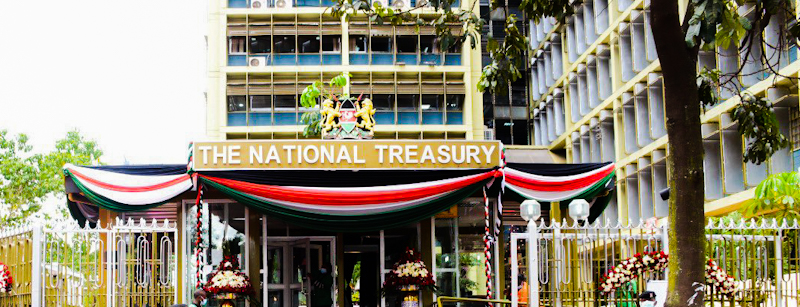
The National Treasury has set out a record Sh5.323 trillion budget for FY2027/28, the first time Kenya’s spending plan will cross the Sh5 trillion mark. The proposal, contained in the Draft 2026 Budget Review and Outlook Paper (BROP) released this month, pushes total expenditure up from Sh4.86 trillion in the current financial year and represents 23.1 percent of GDP.
The BROP sets the fiscal groundwork for the 2027 Budget Policy Statement, due before Parliament by end November. Treasury has opened the document for public comment, with submissions due by August 19.
Where the money goes
Recurrent spending absorbs the bulk of next year’s budget. Treasury has earmarked Sh3.887 trillion, or 73 percent of total expenditure, for recurrent costs including salaries, debt servicing and routine government operations. Development spending, the portion that funds roads, hospitals and other capital projects, comes in at Sh958 billion, equal to 4.2 percent of GDP.
County governments are set to receive Sh472.8 billion through the equitable share, while Treasury has ring fenced Sh5 billion for the Contingency Fund to cover unforeseen expenditure.
| Budget line | Amount (Sh billion) | Share of GDP |
|---|---|---|
| Total expenditure and net lending | 5,322.9 | 23.1% |
| Recurrent expenditure | 3,887.2 | 16.8% |
| Development expenditure | 958.0 | 4.2% |
| Transfer to counties | 472.8 | — |
| Contingency Fund | 5.0 | — |
Source: National Treasury, Draft 2026 Budget Review and Outlook Paper
Revenue targets and the funding gap
Treasury projects total revenue, including appropriations in aid, at Sh3.943 trillion for FY2027/28, equivalent to 17.1 percent of GDP. Ordinary revenue, the tax collections that form the core of government income, accounts for Sh3.208 trillion of that total.
The gap between spending and revenue leaves a fiscal deficit of Sh1.321 trillion, or 5.7 percent of GDP. Treasury plans to bridge most of it through domestic borrowing, which covers Sh1.085 trillion of the shortfall, while external sources contribute Sh235.9 billion.
| Revenue and financing | Amount (Sh billion) | Share of GDP |
|---|---|---|
| Total revenue (including AiA) | 3,943.0 | 17.1% |
| Ordinary revenue | 3,207.8 | 13.9% |
| Fiscal deficit (including grants) | 1,321.0 | 5.7% |
| Net domestic financing | 1,085.2 | 4.7% |
| Net external financing | 235.9 | 1.0% |
Source: National Treasury, Draft 2026 Budget Review and Outlook Paper
A tighter budget process, not a looser one
Treasury frames the record figure as fiscal discipline rather than expansion. Cabinet Secretary John Mbadi says the FY2027/28 budget will run on a zero based approach, requiring every ministry, department and agency to justify its spending line by line rather than simply rolling over prior allocations. In his foreword to the BROP, Mbadi describes the coming budget as prepared within a “constrained resource envelope that calls for greater expenditure discipline.”
That discipline reflects strain from the current financial year. Actual revenue in FY2025/26 came in at Sh3.199 trillion against a Sh3.259 trillion target, a shortfall driven largely by a Sh65.4 billion drop in investment income after government sold down its stake in Safaricom. Total expenditure landed at Sh4.484 trillion, below the Sh4.657 trillion target, and the fiscal deficit closed at 6.8 percent of GDP rather than the planned 7.3 percent.
Kenya’s overall debt position remains a persistent constraint. A joint debt sustainability review by Treasury and the Central Bank puts the present value of public debt at 65.6 percent of GDP in 2026, still above the 55 percent ceiling Treasury has set for itself, though the ratio is expected to ease gradually toward 62 percent by 2030.
The economic backdrop
The budget lands against an economy that has held up better than global peers. Kenya’s GDP grew 5.3 percent in the first quarter of 2026, up from 4.9 percent a year earlier, and Treasury expects full year growth of 5.0 percent in 2026 and 5.1 percent in 2027. Manufacturing, agriculture and tourism led the expansion, with accommodation and food services growing 14.7 percent on the back of stronger visitor arrivals.
Inflation has drifted higher, touching 6.5 percent in July 2026 as global oil prices spiked during the Middle East conflict, though it remains inside the Central Bank’s 5 percent plus or minus 2.5 percent target band. The Central Bank has cut its benchmark rate from 13.0 percent in August 2024 to 8.75 percent by July 2026, a move that has pulled commercial lending rates down to 14.4 percent and pushed private sector credit growth to 10.6 percent.
The Nairobi Securities Exchange has been a rare bright spot. The NSE 20 Share Index climbed 58.8 percent over the year to July 2026, crossing 4,000 points for the first time in nearly a decade, helped along by the Kenya Pipeline Company IPO and the partial sale of a 15 percent Safaricom stake to Vodacom.
What happens next
Treasury will fold the BROP’s figures into the 2027 Budget Policy Statement, due to Cabinet by November 13 and Parliament by November 30, alongside the Division of Revenue Bill and Medium-Term Debt Management Strategy. The Cabinet Secretary is scheduled to present the full Budget Statement to Parliament on March 18, 2027, ahead of the 2027 General Election, a timeline Treasury has compressed specifically to clear the budget process before campaigning begins.
Public and stakeholder comments on the draft paper close on August 19. Whether the zero based budgeting push actually holds ministries to account, or simply adds a new layer of paperwork to old spending habits, will be the real test once the detailed estimates land early next year.
