



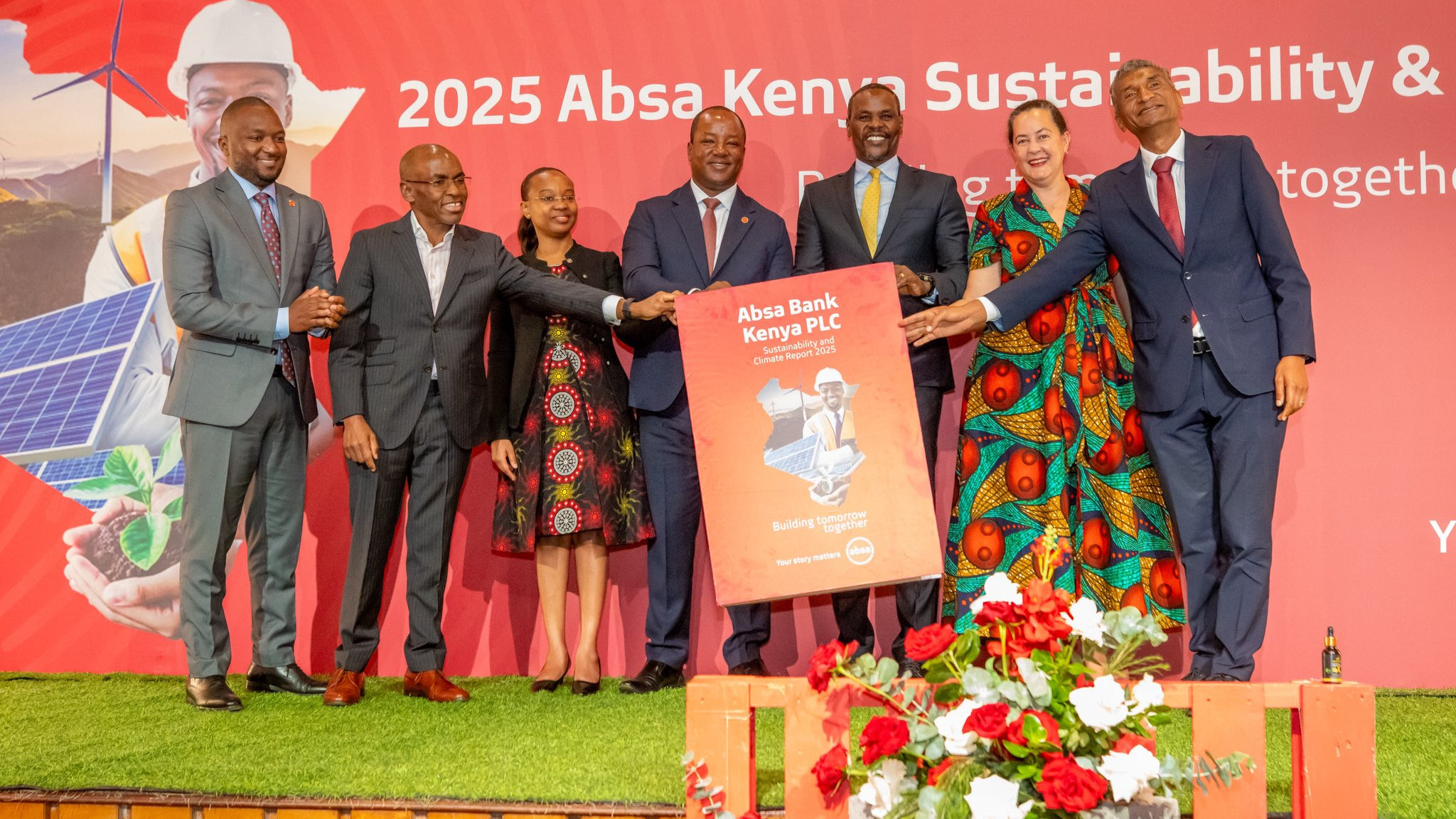
Absa Bank Kenya has channelled more than KES 204 billion into sustainable finance since 2022, a figure that puts real weight behind its promise to grow inclusion, enterprise, and environmental resilience across the country.
The bank released the numbers in its 2025 Sustainability and Climate Report, unveiled this week at Strathmore University.
Behind it sits a bank that beat its own target three times over, retrofitted its branches, tightened its emissions accounting, and pushed tens of thousands of young Kenyans toward employment. Here is what stands out.
The Numbers at a Glance
| Metric | 2025 Result | Context |
|---|---|---|
| Sustainable finance disbursed | KES 55.3 billion | Up from KES 47 billion in 2024 |
| Share of gross loan disbursements | 30% | Triple the original 10% target |
| Climate finance | KES 6.5 billion | Renewable energy, green buildings, energy efficiency, climate smart agriculture |
| Financial inclusion financing | KES 48.8 billion | SMEs, women led businesses, young entrepreneurs, underserved communities |
| Timiza digital lending | KES 26.4 billion | Up 5% on 2024, extending credit to unbanked customers |
| Young people trained (ReadytoWork) | 37,930 | Brings total beneficiaries past 300,000 |
| Trees planted in 2025 | 283,969 | Nearly four times 2024’s total; cumulative total exceeds 1.5 million |
| Waste recycling rate | 96.4% | |
| Gender ratio (female to male) | 52:48 | 49% of managers and 40% of the Board are women |
| Diverse supplier spend | 22% | Women, youth, and persons with disabilities |
Lending Grew Faster Than the Target Ever Asked
Absa set out to make sustainable finance 10% of its loan book by 2025. It hit 30% instead, and growth did not stall as the deadline approached. Disbursements climbed from KES 47 billion in 2024 to KES 55.3 billion in 2025, split between KES 48.8 billion in financial inclusion financing and KES 6.5 billion in climate finance.
That inclusion financing reached small and medium enterprises, women led businesses, young entrepreneurs, and communities that banks often overlook, including KES 1.8 billion disbursed directly to women owned enterprises and KES 10 billion to youth entrepreneurs. The climate portion backed renewable energy, green buildings, energy efficiency, and climate smart agriculture, the sectors most exposed to a warming, unpredictable Kenya.
The Timiza platform extended KES 26.4 billion in lending, a 5% rise on 2024, reaching customers who sit outside the traditional banking net.
The report reflects a year led by Abdi Mohamed, who served as Absa Bank Kenya’s Managing Director and Chief Executive Officer through most of 2025 and into mid 2026, before stepping down at the end of June. Chief Financial Officer Yusuf Omari has since taken over as Interim Managing Director and Chief Executive Officer, and it was Omari who presented the findings.
Board Chairman Mohammed Nyaoga set the tone for the report’s release, framing sustainability as a way of working rather than a side initiative.
“Sustainability has evolved from a separate agenda into a fundamental lens through which organisations and individuals approach decisions, challenges, and opportunities.”
Abdi Mohamed, writing in the report as the year’s Managing Director and Chief Executive Officer, described the intent behind the numbers.
“Our aspiration is to deliver growth responsibly, innovate with purpose, and contribute to lasting progress for future generations.”
Omari, speaking at the launch, tied the results back to the bank’s five year strategy.
“Our 2025 Sustainability and Climate Report highlights what we have achieved under our 2021 to 2025 sustainability strategy, which was anchored on 13 commitments aimed at delivering meaningful economic, social and environmental impact. From supporting businesses to grow and enabling access to affordable housing, to financing climate smart agriculture, renewable energy and broader financial inclusion, we have intentionally deployed capital where it can make the greatest difference. We remain committed to partnering with our customers and stakeholders to build a more inclusive, resilient and sustainable future for Kenya.”
Climate Exposed Sectors Still Make Up a Third of the Loan Book
Absa also tracks how exposed its existing loan book is to climate risk, using UNEP defined categories for carbon intensive industries. Those sectors account for 29.6% of gross loans, or 24% once retail mortgages are excluded.
| Sector | 2024 Value (KES bn) | 2024 Share | 2025 Value (KES bn) | 2025 Share |
|---|---|---|---|---|
| Manufacturing | 52.9 | 15.3% | 46.9 | 13.7% |
| Transport and communication | 13.7 | 4.0% | 15.6 | 4.6% |
| Agriculture and forestry | 14.9 | 4.3% | 14.8 | 4.3% |
| Real estate and business | 18.6 | 5.4% | 19.5 | 5.7% |
| Electricity, gas and water | 2.8 | 0.8% | 1.7 | 0.5% |
| Mining and quarrying | 0.9 | 0.3% | 1.7 | 0.5% |
| Construction | 0.9 | 0.3% | 0.9 | 0.3% |
Manufacturing exposure fell the most, while transport, real estate, and mining edged up. Tracking this concentration lets Absa see where physical and transition risk sit inside its book, not just where its green lending flows.
Emissions Rose on Paper, but the Real Story Is in the Detail
The bank’s own carbon footprint grew in 2025, and that number deserves context rather than alarm. Total operational emissions reached 6,006 tonnes of CO2 equivalent, up from 3,220 tonnes in 2024 and 4,070 tonnes in 2023.
| Scope | 2023 | 2024 | 2025 | Source |
|---|---|---|---|---|
| Scope 1 | 2,410 | 1,160 | 1,300 | Generator diesel and fleet fuel |
| Scope 2 | 1,140 | 840 | 700 | Purchased electricity |
| Scope 3 | 520 | 1,220 | 4,020 | Business travel, paper, water, waste, commuting |
| Total | 4,070 | 3,220 | 6,006 |
Look closer and the rise sits almost entirely in Scope 3, where Absa expanded its measurement to cover more categories of indirect emissions, including commuting and waste. Scope 1 and Scope 2, the emissions the bank controls most directly, both fell in 2025, and combined they sit 41% below the bank’s 2019 baseline. The headline total climbed because Absa is now counting more of what it used to leave unmeasured, not because its core operations became dirtier.
Absa also recycled 96.4% of its waste in 2025 and targets net zero operational emissions by 2040, with net zero across financed emissions by 2050.
The Bank Retrofitted Its Own Buildings, Not Just Its Loan Book
Financing a greener economy is one thing. Living it is another, and Absa moved on both fronts in 2025. Four pilot branches gained solar installations and building retrofits, cutting grid electricity dependency and delivering energy efficiency gains between 30% and 51%. Five bank owned facilities now hold EDGE green building certification, roughly 6% of the estate Absa owns outright.
The bank also launched the Eco Home Loan, financing up to 110% of a property’s value for homeowners who want to buy, build, or retrofit with solar units, rainwater harvesting, or energy efficient insulation. Absa signed on to the Taskforce on Nature related Financial Disclosures during the year too, a step that pushes the bank to account for biodiversity risk and nature dependency across its lending, not just carbon.
On trees, the bank planted 283,969 in 2025, nearly four times the 72,000 planted the year before, pushing its cumulative total past 1.5 million. Absa has set a longer target of 10 million trees by 2032.
Young Kenyans Got Skills, Not Just Speeches
Sustainability at Absa extends past emissions and lending. Nearly 38,000 young people, 37,930 to be exact, gained employability and entrepreneurial skills through the ReadytoWork programme this year, lifting total beneficiaries beyond 300,000 since the programme began. The bank has set its sights on training 1 million young people through the programme by 2030.
Supplier diversity moved in step. Working with the International Finance Corporation under the Sourcing2Equal programme, Absa lifted diverse supplier spend to 22%, beating a 21% target and directing contracts toward women, youth, and persons with disabilities. Representation of employees with disabilities doubled from 1% to 2% of the workforce, or 46 employees.
Meanwhile, the Absa Kenya Foundation widened its reach across education, entrepreneurship, and natural resource management, touching more than 50,000 individuals through the year.
| Commitment | Target | 2025 Status |
|---|---|---|
| Workplace gender parity | 50% female representation across all levels | 52% junior staff, 49% management, 40% Board |
| Supplier diversity | 21% of procurement spend by 2025 | Reached 22%; target raised to 30% by 2030 |
| Youth employability | Train 1 million youth via ReadytoWork by 2030 | Over 300,000 trained to date |
| Inclusion of persons with disabilities | Double representation | Grew from 1% to 2% of the workforce |
Government Backs the Private Sector’s Climate Push
Dr Festus Ng’eno, Principal Secretary at the State Department for Environment and Climate Change, attended the launch and praised Absa’s role in advancing private sector climate action. His warning carried as much weight as his praise.
“Climate change is already affecting livelihoods, infrastructure, ecosystems and economic productivity. The cost of inaction continues to rise, making climate investment not only an environmental necessity but also a sound economic decision. I encourage financial institutions, investors and development partners to continue expanding support for climate solutions, green enterprises and sustainable infrastructure.”
Climate Risk Now Sits Inside Every Lending Decision
Absa wove climate considerations into its business strategy, lending decisions, and enterprise risk management, giving it a sharper read on customers navigating a world reshaped by climate change and fast moving technology.
Governance runs on a three line structure. Business units act as the first line, running daily environmental screening. Risk and Compliance form the second line, setting risk appetite and testing controls through the bank’s Environmental and Social Management System. Internal and external auditors sit as the third line, checking that controls work and that the bank meets Central Bank of Kenya directives. The Board keeps oversight of climate disclosures directly, reviewing and approving reporting against IFRS S1 and IFRS S2. Absa aims for full compliance with IFRS Sustainability Disclosure Standards by 2027, matching the national timeline set by the Institute of Certified Public Accountants of Kenya.
Four Pillars Will Carry the Next Chapter
With the 2021 to 2025 strategy delivered, Absa Bank Kenya has launched a new sustainability strategy built on four measurable pillars designed to accelerate growth, sharpen efficiency, and improve customer experience:
- Grow sustainable finance further — keep at least 30% of gross loan disbursements flowing into financial inclusion, green finance, and nature based finance.
- Reach net zero — operational emissions by 2040, financed emissions by 2050, through a full decarbonisation agenda.
- Sharpen sustainability risk management — strengthen governance around climate and sustainability exposure.
- Embed sustainability into the bank’s culture — and use it to improve the client experience.
Omari framed the next phase as a continuation of a long partnership rather than a fresh start.
“As Kenya accelerates its transition towards a greener and more inclusive economy, Absa will continue partnering with government, businesses, development partners and communities to finance solutions that create lasting value and contribute meaningfully to the country’s long term development priorities.”
Four years, KES 204 billion, and a target beaten three times over: Absa Bank Kenya has shown what sustainable finance can look like at scale in Kenya. The next strategy, and a new interim leader, will decide whether it can go further, and faster.
