



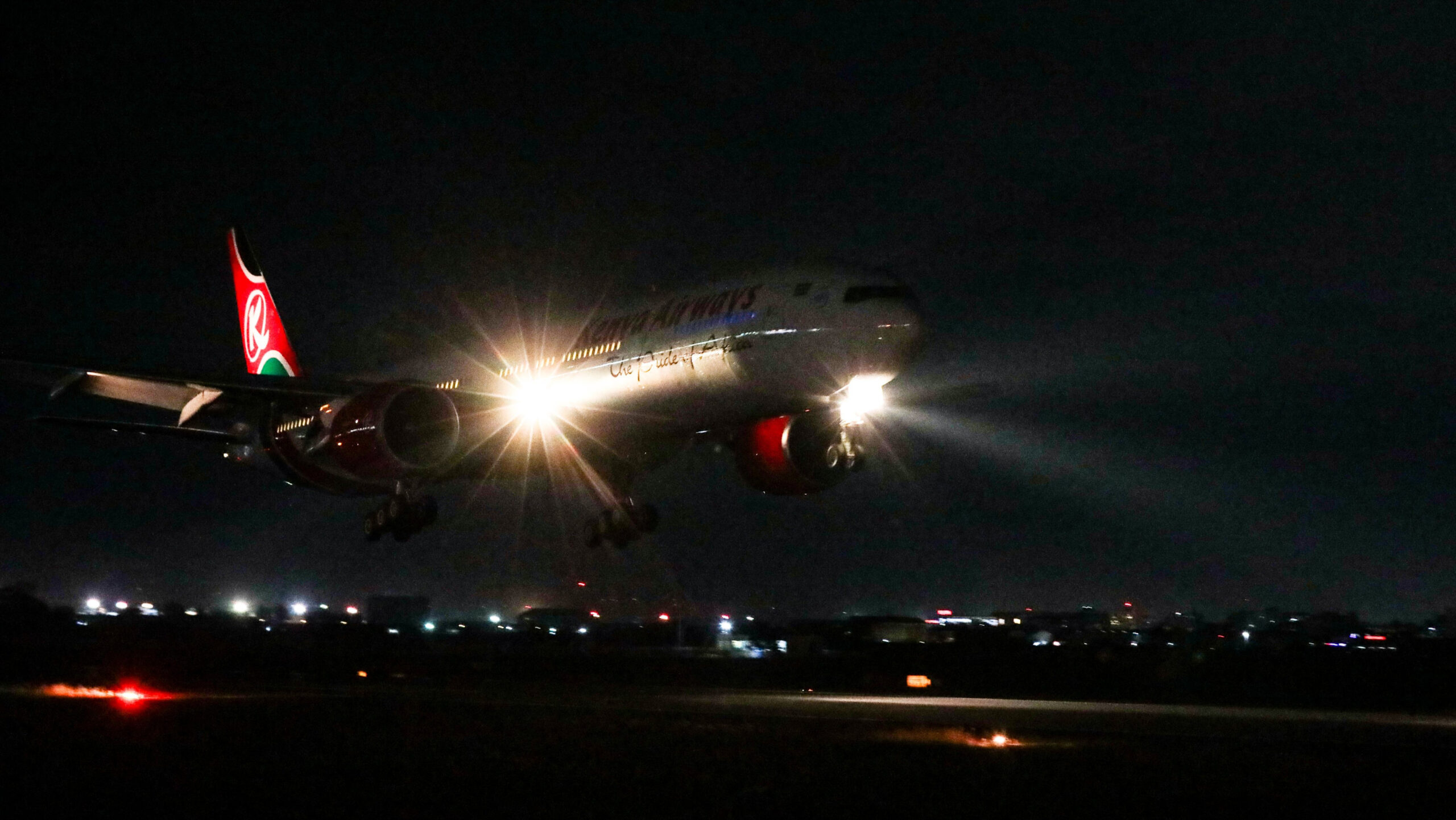
Kenya Airways is dusting off a giant it once sent away. The airline will return its Boeing 777-300ER to scheduled commercial service on the Nairobi to London Heathrow route starting 17 July 2026, ending a decade in which the 400 seat jet flew for other carriers instead of its own.
A Decade Away and Why It Ended
The story of this aircraft did not begin with triumph. Kenya Airways took delivery of its first Boeing 777-300ER in October 2013, building a fleet of three to support long haul growth under its original Project Mawingu plan. Financial strain forced a rethink within years.
In 2016, the airline subleased the jets to Turkish Airlines under a restructuring push known as Operation Pride, deregistering them in Kenya and handing them over to reduce excess capacity and cut costs. Two Boeing 777-200ER aircraft went to Omni Air International around the same period, and Boeing 787-8 Dreamliners went to Oman Air, part of an effort to shrink the fleet to what the balance sheet could carry.
The Rest of the Fleet Is Still Under Repair
The 777-300ER return does not mean Kenya Airways has solved its capacity problem. As recently as March 2026, the airline had three Embraer regional jets and two Boeing 787-8 Dreamliners grounded, a gap that removed between 15 and 18 percent of available seats across the network. The Dreamliner grounding traces back to late 2024, when three aircraft, registered 5Y-KZA, 5Y-KZC and 5Y-KZH, came out of service for engine overhauls tied to a global shortage of spare parts affecting airlines worldwide, including British Airways and Air New Zealand. Group CEO George Kamal received the first of those aircraft back at Jomo Kenyatta International Airport on 9 May 2026.
The shortage carries a direct cost beyond lost seats. Kenya Airways postponed its planned direct route to Beijing Daxing until later in 2026 because it lacked spare widebody aircraft to launch it, choosing to protect existing schedules over new expansion.
By the end of 2025, the airline operated 37 owned and leased aircraft in total, comprising seven Boeing 787 widebody jets, nine Boeing 737 narrowbody jets, seven Embraer regional jets, four Boeing 737 freighters and ten Bombardier Dash 8-400 turboprops. Bringing the 777-300ER back into service is meant to close part of that gap, cutting the grounded share of capacity from around 18 percent to between six and eight percent, according to Kamal.
What Changes From Mid July
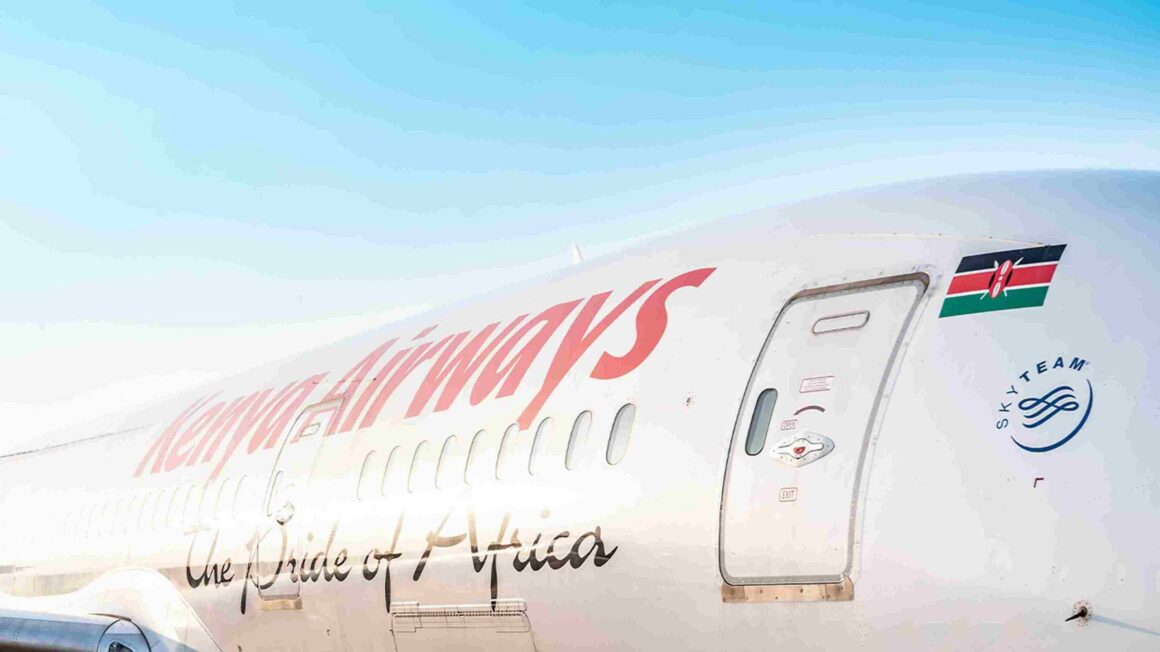
That period of exile for the 777-300ER is now ending. From 17 July, four of Kenya Airways’ seven weekly flights between Nairobi and London Heathrow will switch from the Boeing 787-8 Dreamliner to the reactivated 777-300ER, according to Aero Routes, while trade advisories circulated to travel agents in March pointed to the aircraft eventually operating five weekly rotations on the route. Either way, the shift adds capacity.
The 777-300ER seats around 400 passengers across two cabins, 28 in business class with fully flat seats that recline to 180 degrees, and 372 in a three three three economy layout, roughly 78 more seats per flight than the smaller 777-200ER it once flew alongside.
Ahead of the London relaunch, Kenya Airways flew the aircraft on discounted showcase flights on the Nairobi to Mombasa corridor, one of the busiest domestic routes in the country, giving local travelers a chance to experience a long haul jet on a short route while the airline marks its fiftieth anniversary. It is an unusual use for an aircraft built to cross continents, but a useful way to build momentum before the harder test of international service resumes.
Where the Dreamliner and Wider Network Stand
The Boeing 787-8 remains the backbone of Kenya Airways’ long haul network even as the 777-300ER returns. The Dreamliner anchors the nonstop route to New York JFK, along with services to Dubai, Mumbai, Guangzhou and Bangkok, and connects Nairobi to Johannesburg and Cape Town using its passenger and cargo capacity.
From July 2026, schedule filings point to additional Nairobi to London Gatwick services on the 787-8, building on the airline’s earlier launch of that route and its push to serve both premium and leisure travelers heading to Kenya for safari and beach tourism. The timing lines up with a projected travel surge tied to the 2026 World Cup in the United States, Mexico and Canada, an event Kenya Airways hopes to capture through its New York route among others.

Fleet growth beyond these repairs remains slower than originally planned. CEO Kamal has said the airline pushed its plan to acquire Boeing 737 MAX aircraft back to 2027, while targeting a fleet of 60 aircraft by 2030 and 100 by 2035, a mix of owned and leased jets. In 2025 the airline added one Boeing 737-800 and two Bombardier Dash 8 aircraft, alongside a five year, roughly 400 million dollar plan covering new aircraft and refurbishment of existing ones, including cabin upgrades and in flight Wi-Fi.
A Financial Picture Still Under Repair
Kenya Airways swung to a net loss of KES 17.2 billion for the year ended 31 December 2025, reversing from a net profit of KES 5.4 billion the year before. Revenue fell 14.3 percent to KES 161.5 billion, passenger numbers dropped 13 percent to 4.55 million, and cargo volumes slipped from 70,776 tonnes to 64,780 tonnes. Fleet ownership costs climbed 33 percent, driven by the remeasurement of leased aircraft and new Boeing 737-800 additions, while total operating costs eased only slightly to KES 167.1 billion, leaving an operating loss of KES 5.6 billion. Basic loss per share came in at KES 2.94, against basic earnings of KES 0.95 the year before, and the board declared no dividend for the year.
Half year results for 2025 already carried a net loss of KES 12.2 billion, down from a net profit of KES 513 million in the same period of 2024, as revenue fell 19 percent to KES 74.5 billion on a 14 percent drop in passenger numbers to 2.19 million. That decline followed a rare high point the year before it, when Kenya Airways posted a full year net profit of KES 5.4 billion for 2024, a turnaround of 124 percent from a loss of KES 22.7 billion in 2023, supported by a 6 percent rise in revenue to KES 188.5 billion and an operating profit up 58 percent to KES 16.2 billion.
Kenya Airways is now pursuing a capital raise, reported at figures ranging from roughly KES 194 billion to a proposed KES 258 billion government injection depending on the source, aimed at strengthening liquidity, funding fleet growth and reducing financial leverage. The raise sits alongside an ongoing dispute over the National Treasury’s shareholding, which Kenya Airways has placed at 48.9 percent against reports claiming the government crossed the 50 percent threshold after the employee share scheme wound up.
What This Means for the Route Network
Bringing the 777-300ER back to London is as much a signal as it is a schedule change. The Nairobi to Heathrow corridor remains one of Africa’s most important long haul links, and putting a larger aircraft on it points to confidence in demand even while the rest of the fleet works through engine shortages and the balance sheet works through losses. Whether that confidence turns into a lasting recovery will depend less on this single aircraft and more on whether the capital raise closes, the grounded Embraer and Dreamliner jets return on schedule, and the Beijing route finally gets off the ground.
