


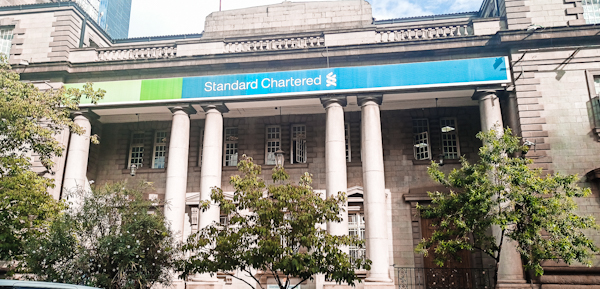
Standard Chartered Bank Kenya posted profit after tax of KSh 3.58 billion for the quarter ended March 31, 2026, a 26.3% decline from KSh 4.86 billion a year earlier.
The result extends one of the most difficult earnings runs in the bank’s recent history, as falling interest rates continue to compress margins with no immediate relief in sight.
Falling Rates Squeeze the Core Business
Net interest income bore the sharpest pain. It fell 23.3% to KSh 6.29 billion, the steepest annual decline on record and a second consecutive year of contraction. Interest income dropped 22.4% to KSh 7.22 billion, while interest expenses fell at a shallower 15.1% pace to KSh 921.88 million. That asymmetry, where income shrinks faster than costs, defines the margin squeeze that now runs through the entire income statement.
The result marks a sharp reversal from the KSh 8.27 billion net interest income peak recorded in Q1 2024 and represents the weakest Q1 figure since 2021. Earnings per share fell to KSh 9.36 from KSh 12.75 in the same quarter last year.
Non-Interest Income Cushions, But Cannot Cover the Gap
Non-interest income provided partial relief, rising 10.3% to KSh 3.74 billion, the second highest Q1 figure on record. Fees, commissions, and foreign exchange trading income all held firm. The problem is scale. A KSh 350 million gain in one line cannot offset a KSh 1.9 billion loss in another.
Total operating income fell 13.5% to KSh 10.03 billion. With costs broadly flat at KSh 4.94 billion, the cost-to-income ratio widened to 49.3% from 42.7% a year earlier, a measure of how quickly efficiency deteriorates when revenue contracts while the cost base stays anchored.
The Balance Sheet Keeps Growing
The income statement may be under pressure, but the balance sheet tells a different story. Total assets crossed KSh 400 billion for the first time, closing the quarter at KSh 413.27 billion, up 8.1% from KSh 382.26 billion in Q1 2025.
Customer deposits grew 12.6% to a record KSh 321.15 billion. That funding went largely into government securities, Central Bank of Kenya balances, and loans. Loans and advances rose 19.96% to KSh 165.38 billion, the highest Q1 loan book in the bank’s history. At 40% of total assets, however, a significant share of the balance sheet remains undeployed into lending, pointing to room for further growth if rate conditions stabilise.
Asset Quality Reaches a Decade-Long Best
One area of unambiguous improvement is asset quality. Gross non-performing loans fell 26.7% to KSh 8.95 billion, the lowest level since Q1 2015, completing a three-year cleanup from a peak of KSh 22.60 billion in Q1 2023. Net NPL exposure narrowed sharply to KSh 161.45 million from KSh 477.93 million a year earlier. The bank has spent three years rebuilding its loan book, and that work now shows clearly in the numbers.
Q1 2026 Profit & Earnings Summary
| Metric | Q1 2026 | Q1 2025 | Change |
|---|---|---|---|
| Profit After Tax | KSh 3.58bn | KSh 4.86bn | −26.3% |
| Earnings Per Share | KSh 9.36 | KSh 12.75 | −26.6% |
| Total Operating Income | KSh 10.03bn | KSh 11.59bn | −13.5% |
| Cost-to-Income Ratio | 49.3% | 42.7% | +6.6pp |
| Total Costs | KSh 4.94bn | KSh 4.94bn | Flat |
Income Statement Breakdown
| Metric | Q1 2026 | Q1 2025 | Change |
|---|---|---|---|
| Net Interest Income | KSh 6.29bn | KSh 8.20bn | −23.3% |
| Interest Income | KSh 7.22bn | KSh 9.31bn | −22.4% |
| Interest Expenses | KSh 921.88m | KSh 1.09bn | −15.1% |
| Non-Interest Income | KSh 3.74bn | KSh 3.39bn | +10.3% |
Balance Sheet Highlights
| Metric | Q1 2026 | Q1 2025 | Change |
|---|---|---|---|
| Total Assets | KSh 413.27bn | KSh 382.26bn | +8.1% |
| Customer Deposits | KSh 321.15bn | KSh 285.22bn | +12.6% |
| Loans and Advances | KSh 165.38bn | KSh 137.87bn | +19.96% |
| Loans as % of Total Assets | 40.0% | 36.1% | +3.9pp |
Asset Quality Trend
| Metric | Q1 2026 | Q1 2025 | Change |
|---|---|---|---|
| Gross Non-Performing Loans | KSh 8.95bn | KSh 12.21bn | −26.7% |
| Net NPL Exposure | KSh 161.45m | KSh 477.93m | −66.2% |
| Gross NPL Peak (Q1 2023) | KSh 22.60bn | — | — |
| Gross NPL Low (Q1 2015 level) | KSh 8.95bn | — | — |
New Leadership Arrives at a Defining Moment
The results land during a period of significant leadership transition. CEO Kariuki Ngari formally departed in April 2026 after more than two decades at the bank. Birju Sanghrajka has taken over as Managing Director and CEO, subject to regulatory approval. CFO Chemutai Murgor exits on May 31, 2026, after 25 years at the institution, with Gladys Warirah named as her successor.
The leadership change compounds an already complex picture. In FY2025, the bank recorded a KSh 2.5 billion pension charge following a Supreme Court ruling that upheld a Retirement Benefits Appeals Tribunal decision in favour of 629 former employees. That charge contributed to a 38% fall in full-year 2025 profit, making 2025 the most financially disruptive year for the bank in recent memory.
The incoming leadership team therefore inherits a business with a clean loan book, a growing balance sheet, and record deposits on one side, and compressed margins, a rising cost-to-income ratio, and a prolonged rate cycle working against recovery on the other. How quickly that tension resolves will define Standard Chartered Kenya’s trajectory through the remainder of 2026.
