



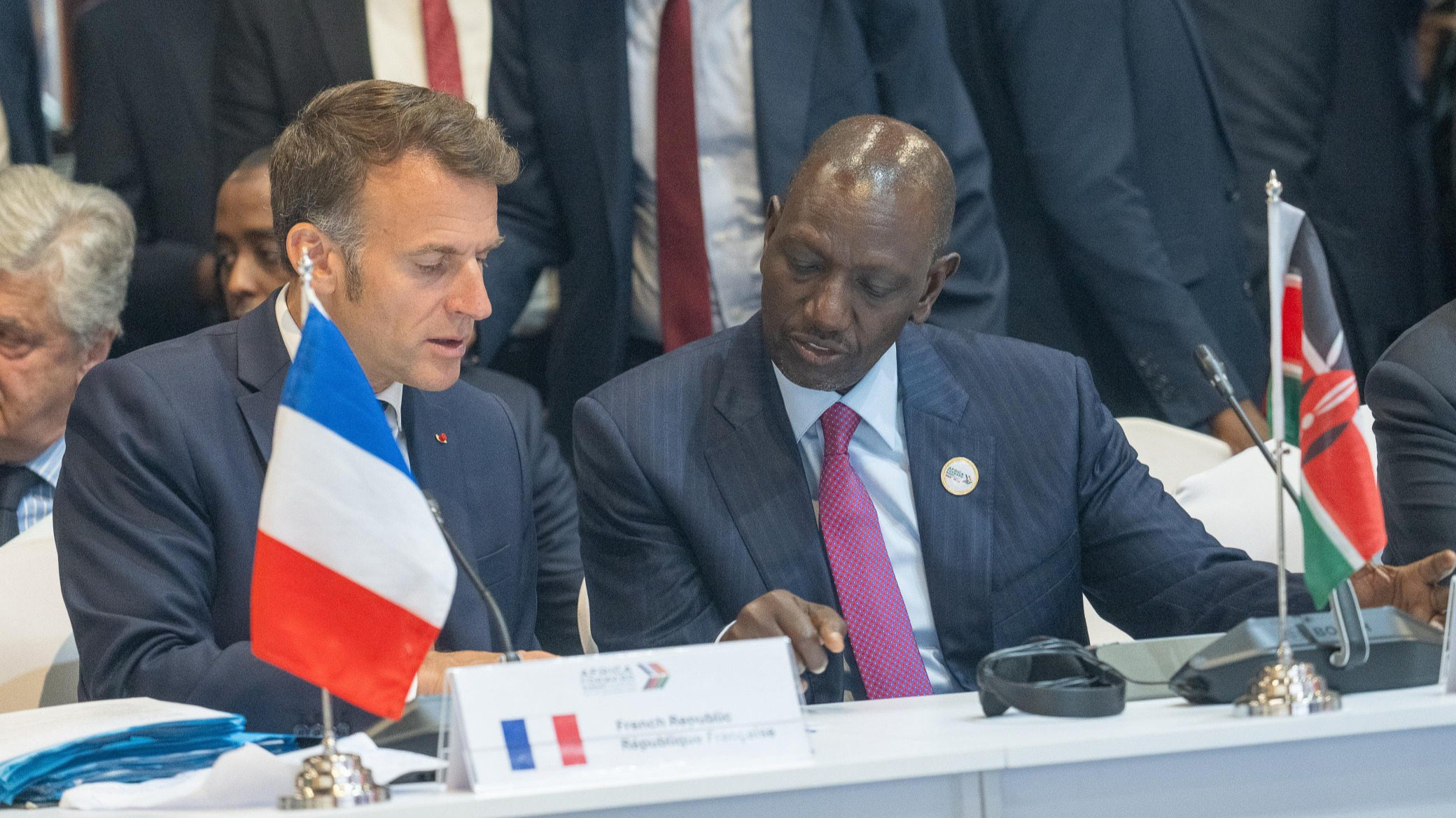
France is rewriting its Africa strategy, one summit at a time. Accused of neo-colonial meddling across the continent where it once held decisive influence, Paris chose Nairobi — an English-speaking capital well outside its traditional orbit — to co-host the Africa Forward Summit, a deliberate signal that the old rules no longer apply.
Speaking in the Kenyan capital on Tuesday, French President Emmanuel Macron repeatedly reached for the language of reciprocity, invoking “co-investment” and “equal footing partnerships” as he addressed pressures that leaders on both sides of the relationship know all too well: regional insecurity, economic dependence and intensifying competition from rival powers.
Kenya’s President William Ruto, who co-chaired the two-day gathering, put it more plainly, arguing that Africa must help shape the emerging global order rather than watch it form from the outside.
The summit’s centrepiece was a French investment commitment of $27bn across energy transition, artificial intelligence, the maritime economy and agriculture, with Macron claiming it would generate around 250,000 jobs across Africa and France. “Africa is succeeding,” he said on Monday. “It’s the youngest continent in the world and needs investment to become more self-reliant.”
The declaration adopted in Nairobi on 12 May 2026 runs to eleven areas of commitment and reads less like a traditional aid framework than a demand for structural change. It calls explicitly for a shift away from “extractive economic models toward value addition, manufacturing and sustainable production systems,” and states that Africa should be seen “not only as a market of the future, but as a partner in production, innovation and global economic leadership.”
On security, leaders backed African-led solutions through the African Union’s Peace and Security Architecture and called for reform of the UN Security Council to give Africa fairer representation, in line with the Ezulwini Consensus and Sirte Declaration. The declaration names active conflicts in Sudan, South Sudan, the Great Lakes, Somalia and the Sahel as priorities, calling for the cessation of hostilities, inclusive dialogue and counter-terrorism capacity building.
Agriculture featured prominently. The declaration commits to transforming the sector from one built on raw commodity exports into “a driver of industrialization, value addition, and economic sovereignty,” with investment in agro-processing, cold chains, digital precision tools and the Africa Fertilizer and Soil Health Action Plan 2024 to 2034.
On artificial intelligence, the declaration took an assertive position. Leaders committed to supporting African language models, local datasets and what they called “a third path for Africa: one grounded in strategic autonomy, reduced dependence on concentrated technological power, transparent and rights-respecting technologies.” The summit built on the Paris AI Action Summit of 2025 and aligned with the African Union’s Continental AI Strategy.
On finance, leaders pushed for a concrete rebalancing of global institutions. The declaration calls for a realignment of IMF quota shares to better reflect Africa’s position in the world economy, secures the 25th IMF Executive Board chair created in November 2024 for Sub-Saharan Africa, and presses major economies to reduce global macroeconomic imbalances that, as the summit document notes, “artificially depress global commodity prices, undermine the competitiveness of nascent African industries and discourage foreign direct investment.”
France and Kenya also called on Paris to carry Africa’s concerns directly to the G7 summit in Evian in June 2026.
Whether the pledges survive contact with implementation remains the test. But the decision to hold the summit in Nairobi, the scale of the financial commitment and the declaration’s insistence on “mutual respect, shared responsibility and co-development” all point to a France that recognises its old playbook has run out of road.
The New Scramble: How America, China and Europe Are Competing for Africa’s Future
