


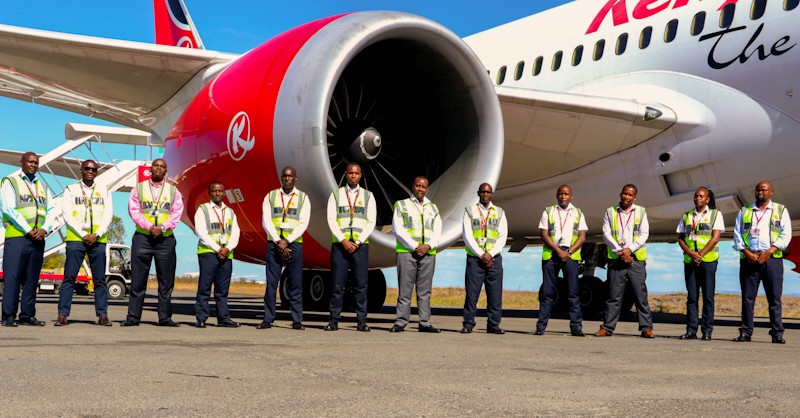
Kenya Airways and Rubis Energy Kenya have signed a memorandum of understanding to build Africa’s first dedicated sustainable aviation fuel (SAF) refinery, targeting annual output of 32,000 tonnes at a projected cost of between $68 million and $79 million.
The agreement establishes a framework for jointly engineering, financing and operating a facility near Jomo Kenyatta International Airport that will produce low-carbon fuel from locally sourced waste materials. By locating production adjacent to existing fuel infrastructure, the partnership cuts the logistical chain between manufacture and use — a key factor in making SAF commercially viable against conventional jet fuel.
The signing took place in the presence of Kenyan President William Ruto and French President Emmanuel Macron during the Africa Forward Summit in Nairobi. The summit carried its own symbolic weight: for the first time, the forum convened outside a Francophone nation, signalling a widening of the two countries’ shared agenda on green energy and industrial investment.
When does the refinery open?
The MOU launches a fast-track process, but the timeline depends on regulatory progress. With backing from Kenya Airways, Rubis Energy Kenya and the Kenyan government, the target is to commission the plant within 18 to 24 months of receiving all required local planning approvals.
How much will it reduce carbon emissions?
The European Union, which leads on mandatory SAF adoption, requires that biogenic SAF achieve at least a 65% reduction in carbon intensity compared with conventional Jet A1 fuel. Dragonfly’s shorter supply chains and efficient refining process are designed to exceed that threshold.
Is it safe to fly on SAF?
Yes. Dragonfly’s technology has been in commercial operation for over seven years and produces a fuel molecule that is chemically identical to regular jet fuel. It meets the same technical standards. The distinction is origin: SAF derives from waste rather than fossil crude oil, which is what makes it sustainable. The flying experience and safety profile remain unchanged.
How many jobs will it create?
The Nairobi refinery expects to employ up to 50 people directly. Beyond the facility itself, hundreds more jobs will emerge across the feedstock supply chain.
What is SAF made from?
The SAF produced at the Nairobi refinery comes from biogenic feedstocks that meet international certification standards. These include used cooking oil, waste animal fats, vegetable oil byproducts and non-edible oils from crops grown on approved land. To verify compliance at every stage, Dragonfly tracks all feedstocks through DragonSoft’s blockchain-secured supply chain authentication platform.
What is HVO?
Hydrotreated vegetable oil, commonly known as HVO or renewable diesel, is produced from the same sustainable feedstocks as SAF but meets road and marine diesel standards rather than aviation ones. The Dragonfly refinery can produce both SAF and HVO, adjusting output to match market demand.
What is HEFA?
HEFA — the hydroprocessing of esters and fatty acids — is the chemical pathway Dragonfly uses to convert biogenic lipid waste into SAF. It already accounts for over 80% of global SAF production, driven by mature technology, strong yield efficiency and established feedstock supply chains. HEFA is forecast to represent 70% of SAF output by 2035. Alternative pathways such as Power-to-Liquid and Alcohol-to-Jet remain years from meaningful scale. HEFA carries a clear cost advantage: lower capital expenditure, faster deployment and supply chains that already function at commercial volumes.
Why can Dragonfly build refineries faster than conventional operators?
Traditional oil refineries are custom-designed from scratch for each location, cost hundreds of millions of dollars and take at least five years to build. Dragonfly operates on a different model: design once, build many times. The company manufactures standardised modular units in a factory, then deploys them as compact, infrastructure-light sites co-located within existing refineries or terminals. The result is a platform roughly ten times smaller than a conventional refinery, built in significantly less time and at a fraction of the cost — and designed to refine local waste into local fuel.
The Nairobi facility positions Kenya at the front of a continental push to decarbonise aviation, a sector that accounts for roughly 2.5% of global carbon dioxide emissions and has few near-term alternatives to liquid fuel.
