



Kenya’s media sector draws young women in and pushes them out before they reach their prime.
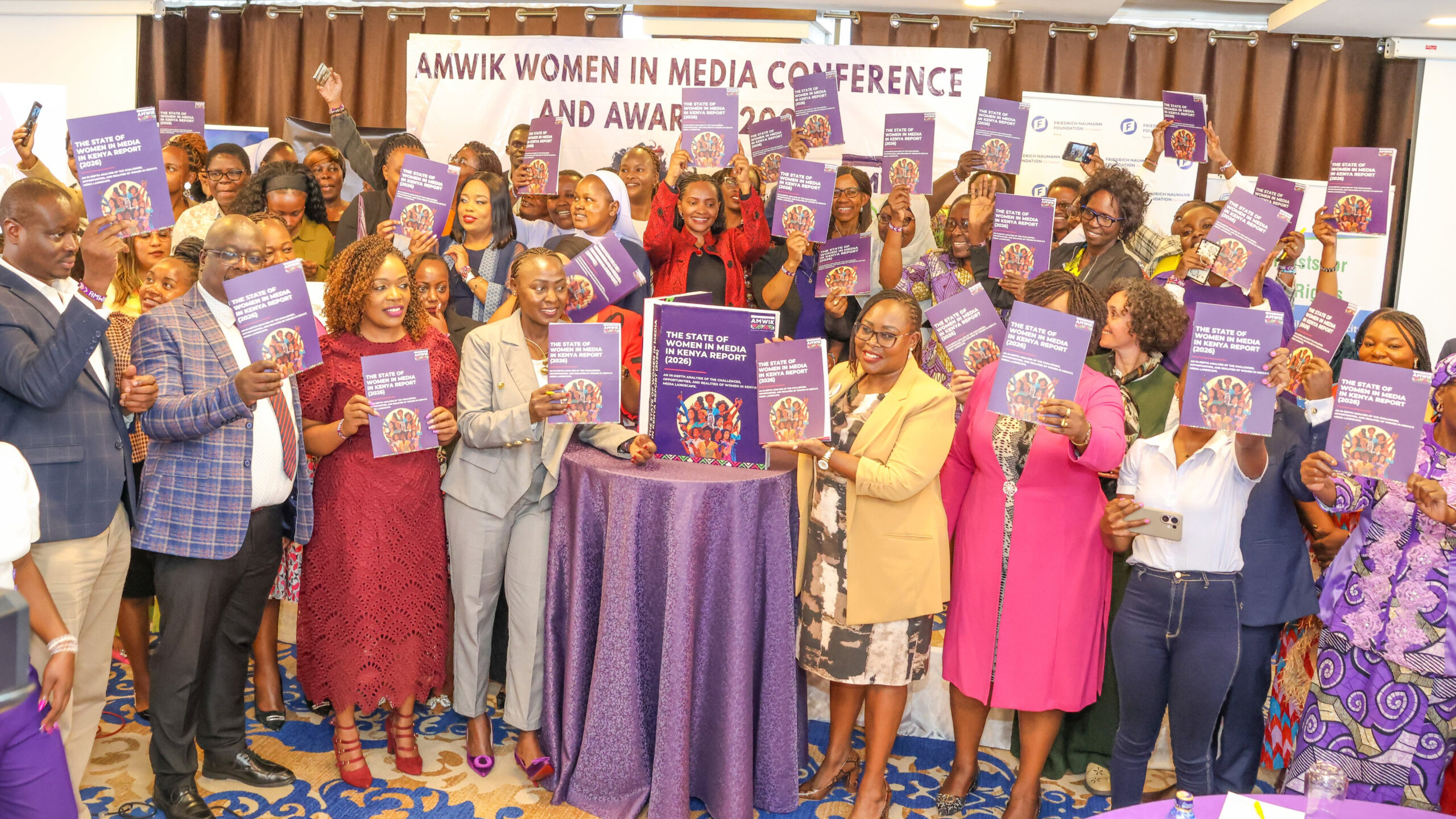
That is the central finding of the State of Women in Media in Kenya 2026 report, published by the Association of Media Women in Kenya (AMWIK) and launched at the 2026 Women in Media Conference under the theme Resilient Professionals and Sustainable Futures.
The report, which draws on responses from 108 women journalists, four key informant interviews, a focus group discussion, and a review of existing industry data, offers the most detailed look yet at what women in Kenyan journalism actually experience on the job.
A Young Workforce With Nowhere to Go
The data tells a clear story about who stays and who leaves. Seven in ten women journalists surveyed are 35 or younger. Only 7.4 percent are above 45. Just 13.2 percent have more than 15 years of experience in the industry. These numbers do not reflect a sector thriving with new talent. They reflect a revolving door.
AMWIK Executive Director Queenter Mbori put it plainly in her foreword to the report:
“While women are highly educated and actively engaged in journalism, many remain concentrated in entry and mid-level roles, with limited representation in leadership and decision-making positions.”
The consequences of this pattern run deeper than individual careers. When experienced women journalists exit the profession, they take institutional knowledge with them. The next generation loses its mentors. Leadership roles stay male-dominated. And journalism itself becomes less representative of the society it covers.
The unveiling and launch of the ‘State of Women in Media in Kenya Report 2026’. A report that has been hailed as a critical read and reference by media practitioners during the event. #MediaWomenConfKE @FNF_Kenya @MediaCouncilK @KenyaEditors @MoICTKenya @CNCSKenya pic.twitter.com/F4VcLPJiGc
— Association of Media Women in Kenya (@AMWIK) April 23, 2026
Precarious Work Is the Norm, Not the Exception
Employment insecurity compounds every other challenge the report identifies. Only 14 percent of respondents hold permanent, full-time positions. Another 26.2 percent work on fixed-term contracts. The remaining 59.5 percent occupy what the report calls “precarious roles” — internships, freelance arrangements, and correspondent positions that offer little job security and even less institutional protection.
The Kenya Union of Journalists, cited in the report, connects this precarity directly to the attrition problem:
“If women are denied high-profile assignments that lead to promotion, they remain in the ‘correspondent’ tier indefinitely. Further, a patriarchal newsroom culture can make the environment toxic for women, leading to a high attrition rate where women leave stable employment for independent content creation or consultancy.”
For women on short-term contracts, the vulnerability is not just professional. Contractual arrangements typically exclude maternity benefits, forcing some to return to work far sooner than their health warrants. One respondent described her experience bluntly: “I had to resume work two weeks after delivery as my supervisor threatened to sack me if I didn’t.”
Harassment Persists, Reporting Mechanisms Do Not
Sexual harassment registers as a major workplace concern for 38.7 percent of respondents. The consequences extend beyond distress in the moment. Women journalists report damaged professional reputations, self-censorship, and narrowed reporting scope. Employer responses, the report finds, are often slow or absent altogether.
Cultural silence compounds the problem. Fear of retaliation keeps many women from reporting incidents at all, which allows the behaviour to continue and communicates to the wider workforce that no accountability exists. One respondent captured the dynamic precisely:
“Sometimes sexual harassment targeting women journalists emanates from the management itself, as well as media colleagues. And it is so unfortunate that even the ones who are supposed to protect you know the law well.”
Online harassment presents a parallel and growing threat. A third of respondents — 33.4 percent — experience stress and anxiety directly linked to digital abuse, including trolling, doxing, and coordinated attacks. One in five women journalists now avoids covering certain topics because of fears about online harassment. Very few media houses have ICT policies that address this reality.
Physical Safety Breaks Down in the Field
The risks women face are not limited to the newsroom. A striking 64.8 percent of respondents have experienced a safety or security breach during their careers. Only 35.2 percent report feeling safe in their working environment.
Election coverage crystallises the danger. With Kenya’s 2027 general election approaching, only 17.2 percent of women journalists say they feel safe covering it. Nearly half describe themselves as unsafe or least safe during election assignments. Media houses, the report concludes, lack the safety policies, pre-deployment training, protective equipment, and emergency protocols that high-risk reporting demands.
“There is a need for the leadership of respective media enterprises to implement robust measures and hold perpetrators accountable to safeguard journalists from threats, physical attacks, and harassment especially when covering issues like election and corruption,” one respondent stated.
Mental Health Carries the Weight of Everything Else
The cumulative pressure takes a measurable toll. Some 44.6 percent of respondents say mental health challenges significantly reduce their productivity. Another 43.6 percent report mental exhaustion stemming from workplace stress, harassment, and unsafe conditions. Access to professional counselling remains rare across the industry.
Pay disparities sharpen the psychological strain. The report notes that despite the Employment Act of 2007 mandating equal pay for equal work, a significant gender pay gap persists. Women cluster in lower-tier roles or “soft beats” — features, lifestyle, entertainment — that carry lower bonuses and allowances than the politics and business coverage typically assigned to male colleagues. Some 61.8 percent of respondents report reduced motivation as a direct result of workplace inequality.
Leadership Positions Remain Out of Reach
The career ceiling is not a metaphor. It is measurable. Reporters and correspondents account for 35.5 percent of the women surveyed, making it the most common role. News anchors and presenters make up 17.8 percent — visible positions, but not decision-making ones. Only 3.7 percent have reached managing editor or media manager level. Just 2.8 percent are media owners.
A Key Informant Interview participant offered a moment of guarded progress: “At least now we have a woman at the helm of the Standard Group Plc and another at the Kenya Broadcasting Corporation (KBC), but the numbers are still low.”
The Reuters Institute’s 2025 Digital News Report found that only 27 percent of top editors globally are women. Kenya’s figures sit below even that inadequate global benchmark.
Women Lead More Banks, But the Boardroom Gap Widens in Africa
What Women Journalists Say They Need
The report does not stop at diagnosis. Respondents identified their most urgent needs with clarity. Legal protection and harassment response mechanisms topped the list at 65.7 percent. Mental health support followed at 51.4 percent. Equal pay advocacy came third at 48.6 percent. Rounding out the priorities were professional networking, safety training, childcare support, job security, and structured mentorship.
Institutional support currently falls far short of these needs. Women journalists rated their media houses an average of 4.83 out of 10 for support. Only 4.8 percent can access legal support through their employer — a critical gap that leaves most women with no recourse when their rights are violated.
What Needs to Change
AMWIK’s recommendations address three audiences: media houses, government regulators, and development partners.
Media houses must implement zero-tolerance policies on gender-based violence, establish transparent pay structures, provide counselling services, and adopt family-friendly working conditions. Government regulators must mandate gender policy compliance across all licensed media organisations, require public reporting on gender pay gaps, extend employment protections to freelancers and contract workers, and enforce 50/50 hiring and promotion targets linked to licensing.
For its own part, AMWIK calls on partners to fund investigative grants for women journalists, establish a legal aid helpline for harassment victims, develop leadership training programmes, and push academic institutions to integrate gender-responsive content into journalism education.
The Cost of Inaction
Kenya’s media sector reaches 90 percent of the population through radio and television alone. It shapes how citizens understand politics, health, justice, and public life. A sector that loses its women journalists at mid-career does not simply waste talent. It narrows the range of stories that get told and the voices that get heard.
