



Six days into the Glasgow 2026 Commonwealth Games, Africa’s athletes have turned promise into podiums.
Nigeria sits fifth on the overall medal table, South Africa’s swimmers sit second in their sport, Kenya and Uganda have traded blows in one of the races of the Games, and Rwanda has a first senior Commonwealth medal to celebrate.
Nigeria Climbs to Fifth With a Medal Rush
Team Nigeria arrived in Glasgow chasing 16 gold medals, and the squad has backed that ambition with results. By Wednesday, 29 July, Nigeria had banked 12 medals, six gold, four silver and two bronze, enough to sit fifth overall behind Australia, England and Canada, and comfortably the highest ranked African nation at the Games.
Weightlifting has carried much of that haul, and no lifter has stood taller than Onome Omolola Didih. Competing at her first Commonwealth Games, the 22 year old took total control of the women’s 53kg category, opening with a snatch five kilograms clear of the field before adding a clean and jerk that shut the door on India’s Gyaneshwari Yadav, who settled for silver. Canada’s Rebeka Groulx took bronze. Didih’s day yielded three records in one sitting, for the snatch, the clean and jerk and the combined total, continuing a run of record breaking form that had already seen her rewrite the marks at the African Championships earlier this year. Nigeria’s other weightlifting and para powerlifting golds came from Esther Nworgu, Folashade Oluwafemiayo, Riluwan Idris, Edidiong Umoafia and Rafiatu Lawal.
Cameroon Gatecrashes the Sprint Party, Nigeria Shares the Podium
Tuesday’s men’s 100m final belonged to Cameroon’s Emmanuel Eseme, and few outside his own camp saw it coming. Eseme had already served notice by qualifying fastest in a lifetime best of 9.89 seconds, then tore that mark apart in the final with a Commonwealth Games record of 9.83, breaking a benchmark that had stood since Ato Boldon set it 28 years earlier in Kuala Lumpur. It was Cameroon’s first medal of the Games, and Eseme credited a simple race plan for the breakthrough, resisting the urge to chase the field early and trusting his closing speed to do the rest.
Australia’s Lachlan Kennedy took silver, but the bronze went to Nigeria’s Kanyinsola Ajayi, who clocked 9.90 to end a 20 year wait for a Nigerian medal in the event. Ajayi became the first Nigerian man to reach the podium in the blue riband sprint since Olusoji Fasuba’s silver back in 2006, a drought that had spanned two decades of near misses.
Nigeria’s other sprint hopes fell just short on the day. Favour Ashe finished fifth in his semifinal, while Nicholas Fakorede missed out in fourth, and the women’s sprint trio of Rosemary Chukwuma, Blessing Ogundiran and Miracle Ezechukwu were also eliminated at the semifinal stage. High jumper Temitope Adeshina delivered some consolation of her own, clearing 1.90m for bronze, a significant improvement on her 10th place finish on her Commonwealth Games debut four years ago.
Kenya and Uganda Collide in an Instant Classic
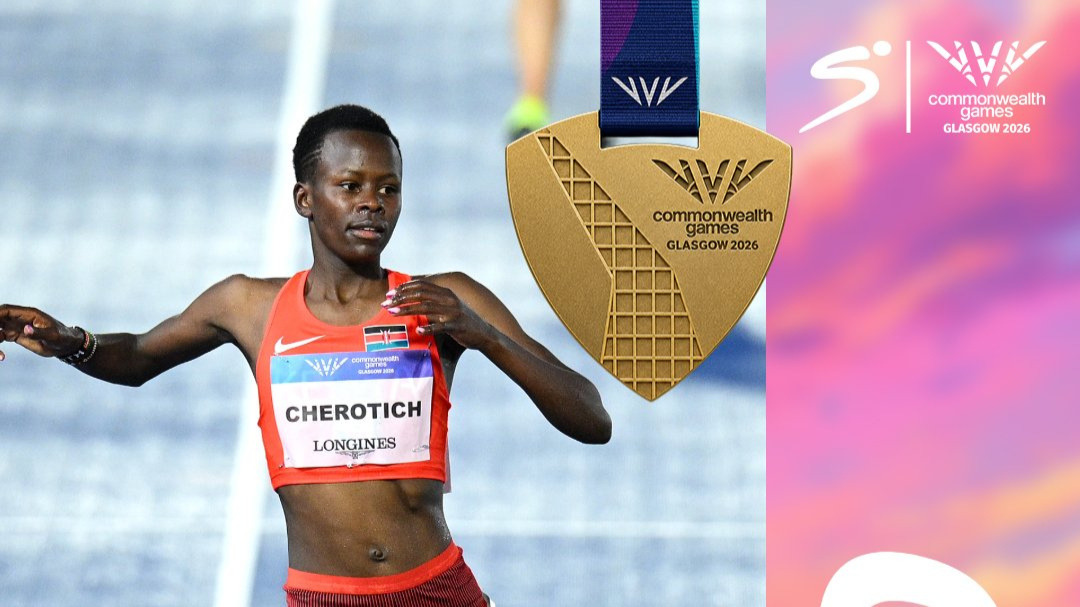
If one race summed up the depth of East African distance running this week, it was the women’s 3000m steeplechase. Billed beforehand as a straight fight between world leader Peruth Chemutai of Uganda and Kenya’s Faith Cherotich, the third and fourth fastest women in history over the distance, the race refused to follow the script. Cherotich broke Chemutai with three laps remaining and powered clear for gold, but the real twist came on the final lap, when England’s Elise Thorner reeled in a fading Chemutai to snatch a stunning silver with a huge personal best. Chemutai held on for bronze in a race that instantly ranked among the highlights of the Games.
🇰🇪 Faith Cherotich sets a new Games record of 9:01.76 in the Women’s 3 000m steeplechase 🥇#Glasgow2026 #SSCommonwealthGames pic.twitter.com/1qRf2HAgpb
— SuperSport 🏆 (@SuperSportTV) July 29, 2026
Kenya’s broader distance running programme remains the benchmark for the continent, built on a mix of proven champions and emerging talent. Timothy Cheruiyot, Mary Moraa and Lilian Odira headline a squad with strength across the middle distances, while javelin veteran Julius Yego is using Glasgow as a farewell stage.
Now 37 and competing at his sixth and final Commonwealth Games, Yego made his debut in Delhi in 2010, won gold on this same Glasgow track in 2014 and took bronze in Birmingham four years ago. His men’s javelin final falls on Friday, 31 July, and a place on the podium would be a fitting send off before he turns his focus to a fourth Olympic appearance at Los Angeles in 2028.
Rwanda Breaks a 16 Year Wait
Few moments in Glasgow carried more weight for a single nation than Florence Niyonkuru’s bronze in the women’s 10,000m. Rwanda had competed at every senior Commonwealth Games since its debut in Delhi in 2010 without reaching the podium, coming closest at Birmingham 2022 when its men’s beach volleyball pair finished fourth. Niyonkuru ended that wait by holding off Uganda’s Esther Chebet by a fraction of a second, with Australia’s Rose Davies taking gold and Kenya’s Diana Wanza claiming silver.
🥉 HISTORY MADE! 🇷🇼
Niyonkuru Florence has become the first Rwandan athlete ever to win a medal at the Commonwealth Games, securing a historic bronze in the Women’s 10,000m at Glasgow 2026. pic.twitter.com/97UjuGoaj8
— Rwanda Commonwealth Games Association (@RwandaCGA) July 27, 2026
The result capped a breakout season for the Rwandan, who set a national record at the Berlin Half Marathon in March, won her 10km debut in Bengaluru in April and claimed silver at the African Championships in May. Her Glasgow bronze puts Rwanda on the Commonwealth Games medal table for the first time, a marker 16 years in the making.
South Africa’s Swimmers Turn the Pool Into a Stronghold
South Africa has quietly built one of the strongest swimming campaigns of any nation in Glasgow. The team finished the six day swimming programme second on the sport’s medal table, with six golds among 22 medals overall, sitting behind only Australia and ahead of hosts Scotland and England.
Two swimmers defined that campaign. Chad le Clos closed the meet by helping South Africa to bronze in the men’s 4x100m medley relay, a swim that delivered the 21st Commonwealth Games medal of his career and moved him one clear of Australia’s Emma McKeon as the most decorated athlete in the history of the Games, across five editions stretching back to Delhi 2010. Pieter Coetze completed a clean sweep of the men’s backstroke events by winning the 100m in 51.77 seconds, the second fastest time ever swum over the distance, before leading off South Africa’s medley relay in a Games record 51.71.
The most striking story, though, belonged to Lara van Niekerk, who defended her women’s 50m breaststroke title after four years marked by a foot operation, glandular fever and an autoimmune thyroid condition that disrupted her training and had at one stage pushed her toward walking away from the sport altogether. An administrative error also cost her a place at the Paris 2024 Olympics despite qualifying twice, a blow that made the timing of her Glasgow gold, delivered by the narrowest of margins, all the sweeter for a swimmer still aiming for her Olympic debut in Los Angeles in 2028.
South Africa’s Netball Team Heads Into a Shootout
South Africa’s netballers have matched the swimmers for drama. The Proteas opened with a 65-44 win over Malawi before setting a new Commonwealth Games scoring record with a 96-42 rout of Tonga, a total that eclipsed the previous mark of 92 goals. A 78-30 win over Northern Ireland followed, extending the unbeaten run to three matches before defending champions Australia finally applied the brakes on Wednesday. South Africa trailed by as much as 11 points at halftime but clawed the gap back to five with two minutes left before Australia closed out a 57-47 win.
That result sets up a straight shootout for a semifinal spot on Thursday, when South Africa face England, who cruised past Tonga 94-32 on Wednesday. Whoever wins in Pool A joins Australia in the last four, giving the Proteas one more chance to prove their unbeaten start was no fluke.
The Continent’s Depth Keeps Growing
Beyond the headline nations, Botswana’s sprint programme has built a reputation few countries can match, part of a wider pattern that includes Zambia and Uganda steadily raising their own competitiveness on the Commonwealth stage. Uganda’s Samuel Simba Cherop offered an unlikely reminder of that resilience in the men’s 10,000m, losing a shoe mid race yet still battling home in seventh running in one shoe and one sock.
That depth reflects years of investment in coaching, facilities and athlete development across the continent, and it shows in results beyond the marquee events. Nigeria’s boxing and 3×3 basketball teams have both featured prominently even where results have been mixed. Patricia Mbata lost a tight split decision in the women’s 75kg boxing, while the men’s basketball side beat the Cayman Islands before falling to Australia and New Zealand.
Records Broken, and a Few Still to Chase
Several marks have already fallen in Glasgow, and more remain within reach as the Games move into their final days.
Men’s 100m. Already broken. Emmanuel Eseme’s 9.83 seconds on Tuesday eclipsed a Commonwealth Games record that had lasted almost three decades, with Nigeria’s Kanyinsola Ajayi sharing the podium in bronze.
Netball scoring record. Already broken. South Africa’s 96-42 win over Tonga surpassed the Proteas’ own previous high of 92 goals at a single Games.
Men’s backstroke clean sweep. Already delivered. Pieter Coetze’s win in the 100m backstroke completed South Africa’s sweep of the 50m, 100m and 200m, with his relay leadoff standing as the fastest 100m backstroke split in Games history.
Women’s 53kg weightlifting. Already broken, three times over. Onome Didih’s snatch, clean and jerk and total all stand as new Commonwealth Games records.
Men’s javelin, Friday, 31 July. Julius Yego’s farewell final gives Kenya a shot at a medal in the event that made him a global name, on the same Glasgow circuit where he won gold in 2014.
Most medals by one athlete at a single Games. Chad le Clos has already rewritten the all time record with 21 medals across his Commonwealth Games career. Attention now turns to whether any swimmer or gymnast at these Games can match his single tournament haul before competition ends on 2 August.
Five Facts About the Commonwealth Games
The first Games took place in Hamilton, Canada, in 1930, under the name the British Empire Games. Held every four years since, the event has grown from 11 nations and around 400 athletes at that debut edition to 74 nations and territories competing in Glasgow. Australia remains the most successful country in Commonwealth Games history, a record built over nearly a century of competition. The Games carry the nickname the Friendly Games, a nod to the unity and sportsmanship the event has aimed to promote since it began.
What Comes Next
Africa’s story at Glasgow 2026 is no longer about arriving, it is about winning. Nigeria’s medal count keeps climbing, South Africa’s swimmers and netballers keep making history in their own right, Kenya and Uganda have already delivered one of the races of the Games, and Rwanda has a first Commonwealth medal to build on for years to come. With four days of competition remaining, South Africa’s netballers facing a shootout for a semifinal place and Julius Yego chasing one last podium in the javelin, the continent’s biggest question is no longer whether it will make an impact in Glasgow, but how many more records fall before the closing ceremony on 2 August.
