




Spotify hosted its third Investor Day in New York on May 21, 2026, and the message from its new leadership was direct: the company that spent twenty years building the world’s dominant audio platform now wants to become something considerably larger.
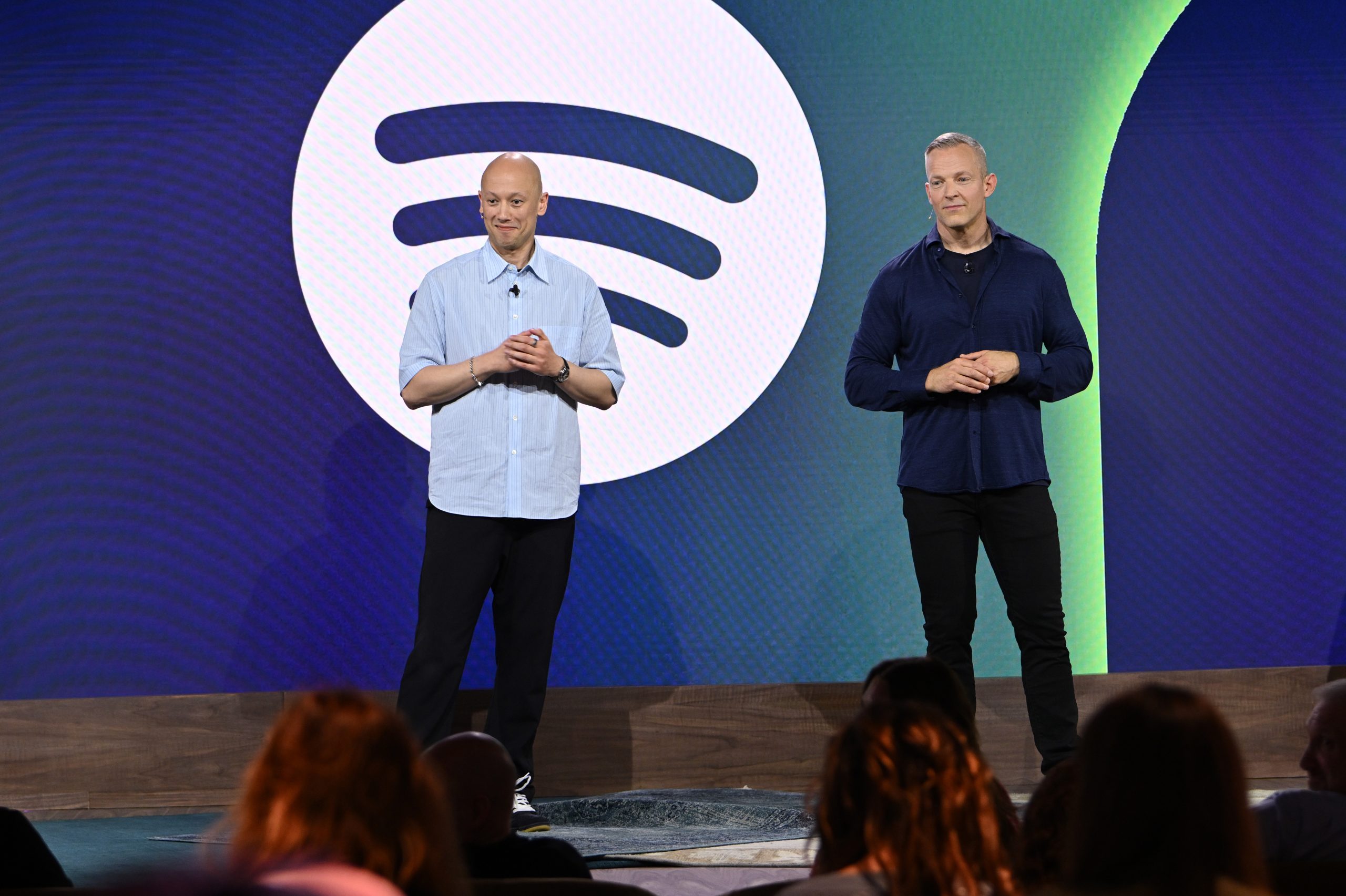
Co-CEOs Alex Norström and Gustav Söderström took the stage together for the first time at an investor event since taking charge in January 2026, following the departure of founder Daniel Ek, who stepped down after nearly two decades as CEO. Presenting alongside their global leadership team, they mapped out a business that now reaches 761 million active users across 184 markets, carries nearly 300 million subscribers, and generated almost €3 billion in free cash flow in 2025. Since 2022, Spotify has added more than 340 million new users and grown its subscriber base by more than 110 million.
“We are still firing on all cylinders,” Söderström says. “We’re seeing strong growth in free users and in subscribers.”
A Company Under Pressure, With a Clear Target
Spotify shares have shed about a quarter of their value over the past year. This was the first investor day in four years, held under new leadership, at a moment when the company is working to prove it can grow beyond music streaming into a durable, multi-vertical media business.
The north star Spotify set publicly: one billion subscribers and $100 billion in revenue. The financial targets supporting that goal include a mid-teens revenue compound annual growth rate, a gross margin of 35% to 40%, and an operating margin above 20% by 2030. CFO Christian Luiga added that in the US alone, customer lifetime value has risen by more than 70% since 2022.
From Curation to Generation
The central argument running through the day was that Spotify stands at the start of a new phase. Four years ago, the company described itself as a curation and recommendation engine. Now it describes itself as a generation platform, one that uses a proprietary Large Taste Model, trained on 3.4 trillion daily behavioural signals, to build real-time personalised experiences rather than passive playlists.
Söderström framed the arc simply: first access, then personalisation, now generation. Each stage, he argued, compounds Spotify’s advantage in scale, data, and user understanding.
The Universal Deal: AI Covers, Artist Voices, and a Legal Framework
The most significant announcement of the day arrived in the form of landmark licensing agreements with Universal Music Group and Universal Music Publishing Group. Under the deal, Spotify will let users create covers and remixes using the voices of artists and songwriters who opt in — with consent, credit, and compensation built into the process from the start. The tool launches as a paid add-on for Premium subscribers and opens a new revenue stream for artists. Universal’s roster includes Billie Eilish and Taylor Swift.
The deal lands in the middle of a legal storm convulsing the broader music industry. Record labels have spent the past two years grappling with how to protect artists as AI music generation platforms rise in popularity and blur the line between machine-made and human-made music. In 2024, Warner Music, UMG, and Sony sued AI music startups Suno and Udio, alleging they used copyrighted songs to train their models without authorisation. Suno, which raised $250 million in November, later settled with Warner Music and signed an agreement allowing AI-generated music featuring participating artists. Universal and Warner both settled separately with Udio.
Spotify’s deal with Universal attempts to thread that needle — building an AI creation tool within a rights framework rather than outside one.
“It hasn’t been possible for existing creators to participate because there was no legal licensing framework,” Söderström said. “The deal expands Spotify’s existing content catalogue and lets artists and songwriters get in on AI innovation occurring across the industry.”
Charlie Hellman, SVP and Global Head of Music, put the stakes plainly: “Generative AI is accelerating creation at an unprecedented pace. Without a rights system in place, artists can lose control of their work, and value can be created without flowing back to the people who made it. This is exactly the kind of problem Spotify was built to solve.”
Spotify paid more than $11 billion to the music industry in 2025, a year-on-year increase of more than 10%, and more than double the growth rate of all other music revenue sources combined. Total all-time payouts now exceed $70 billion.
Reserved by Spotify: Priority Tickets for Premium Subscribers
Rene Volker, Head of Live Events, unveiled Reserved by Spotify — a feature that holds two tour tickets exclusively for an artist’s most dedicated fans on Premium, before tickets go on general sale to the public. Reserved launches this summer with Live Nation as its launch partner, making Spotify the only audio streaming service offering this type of pre-sale access to Live Nation events in the US, with more markets to follow.
“Every streaming service has the same music,” Volker said. “Reserved is something only Spotify can offer — and that changes what it means to be a subscriber.”
The Path to One Billion Subscribers
Gustav Gyllenhammar, SVP of Markets and Subscriptions, set out the mechanics behind Spotify’s subscriber ambition. The model starts with the Free tier, which builds habits and drives conversion to Premium. From there, Spotify deepens retention and grows average revenue per user through add-ons and higher-value tiers.
The numbers already illustrate the model working. In Sweden, paid penetration approaches 50% of the population — more than ten times the global average. In Brazil, the conversion rate from free to paid has doubled to 44% since 2016, while the user base has grown fourteenfold. In India, one of Spotify’s largest markets by monthly active users, the subscriber count has grown sevenfold since the 2022 Investor Day.
Podcasts: Profitable and Adding Creator Memberships
Roman Wasenmüller, VP and Global Head of Podcasts, confirmed that podcasts entered their second year of profitability, with growth accelerating. He announced Memberships, a new toolset allowing eligible creators to offer subscriptions directly to their most dedicated listeners on Spotify.
Maya Prohovnik, VP of Podcast Product, showcased updates including transcripts, automatic chapters, and real-time questions about audio content. Spotify’s fitness partnership with Peloton will also expand to include guided running sessions where users can prompt the platform for a playlist at a specific tempo and pace.
Audiobooks: 700,000 Titles and a $100 Million Revenue Milestone
Owen Smith, VP and Global Head of Audiobooks, reported that Spotify has grown from 150,000 to over 700,000 audiobook titles across 22 markets in two years. Listening hours grew 60% between 2024 and 2025, with almost half of listeners under 35 — a demographic publishing has historically struggled to reach.
Audiobooks+ is on track to reach $100 million in annualised recurring revenue this July. The Spotify for Authors programme expands into 10 new languages, and Audiobook Creation Tools launching in beta in early June will give self-published authors access to digital voice generation with no exclusivity requirements.
Advertising: Active Advertisers Up 68%
Katie English, Global Head of Ad Product, reported that active advertisers grew 68% year over year in Q1 2026. Latin America grew 25% year over year, while Europe, the Middle East, and Africa grew nearly 10%. Biddable advertising channels now account for more than a third of the total ads business.
AI Runs Through Everything
Niklas Gustavsson, VP of Engineering, shared how thoroughly AI tools now run through Spotify’s internal operations. Today, 99% of Spotify engineers use AI weekly and more than 73% of code contributions involve AI assistance.
Gustavsson also introduced Studio by Spotify Labs, a standalone desktop app for Premium users that generates personalised audio experiences — including daily briefings — saved directly to a user’s library. Studio understands taste across music, podcasts, and audiobooks, can browse the web, research topics, and complete tasks across tools a user already relies on. It launches as a Research Preview for Premium users in more than 20 markets.
Closing: “The Opportunity Has Never Been Greater”
Alex Norström closed the day by pointing not to what Spotify has already built, but to what lies ahead.
“What matters most in this next chapter — taste, trust, and culture — has always mattered to Spotify,” he said. “It’s why we exist. It’s where we succeed. And it’s what we will continue building for.”
Söderström added: “We’re proud of what we’ve built. But we’re even more excited about the next twenty years.”
