



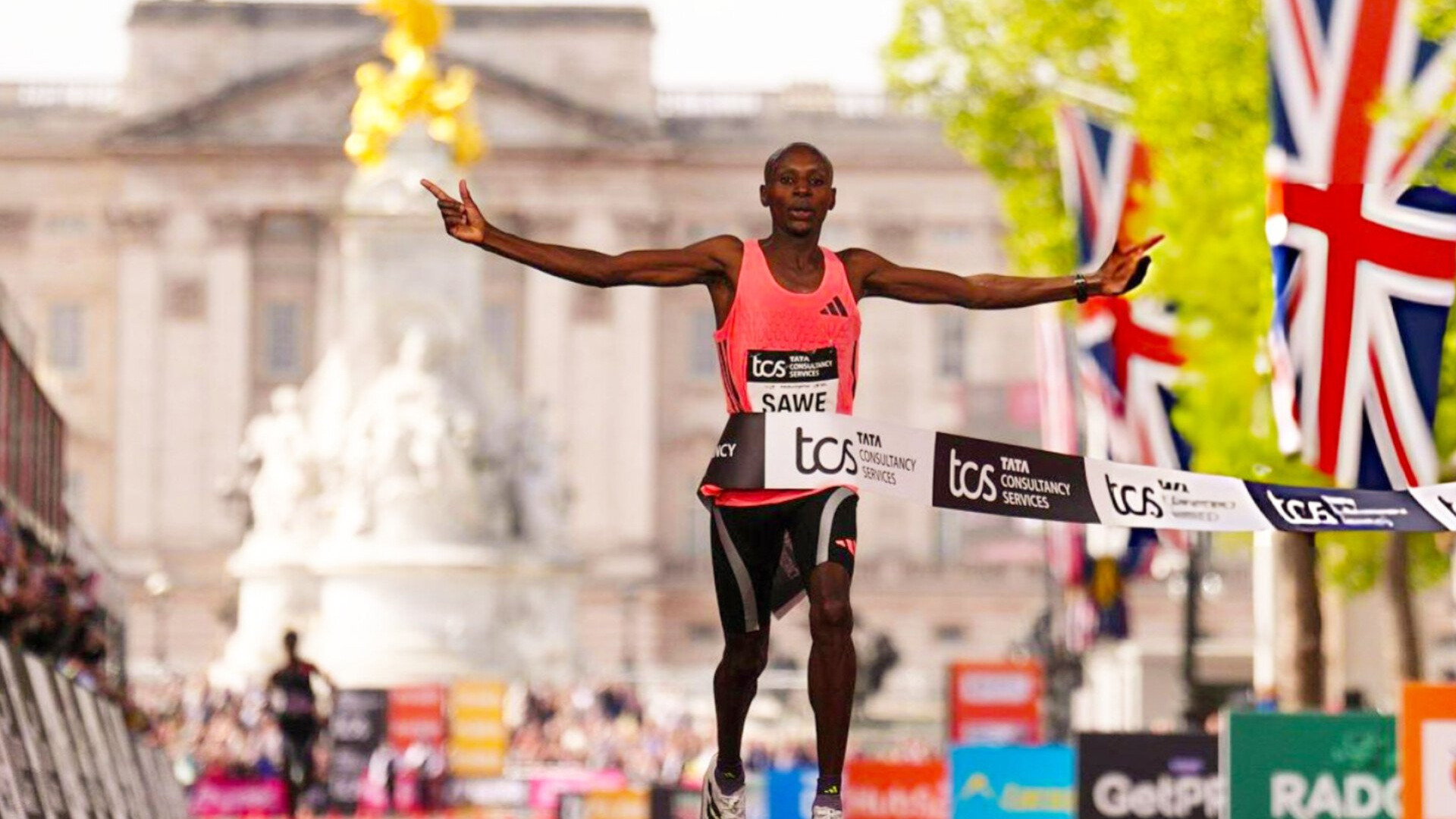
Kenya’s Sabastian Sawe shattered the marathon world record at the 2026 London Marathon on Sunday, crossing the line in 1:59:30 to become the first man in history to run 26.2 miles under two hours in an officially sanctioned race.
The feat arrived not as a formality but as a fight. Ethiopia’s Yomif Kejelcha, running his first marathon, refused to let Sawe go until less than a mile remained. Kejelcha finished in 1:59:41, the second fastest marathon ever recorded. Uganda’s Jacob Kiplimo, the reigning world cross country champion, took third in 2:00:28. All three men finished faster than the previous world record of 2:00:35, set by Kenya’s Kelvin Kiptum at the 2023 Chicago Marathon.
A barrier four decades in the making
The sub-two-hour marathon has defined long-distance running’s ambition for generations. Kenya’s Eliud Kipchoge made two formal attempts at the mark through specially organised exhibition events, in 2017 and 2019. He succeeded in Vienna in October 2019, running 1:59:40, but the conditions disqualified the performance as an official world record. Rotating teams of elite pacemakers, a laser-guided vehicle and a closed course kept the run outside World Athletics ratification rules.
Sawe’s run carries none of those qualifications. It happened on an open course, in a competitive race, against other elite athletes. History, when it arrived, arrived cleanly.
How Sawe ran the second half faster than anyone ever has
Sawe reached the halfway mark in 60:29, a controlled but measured opening. Then he accelerated. His second half clocked 59:01, the fastest second half ever recorded in a marathon. The previous best, Kiptum’s 59:45 at the 2023 London Marathon, stood for less than three years.
At the 30km mark, Sawe sat on 2:01:01 pace — world record territory, but not yet certain. What followed over the final 12.195 kilometres was something most coaches would not have scripted. He covered the stretch from 30km to 35km in 13:54, then pushed again, running 13:42 between 35km and 40km. That segment included a 4:12 24th mile, with Kejelcha still stride for stride beside him.
Sawe sealed it with a final 2.195km in 5:51, equivalent to 13:19.5 per five kilometres. Across the entire final 12.195km, he averaged 4:24.3 per mile, a pace that translates to a 1:55:30 marathon. He did not just break the record. He ran away from it.
Kejelcha and Kiplimo redefine the depth of the field
Context matters here. On any other day in marathon history, Kejelcha’s 1:59:41 and Kiplimo’s 2:00:28 would each have stood as the performance of a generation. Amos Kipruto finished fourth in 2:01:39, the sixth fastest marathon time ever recorded. The 2026 London Marathon produced four of the fastest times the sport has ever seen, in a single race, on a single morning.
Sawe speaks after making history
Speaking to the BBC immediately after the race, Sawe described the final kilometres as a test of strength and gratitude.
“I’m so happy. It’s a day to remember for me,” he said. “Approaching the end of the race, I was feeling strong, and the Ethiopian was so competitive. I think he was the one who helped a lot. And finally reaching the finishing line, I saw the time, and I was so excited to see a world record today. I think today shows that there is a time for everyone, and I am so happy.”
Full men’s results — 2026 London Marathon
| Position | Athlete | Time | Note |
|---|---|---|---|
| 1 | Sabastian Sawe (KEN) | 1:59:30 | World Record |
| 2 | Yomif Kejelcha (ETH) | 1:59:41 | 2nd fastest all time |
| 3 | Jacob Kiplimo (UGA) | 2:00:28 | 3rd fastest all time |
| 4 | Amos Kipruto (KEN) | 2:01:39 | 6th fastest all time |
| 5 | Tamirat Tola (ETH) | 2:02:59 | |
| 6 | Deresa Geleta (ETH) | 2:03:23 | |
| 7 | Addisu Gobena (ETH) | 2:05:23 | |
| 8 | Geoffrey Kamworor (KEN) | 2:05:38 | |
| 9 | Peter Lynch (GBR) | 2:06:08 | National Record |
| 10 | Mahamed Mahamed (GBR) | 2:06:14 |
