



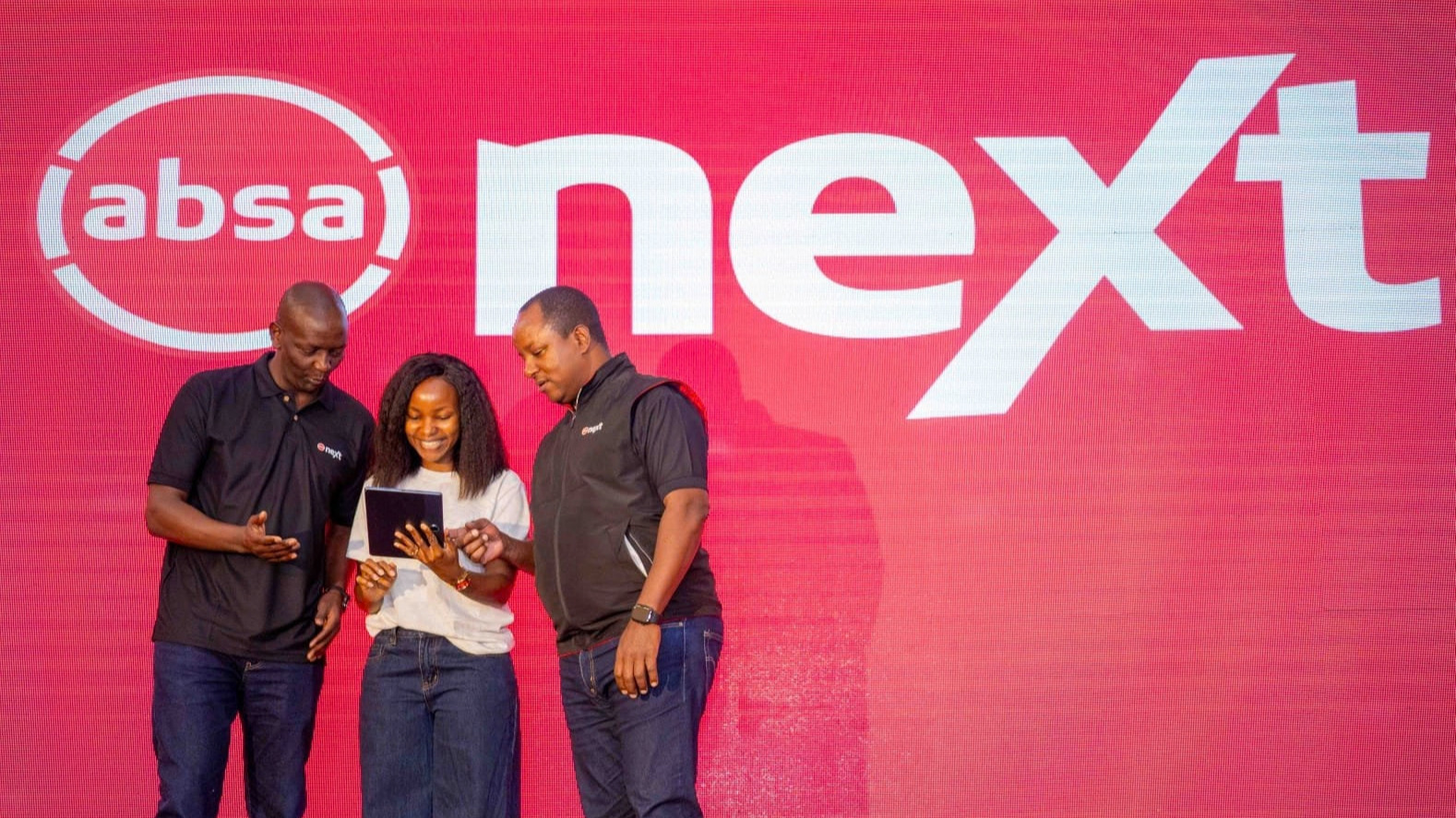
Absa Bank Kenya has launched Absa Next, a digital financial app built around everyday spending, saving and borrowing rather than the account and branch model that defines its main banking app.
The bank unveiled the product at an event in Nairobi attended by its board, its regional leadership and customers who took part in building it.
A Product Built Through Customer Testing, Not a Boardroom
Absa framed the launch as a departure from how it normally develops products. Instead of designing internally and releasing to the market, the bank says it spent close to three years running the idea past focus groups, then handed a working prototype to more than 50 customers, entrepreneurs and content creators to test and critique before release.
Absa Bank Kenya Managing Director Yusuf Omari told attendees the app reflects a shift the bank could not make alone.
“A customer does not necessarily wake up thinking about a banking product. They are thinking about paying rent, running a business or saving for something specific. We built Absa Next around that reality,” Omari said.
Absa Group Chief Executive for Personal and Private Banking, Sitoyo Lopokoiyit, said the app marks a departure from treating banking as a destination.
“We are moving away from looking at a bank as a place you go to. Absa Next is about being present in the moments that matter for our customers,” he said.
The launch sits inside a wider rebrand Absa has been rolling out across its African markets under the promise “Your Story Matters”, a push toward what the bank calls more personal, less transactional service.
What the App Actually Does
Steven Omamo, Absa’s Head of Digital Banking, walked attendees through the build. Absa Next runs on two separate wallets inside one app, a personal wallet for everyday spending and a business wallet built for small enterprise owners.
Signing up takes a phone number and a national ID, and the bank says most users finish onboarding in under two minutes. The app does not require an existing Absa account, and anyone, not just Absa customers, can download it.
| Feature | What it offers |
|---|---|
| Onboarding | Phone number and ID only, completed in under two minutes |
| Personal wallet | Send, receive, pay bills, buy airtime, split bills with friends |
| Business wallet | Named business profile, QR payments, income and expense summaries |
| Credit | Instant loans from KES 500 to KES 1 million for individuals and businesses |
| Savings | Up to 7 percent annual interest, paid monthly, with no withdrawal penalty |
| Investments | Access to unit trusts and money market funds, with returns cited up to 16 percent |
| Chama and group savings | Create or join a group, track contributions, invite members who are not on the app, exit and withdraw up to your own contribution |
| Rewards | NEXT Coins earned on transactions, tiered Silver, Gold and Platinum, with weekly and monthly cash draws |
| Card linking | Link external bank cards, including Visa, to pull funds into the app |
| Transfers within app | Free of charge |
Ziidi Explained: What Safaricom’s M-PESA Savings and Trading Suite Actually Does
Absa built the app with cloud infrastructure partner AWS and application developer Happiest Minds, using what the bank’s Chief Operating and Digital Officer, Julius Kamau, called a security-first, or DevSecOps, approach.
Chief Information Technology Officer Moses Okundi said the cloud setup allows the app to scale up or down during demand spikes, such as the shopping period around Black Friday in November.
How It Differs From Timiza
Absa already runs Timiza, a mobile wallet it launched in 2018 under the Barclays brand, built specifically around Safaricom’s M-Pesa network. Timiza requires an active M-Pesa line to register, and its main draw is short term borrowing, loans of up to KES 150,000 disbursed into the Timiza wallet rather than directly to M-Pesa, alongside a savings account called Zidisha, bill payments and insurance.
Absa Next covers similar ground on paper, borrowing, saving, bill payments, but does not require an M-Pesa subscription to sign up, and extends further into areas Timiza does not touch. It adds a dedicated business wallet with QR payments and income tracking, a structured chama feature for group savings, a tiered rewards system that converts spending into cash, unit trust and money market investment options, and the ability to link cards from other banks into a single interface.
Timiza works as a loan and mobile money companion tied to Safaricom’s network. Absa Next works as a broader financial hub that treats borrowing as one feature among several, alongside saving, investing, group finance and small business tools, open to anyone regardless of which network or bank they already use. Absa has not said whether Absa Next will eventually replace Timiza or whether the two will run side by side.
Where This Fits in Kenya’s Wallet Market
Absa Next enters a market already shaped by M-Pesa, Airtel Money and banking apps from Equity and KCB. The bank is not positioning it as a replacement for M-Pesa, which still processes the bulk of mobile money transactions in Kenya, but as a layer on top of it, one that bundles savings returns, group finance and rewards into a single app rather than spreading them across several.
Renato D’souza, Absa’s Business Banking Director, said the app targets small business owners directly, pointing to instant credit of up to KES 1 million for businesses without the wait typically associated with loan applications. Traders who tested the product ahead of launch, including a leather goods maker and a sportswear retailer in Nairobi, said faster access to working capital and clearer cash flow tracking were the features they valued most.
Absa operates across 12 African markets reaching an estimated 400 million people, and executives at the launch said Absa Next was built in Kenya with a Kenyan team, positioning it as a product the group could eventually roll out to its other markets on the continent.
