


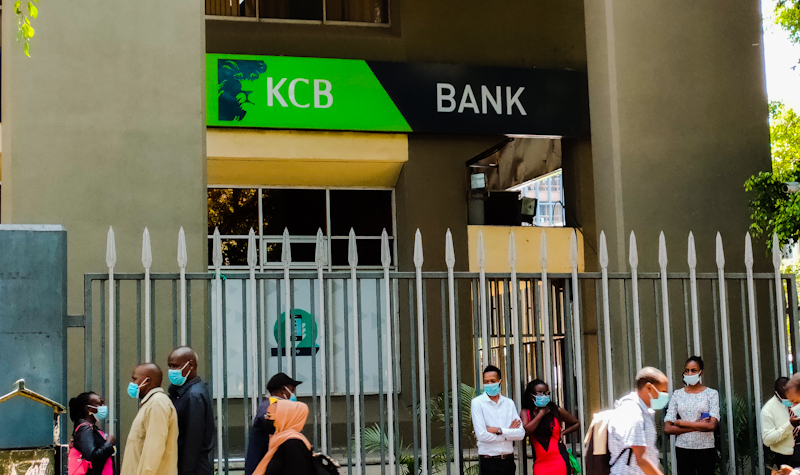
KCB Bank Kenya Limited earned Sh63.7 billion before tax in 2025. That was the highest profit among Kenyan lenders and 20.8 percent of the sector total, according to the Central Bank of Kenya (CBK) Bank Supervision Annual Report 2025.
The bank also held the biggest balance sheet, at Sh1.50 trillion, or 17.9 percent of sector assets. It grew gross loans by 18.8 percent to Sh1.01 trillion, while the sector grew lending by 6.8 percent. Asset quality remained the weak point, as gross nonperforming loans rose 9.0 percent to Sh192.8 billion.
Profit and returns run ahead of the sector
KCB Bank Kenya returned 4.3 percent on assets and 28.4 percent on equity. The sector returned 3.7 percent and 21.8 percent. Equity Bank and Absa Bank Kenya posted higher returns on equity, at 32.3 percent and 32.0 percent, on smaller profits.
Table 1: KCB Bank Kenya against the sector, December 2025
| Measure | KCB Bank Kenya | Sector |
|---|---|---|
| Profit before tax | Sh63.7 billion | Sh306.3 billion |
| Total net assets | Sh1,497.7 billion | Sh8,349.7 billion |
| Return on assets | 4.3% | 3.7% |
| Return on equity | 28.4% | 21.8% |
| Gross loans | Sh1,013.6 billion | Sh4,347.2 billion |
| Loan growth | 18.8% | 6.8% |
| Customer deposit growth | 17.3% | 11.6% |
| Gross nonperforming loans | Sh192.8 billion | Sh696.9 billion |
| Nonperforming loan ratio | 19.0% | 16.0% |
| Core capital to risk weighted assets | 17.0% | 18.2% |
| Total capital to risk weighted assets | 22.3% | 20.7% |
Source: CBK. Loan growth, customer deposit growth for KCB and the KCB nonperforming loan ratio are calculated from CBK appendix data.
A Lion Across the Region: How KCB Group Is Anchoring Financial Stability Across East Africa
Lending grows at nearly three times the sector pace
Gross loans rose from Sh853.1 billion to Sh1,013.6 billion, an increase of Sh160.5 billion. KCB Bank Kenya now holds 23.3 percent of all bank loans in Kenya.
Sector lending expanded far more slowly, and CBK reports that private sector credit growth reached 5.9 percent in December 2025 after starting the year in negative territory.
Bad loans stay above the sector average
Gross nonperforming loans climbed from Sh176.8 billion to Sh192.8 billion. The bank’s ratio of bad loans to total loans eased from 20.7 percent to 19.0 percent because lending grew faster than defaults. It still sits three percentage points above the sector ratio of 16.0 percent, and KCB Bank Kenya carries 27.7 percent of the sector’s non-performing loans.
KCB Group reported a non-performing loan ratio of 16.9 percent for 2025, down from 19.2 percent in 2024. The group ratio is lower because it includes regional subsidiaries. Khusoko reported in May 2025 that KCB Group’s first quarter profit stayed flat at Sh16.5 billion while asset quality pressures persisted.
Table 2: The five most profitable banks, December 2025
| Bank | Profit before tax (Sh billion) | Total assets (Sh billion) | Return on equity | Gross loans (Sh billion) | Nonperforming loan ratio |
|---|---|---|---|---|---|
| KCB Bank Kenya | 63.7 | 1,497.7 | 28.4% | 1,013.6 | 19.0% |
| Equity Bank Kenya | 44.0 | 1,040.6 | 32.3% | 462.5 | 18.3% |
| Co-operative Bank of Kenya | 36.1 | 759.4 | 23.9% | 440.4 | 15.7% |
| Absa Bank Kenya | 29.9 | 536.7 | 32.0% | 337.3 | 11.5% |
| NCBA Bank Kenya | 23.0 | 616.8 | 21.7% | 303.9 | 11.4% |
Source: CBK. Nonperforming loan ratios are calculated from CBK gross loan and nonperforming loan data.
Deposits and capital sit above regulatory minimums
Customer deposits rose 17.3 percent to Sh1,140.4 billion from Sh972.0 billion, against 11.6 percent growth for the sector. CBK puts the bank’s share of sector deposits at 18.0 percent. Insured deposits increased to Sh157.7 billion from Sh153.2 billion.
Core capital stood at Sh183.0 billion, or 17.0 percent of risk weighted assets against a 10.5 percent minimum. Total capital reached 22.3 percent against a 14.5 percent minimum. Both ratios are close to the sector averages of 18.2 percent and 20.7 percent.
Mortgages and agents extend the retail reach
KCB Bank Kenya held Sh102.0 billion in residential mortgages, or 33.2 percent of the market, up from Sh91.5 billion and 32.8 percent. Mortgage nonperforming loans reached Sh22.2 billion, about 21.8 percent of the book.
The bank also contracted 22,413 bank agents. Only Equity Bank, at 39,094, had more. Three banks hold more than 85 percent of the 93,341 agents in the sector. Agent transactions fell 20.2 percent to 113.5 million, and CBK links the drop to customers moving to mobile money and internet banking. KCB Group says digital platforms processed 99 percent of its total transactions.
Regional subsidiaries add branches in Tanzania and Uganda
CBK counts 239 KCB Group branches outside Kenya, up from 236, and credits new branches in Tanzania and Uganda for most of the regional increase. Staff numbers rose to 3,978 from 3,950.
KCB Bank Tanzania drove profit in Tanzania. Trust Merchant Bank in the Democratic Republic of Congo held Sh297.6 billion in assets and Sh244.4 billion in deposits.
Table 3: KCB Group subsidiaries in the region, December 2025
| Country | Branches | Employees |
|---|---|---|
| Democratic Republic of Congo | 109 | 1,833 |
| Rwanda | 73 | 930 |
| Tanzania | 18 | 339 |
| South Sudan | 16 | 246 |
| Uganda | 15 | 430 |
| Burundi | 8 | 200 |
| Total | 239 | 3,978 |
Source: CBK.
Group profit and dividend confirm the trend
At group level, KCB posted an 11 percent rise in net profit to Sh68.4 billion for 2025, and regional subsidiaries contributed 30.7 percent of profit before tax. That followed a 2024 in which Khusoko reported that after tax profit rose 64.9 percent to Sh61.8 billion, as covered in KCB Group announces 2024 full-year profit. The group sold National Bank of Kenya in May 2025, which trimmed balance sheet growth during the year.
Shareholders approved a total dividend of Sh22.5 billion for 2025 at the annual general meeting on May 21, 2026, equal to Sh7 per share. The group then reported first quarter 2026 pre tax profit of Sh24.4 billion, up 15.3 percent from Sh21.2 billion.
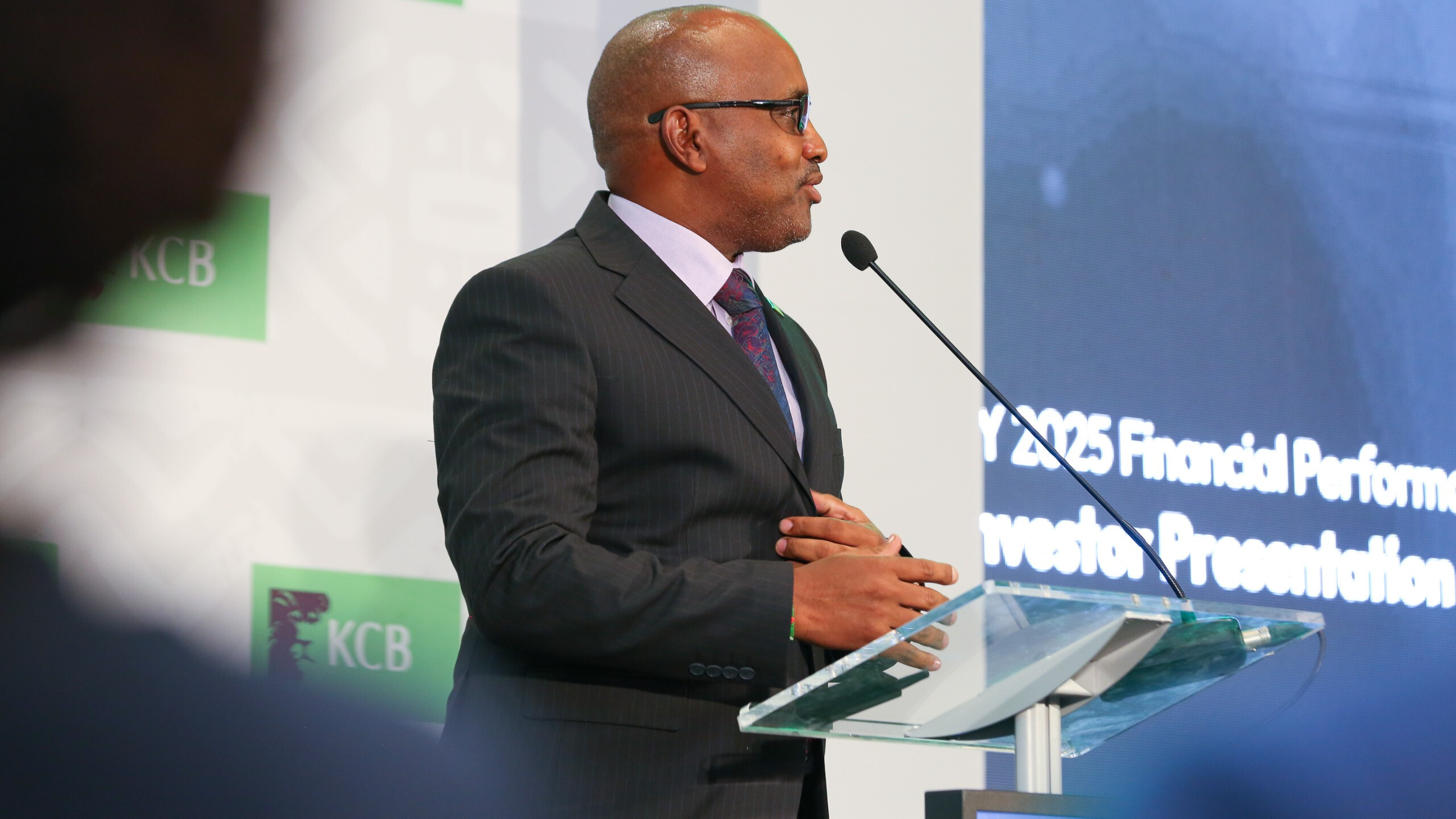
Group Chief Executive Paul Russo said the group “delivered solid growth driven by disciplined execution”. He also flagged the Middle East conflict as a risk, citing reduced credit demand, higher credit risk and lower remittance flows.
The next test for KCB Bank Kenya is credit quality. Profit and capital are secure for now, but a bad loan ratio three points above the sector will keep pressure on provisions if lending keeps growing at this pace.
