



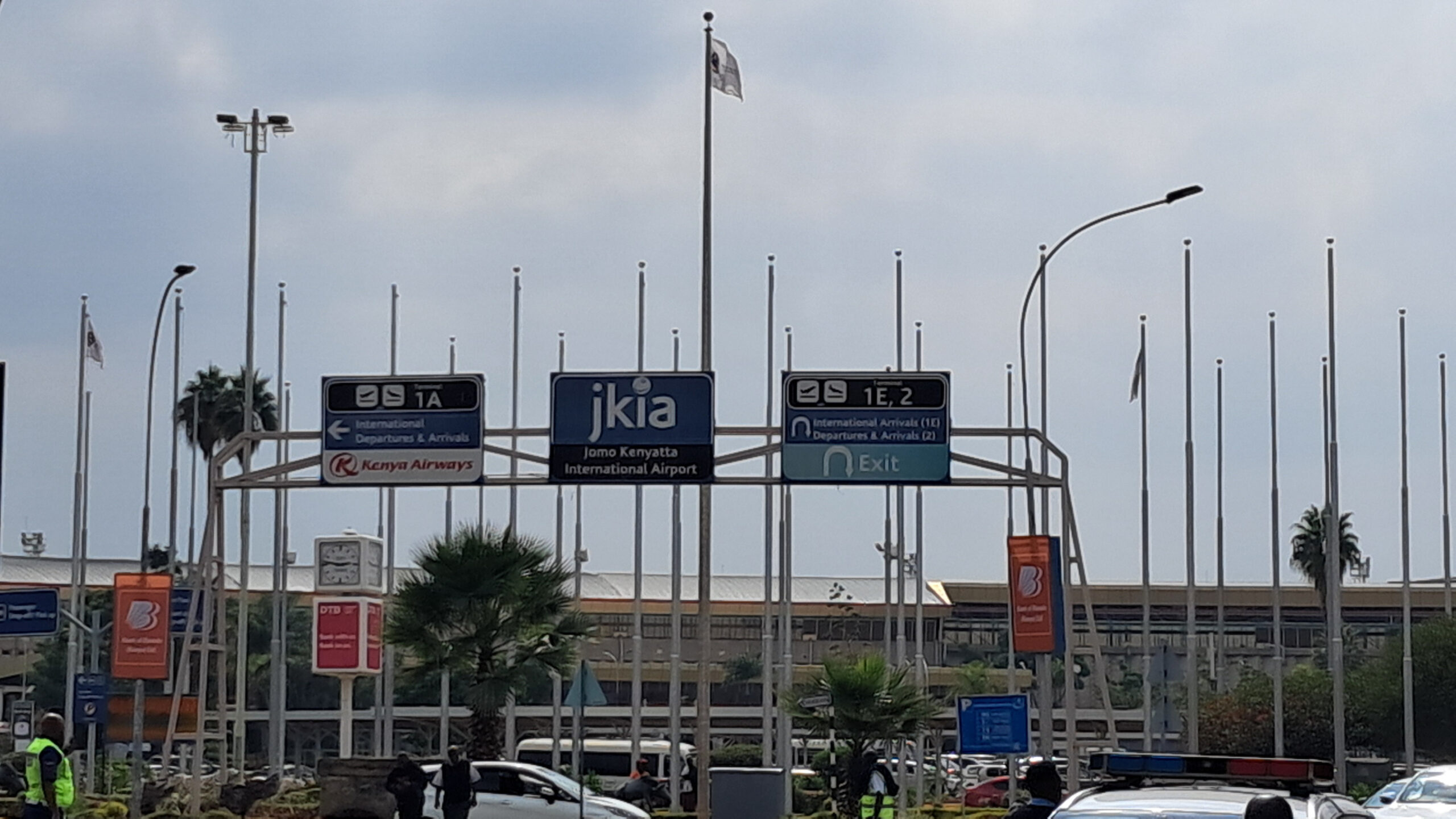
Flights at Jomo Kenyatta International Airport were delayed for hours on Sunday after staff linked to the Kenya Airports Authority and the Kenya Civil Aviation Authority began a go slow, the third labour disruption to hit Kenya’s main airport in 2026.
The go slow started late Saturday night and intensified through Sunday morning. By mid morning, flights scheduled to depart from around 8am remained on the ground.
Kenya Airways said in a customer advisory that it was experiencing delays of two to three hours on departures from JKIA. The airline attributed the disruption to air traffic control issues and did not name the go slow directly.
The Kenya Airports Authority confirmed delays in a passenger advisory issued Sunday.
“Kenya Airports Authority PLC wishes to advise passengers and other airport users that some departing flights are currently experiencing delays at our airports,” the authority said.
KAA said it was working with airlines and aviation agencies to manage the situation and advised passengers to check with their airlines before travelling to the airport.
Stuck at Kigali International Aiport for six hours now. These passengers, booked on KQ471, are stark raving mad. Many had connecting flights that they have now missed. Thought it was the usual Kenya Airways shenanigans; turns out workers at JKIA are on yet another go-slow. Baad! pic.twitter.com/F2RyhiRFZj
— Bernard Mwinzi (@BernardMwinzi) August 30, 2026
Finally boarding Jambojet flight after almost 5 hours of uncertainty sitting at the airport in Malindi on this rainy afternoon.
The Captain has apologised for the delay, explaining that it was beyond the airline’s control because of the KCAA & KAA workers go-slow, and has warned… https://t.co/nHzDEl34sE pic.twitter.com/psIoPeqwZz
— 𝗗𝗿 𝗔𝗵𝗺𝗲𝗱 𝗞𝗮𝗹𝗲𝗯𝗶, 𝕆𝔾𝕎 (@DrAhmedKalebi) August 30, 2026
Flight Cancellation Notice
Due to ongoing air traffic control challenges at Jomo Kenyatta International Airport (NBO), flights WB402/WB403/30 August 2026 have been cancelled.
Affected passengers will be rebooked on the next available flight, and our team is working to minimize…
— RwandAir (@FlyRwandAir) August 30, 2026
Background
The Kenya Aviation Workers Union has cited a failure by the government to honour a memorandum of understanding reached after earlier disputes this year.
A two day strike in February disrupted JKIA before a return to work formula was signed under Transport Cabinet Secretary Davies Chirchir. That agreement provided for the unionisation of employees in grades four and five, compliance with outstanding court orders and protection of workers from victimisation.
In March, KAWU accused the Kenya Civil Aviation Authority of breaching that agreement. KAWU Secretary General Moss Ndiema said at the time that the authority was not respecting the deal.
“KCAA doesn’t seem ready to recognise the rule of law like any other corporate body in this country,” Ndiema said.
The union issued a fresh seven day strike notice on July 17, covering employees at the Kenya Civil Aviation Authority, the Kenya Airports Authority, Kenya Airways and Jambojet. The notice cited a plan to deploy 720 additional National Youth Service officers across the country’s airports, which the union said threatened the jobs of trained aviation staff. The union also demanded the withdrawal of NYS and Kenya Defence Forces personnel stationed at the JKIA fire station and the reinstatement of four dismissed employees.
KAWU and the four employers signed a framework agreement on July 27 that suspended the strike notice and opened further negotiations.
Government Response
Government officials, KAA, KCAA and union representatives were expected to meet Sunday to address the current disruption, following the pattern of previous rounds of talks in February and July.
During the February strike, the Kenya Airline Pilots Association warned that flight duty and crew rest limits needed to be maintained regardless of operational pressure.
“These regulatory safeguards exist to mitigate fatigue and ensure that flight operations are conducted within internationally accepted safety parameters,” said KALPA General Secretary Captain Murithi Nyagah at the time.
Passenger Numbers at Stake
Kenya National Bureau of Statistics data shows the scale of traffic that runs through JKIA on any given day. Commercial air passenger traffic across Kenya reached 12.83 million in 2024, up 5.1 percent from the previous year, according to the KNBS Economic Survey 2025. International passengers accounted for 7.28 million of that total, a 9.6 percent increase, while domestic passenger numbers held steady at 5.32 million.
JKIA alone handled about 8.6 million passengers in 2025, according to the Kenya Airports Authority, well above the airport’s design capacity of 7.5 million.
KNBS monthly data shows passenger volumes running well into six figures each month even before accounting for wider disruption. Its Leading Economic Indicators report for March 2026 recorded 231,598 passengers departing through JKIA that month and 227,974 arriving, alongside 123,682 visitor arrivals through the airport. Visitor arrivals through JKIA, Moi International Airport and other border points combined stood at 193,176 in March, down from 216,738 in February, a decline KNBS attributed in part to seasonal travel patterns.
Those figures translate into an average of roughly 7,000 to 8,000 passengers departing JKIA each day, meaning even a single day of hours long delays can affect thousands of travellers.
Wider Context
The disruption is the latest in a series of incidents affecting JKIA this year. Heavy rain and fog disrupted flights in March and April. A cargo plane aborted takeoff and shut the runway in July. Passenger volumes overwhelmed immigration queues on August 17. A passenger aircraft crash landed at Wilson Airport in May, though no serious injuries were reported.
Kenya Airways has spent much of 2026 restoring capacity after grounding several aircraft for engine and maintenance issues, and the airline has not said whether Sunday’s delays will affect its wider schedule.
The disruption falls during the tail end of Kenya’s peak tourist season, when JKIA and Mombasa’s Moi International Airport carry high volumes of international visitors connecting to coastal and safari destinations.
KAA did not provide a timeline for when normal operations would resume.
