


Equity Group Holdings built its reputation as Kenya’s largest bank. Its half year 2026 results tell a different story. The regional subsidiaries in the Democratic Republic of Congo, Rwanda, Uganda, Tanzania and South Sudan now generate 52% of the Group’s assets, 54% of its loans and 47% of its profit before tax.
Kenya still leads, but the gap is closing fast, and the country doing the most closing is the DRC.
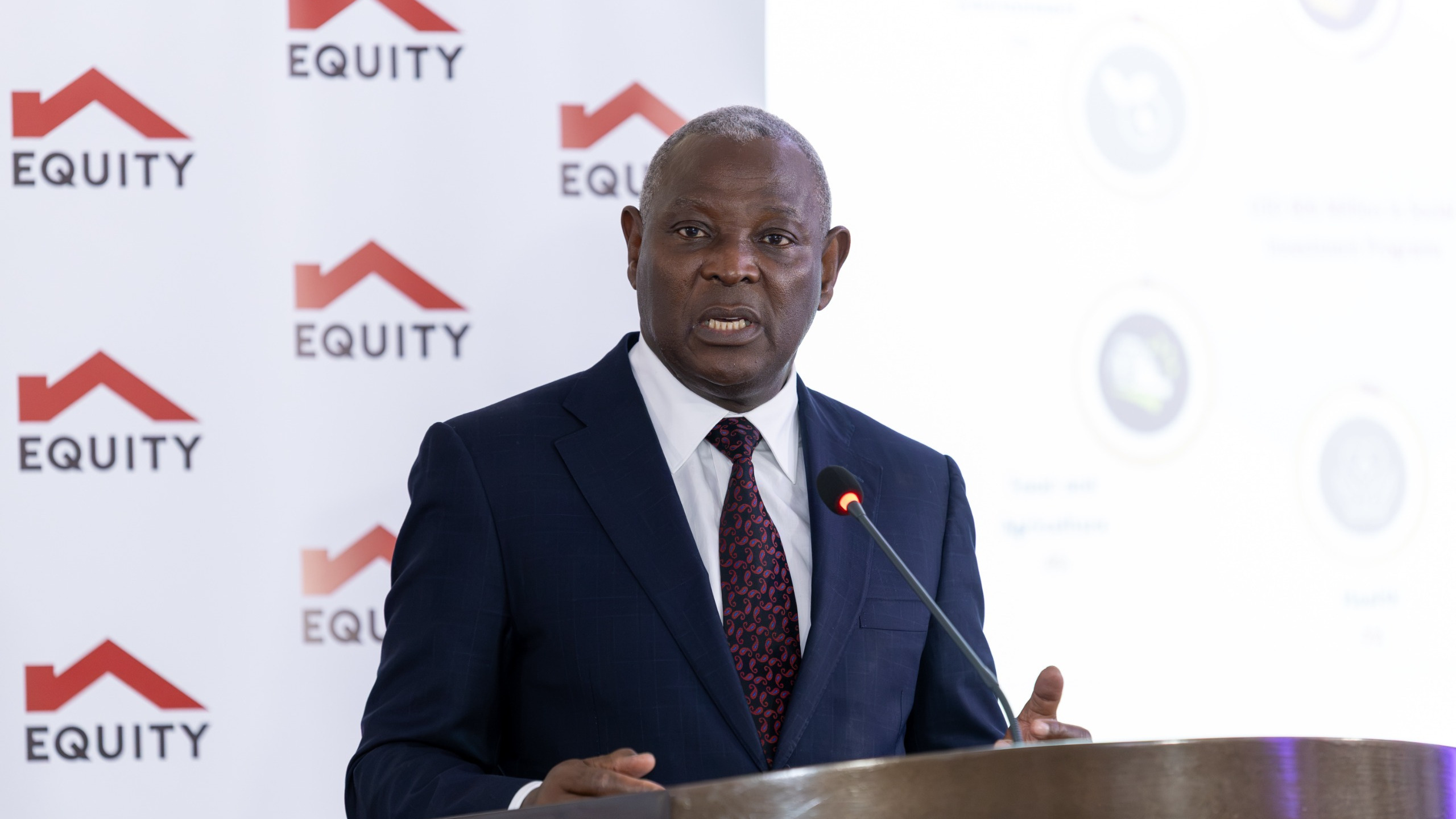
Group Managing Director and CEO Dr. James Mwangi framed it plainly during the investor briefing in Nairobi this week:
“We can see now the race between Kenya and DRC in terms of deposits. Kenya is at KES 900 billion and DRC is at KES 700 billion, but it is the growth of deposits, DRC is growing at 46%, Kenya at 24%.”
For an audience that spans Nairobi, Kampala and Dar es Salaam, that single line matters more than any headline profit number. It signals where the region’s biggest cross border bank is placing its bets, and where the next wave of trade finance, agency banking and small business lending is likely to land.
Kenya versus DRC: the numbers behind the race
Equity built EquityBCDC into its second largest banking subsidiary after acquiring a majority stake in 2020. Five years on, DRC deposits, loans and assets are all expanding at roughly double or triple the pace of Kenya, even though Kenya remains larger and considerably more profitable per shilling of capital deployed.
| Metric (year on year growth, H1 2026) | Kenya | DRC |
|---|---|---|
| Deposit growth | 24% | 46% |
| Loan growth | 8% | 30% |
| Asset growth | 13% | 45% |
| Revenue growth | 23% | 30% |
| Profit before tax growth | 48% | 35% |
| Profit after tax growth | 32% | 30% |
| Return on equity | 35% | 22% |
| Return on assets | 4.8% | 3.2% |
Mwangi’s read on the gap is that Kenya has chosen an efficiency path rather than an aggressive balance sheet expansion, while DRC is still converting a rapidly growing book into returns. “Return on equity Kenya at 35 and DLC at 22, return on asset Kenya at 4.8 and DLC at 3.2, and that is where management’s focus is. How do we make DRC a replica of Kenya?” he told shareholders and analysts.
EquityBCDC Managing Director Willy Mulamba pushed back gently on the framing of a contest. “Our objective is not so much on beating Kenya, but how we provide value to the DRC market so we can deliver on our vision,” he said, pointing to the country’s mineral wealth, still low GDP per capita, and the opportunity to bring more of the population into formal banking. He added that DRC is “well positioned to beat Kenya in three years,” while stressing that closing that gap is not the priority.
The Group is no longer a Kenyan bank with branches abroad
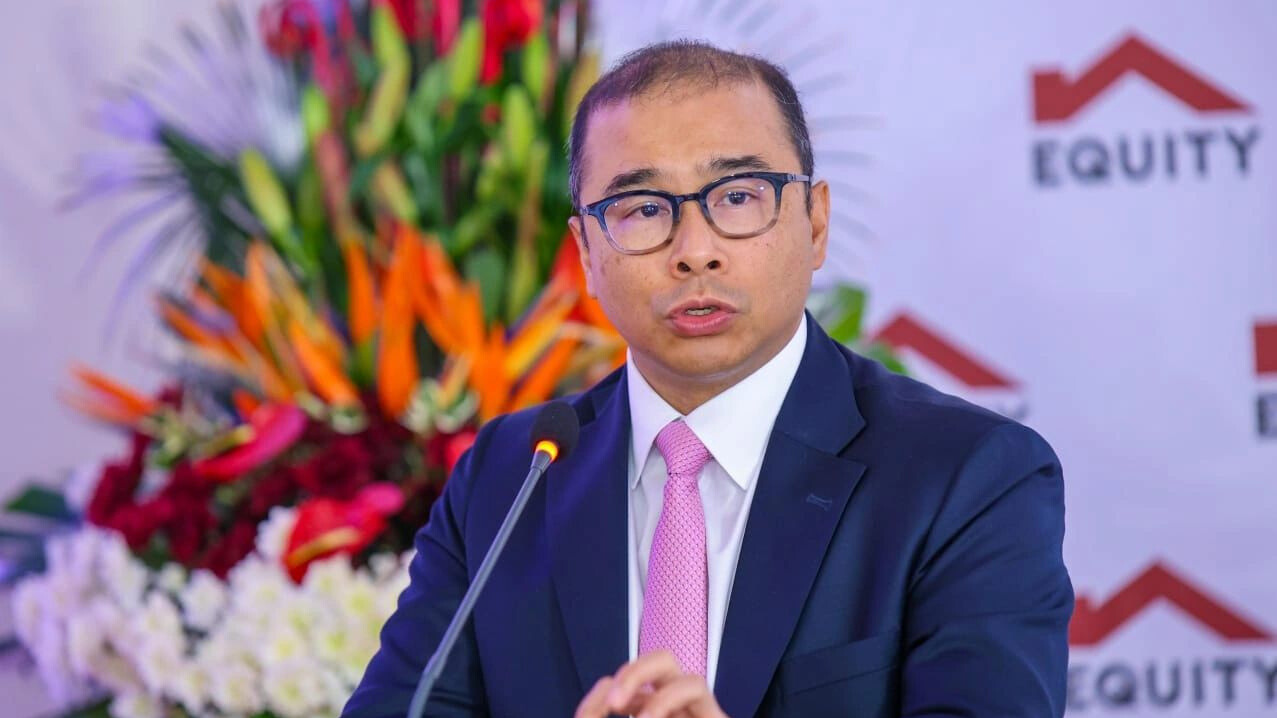
Group Director of Strategy Brent Malahay used the results call to make a structural point that matters for anyone tracking the region rather than a single market: Equity’s business outside Kenya now contributes 49% of profit and 53% of the balance sheet, a shift he said reflects geographic, product and business line diversification rather than a one off swing.
| Contribution to Group totals, H1 2026 | Kenya | Regional subsidiaries |
|---|---|---|
| Customer deposits | 49% | 51% |
| Loan book | 46% | 54% |
| Total assets | 48% | 52% |
| Revenue | 50% | 50% |
| Profit before tax | 53% | 47% |
Rwanda and Tanzania add further texture to that balance. Rwanda’s construction and real estate boom, tied partly to new airport development, pushed regional GDP growth close to 12% in parts of the past year according to Charlie Robertson, head of macro strategy at FIM Partners and Equity Group’s external economic adviser.
Tanzania is opening its local debt market to foreign investors and weighing a debut Eurobond, a reform push Robertson called “quite an exciting story coming out of Tanzania right now.”
Uganda’s oil production, due to start within months, is projected to deliver per capita oil exports similar to Nigeria’s, feeding an expected 10% calendar year growth rate next year.
South Sudan, the hardest market to read given thin data, is also contributing. Robertson noted that oil exports there had doubled over the past year to roughly 187,000 barrels a day.
East Africa rated above Nigeria, Egypt and South Africa
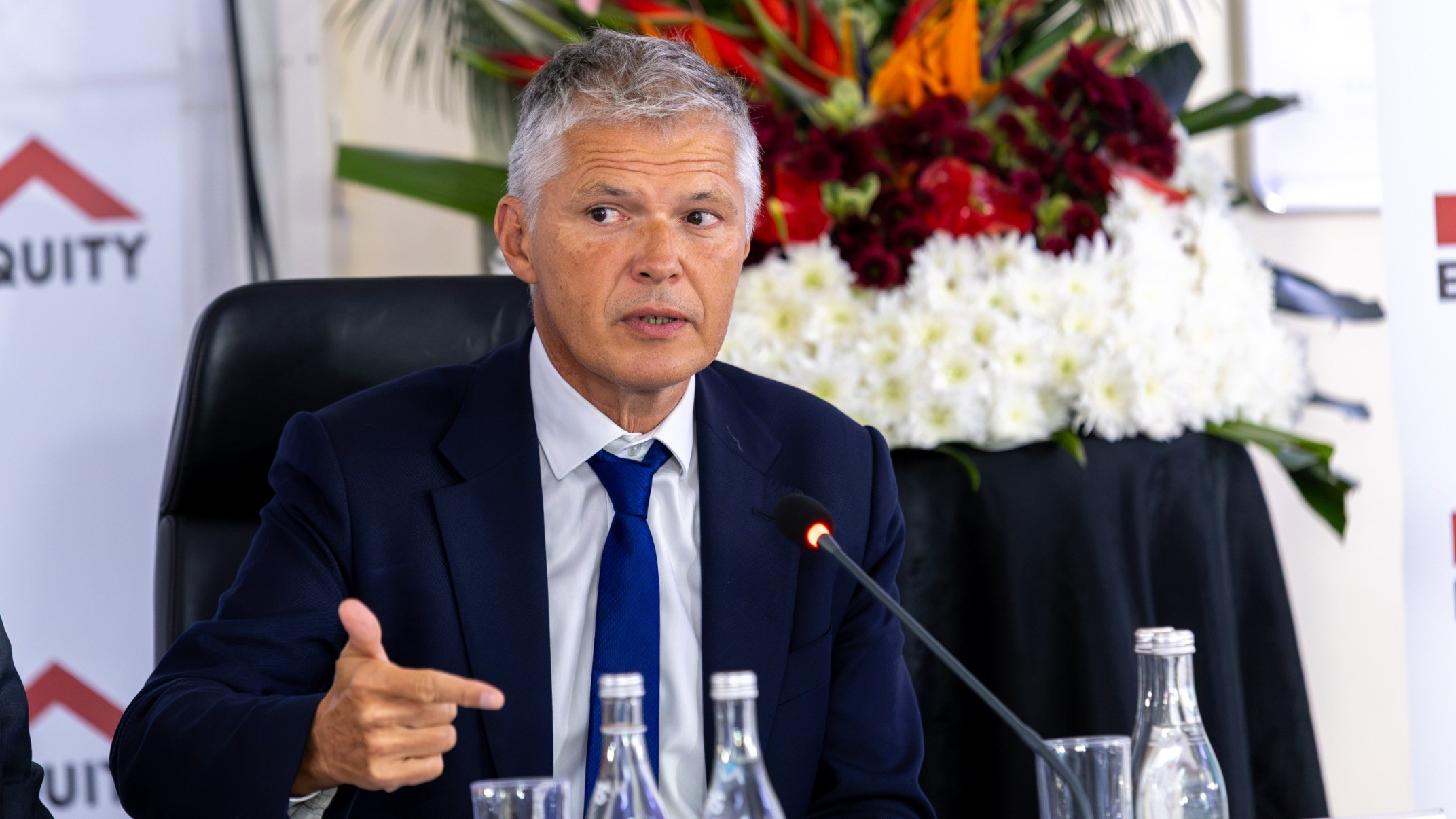
Robertson, the economist behind The Fastest Billion and The Time Travelling Economist, used his slot on the investor call to make a case that goes well beyond Equity Group itself. Where the Group operates, he said, each country is growing faster than the continent’s three most talked about economies.
“Every single one of our countries, Equity Group Holding countries, is growing faster than Nigeria and Egypt and South Africa. Every single one. Minimum growth is 5%,” he told the room, adding that most of the bloc is also posting single digit inflation and holding currencies stable, a combination he called rare given the oil price shocks of the past year.
He walked through what is driving that resilience market by market:
- DRC: Copper prices near USD 14,000 a tonne are pulling in export dollars, stabilising the currency and letting the central bank cut its policy rate from 25% to 12.5% over the past year.
- Kenya: Bank lending swung from negative growth at the start of 2025 to double digit growth today, helped by rate cuts that ran through February this year, alongside FX reserves that have doubled to USD 15 billion in two years.
- Uganda: New oil production expected within months should push per capita oil exports toward Nigeria’s level and support roughly 10% calendar year growth next year.
- Rwanda: Construction and real estate, linked to new airport development, drove growth close to 12% in the third quarter of last year and were still running near 10% in the first quarter of this year.
- Tanzania: Reforms opening the local debt market to foreign investors, talk of a debut Eurobond, and plans to open the electricity transmission market to competition.
- South Sudan: Thin on data but oil exports have doubled over the past year to about 187,000 barrels a day.
Robertson also pointed to how capital markets are already pricing that resilience. DRC issued its first ever Eurobond during a brief lull in fighting around the Strait of Hormuz this year, and its bonds now yield about 8.4% in dollars, a level he called “pretty remarkable for a country that’s never issued before.” Kenya’s yields sit close behind at roughly 8.5%.
“Markets have been quite benign towards East Africa,” he said, “and that’s because the economic performance has been impressively good given the challenges that the region has been having to confront.”
The three ingredients Robertson says separate a Southeast Asia style takeoff from a false start
Asked by Mwangi to compare the region’s trajectory with Southeast Asia’s over the past three decades, Robertson set out a framework drawn from thirty years of covering frontier and emerging markets. Three conditions have to line up together, he argued, not just one:
- Adult literacy of 70 to 80%. This is the threshold that lets workers move out of subsistence farming into manufacturing. He recalled a conversation with a former Levi’s factory manager in the Philippines and Sri Lanka, who explained that reading and writing mattered on the production line because workers had to sort finished jeans by export destination. “You’ve got to be able to read those words,” Robertson said. “It makes the difference.”
- Cheap, reliable, plentiful power. This is still the weak link across much of the region, he said, and it is a function of interest rates, which are themselves a function of demographics. Bring interest rates down and power gets cheaper, which then unlocks industrial investment.
- Favourable demographic structure. The combination of lower fertility and a growing working age population is what eventually pulls interest rates down and completes the cycle.
His verdict on timing was specific rather than vague: “Where we are today in say Kenya is like Philippines was probably in the 1990s, 1980s, 1990s. We’re nearly there.” He expects Kenya to lead an industrialisation wave in the 2030s, with Rwanda and Uganda following close behind as all three metrics, demographics, education and power, come into alignment over the next ten to fifteen years.
Why this matters beyond bank shareholders
Equity’s shift is not only an investor story. Non funded income, the fees earned from trade finance, digital transactions and loan appraisals rather than interest, grew 36% and now makes up 45% of Group revenue. Management expects that share to approach 50% within a year.
Much of that growth is being driven by cross border trade, the kind that matters directly to importers, exporters and small manufacturers moving goods between Nairobi, Kampala, Dar es Salaam, Kigali and Kinshasa.
Equity has also set an internal target of drawing 65% of its business from micro, small and medium enterprises, a category that includes the traders, transporters and manufacturers who rarely make it into bank earnings calls but who account for most formal employment in the region. Brent Malahay linked that target directly to demographic and consumption trends across the bloc, describing mass market banking as “a big opportunity for a business like ours.”
The Group is also building an asset management arm, newly licensed and in the setup phase, aimed at giving retail customers an alternative to bank savings accounts. Its bancassurance and standalone insurance business, still a small share of Group profit, is compounding fast: return on equity of 37% and return on assets of 4.6%, both ahead of the banking business, with gross premiums up 24% and profit up 34%.
For students and young professionals across the three markets, the Group’s scholarship and leadership program is worth noting too. Management said it has funded roughly USD 800 million in social investment, put 33,000 scholars through university, and placed 246 students in institutions including Harvard, Princeton, Yale and the University of Pennsylvania, with Rwanda and other regional markets increasingly represented in that pipeline.
What could slow the momentum
None of this comes without risk. DRC’s growth is unfolding in a market with limited comparable data and real security and governance constraints. Robertson himself, describing his job half jokingly as “chief anxiety officer” and half as “chief opportunity advisor,” pointed to oil price volatility, US thirty year bond yields and geopolitical shocks around the Strait of Hormuz as live risks for the whole region. His comparison point was telling: when the Hormuz oil shock first hit, global investors expected oil importing countries to suffer. Pakistan had to hike rates.
Kenya and Uganda did not, and both held on to single digit inflation and stable currencies through the shock, which is part of why he remains confident in the region’s medium term trajectory even as near term volatility persists.
Group asset quality, at least, is moving in the right direction. Non performing loans fell from 13.7% at the end of 2025 to 9.5% at the half year, with management targeting mid single digits by year end. Capital buffers remain wide, with core capital to risk weighted assets at 17.3% and total capital at 17.5%, giving the Group room to keep funding loan growth in DRC, Uganda and Tanzania without raising fresh equity.
The bigger picture
Equity Group’s H1 2026 results, covered in detail by Khusoko’s earlier report on the numbers, showed profit after tax up 32% to KES 45.5 billion.
What that report’s balance sheet and income statement breakdown does not fully capture is the geographic rebalancing underway inside those totals. Kenya is still the anchor and the most efficient market in the Group. But DRC, Rwanda, Uganda and Tanzania are no longer junior partners bolted onto a Kenyan bank.
They are becoming co-authors of Equity’s growth story, and for SMEs, cross border traders and students following the region’s biggest financial institution, that shift, not the topline profit number, is the number worth watching over the next three years.
