


Equity Group Holdings grew profit after tax 32% to KES 45.5 billion in the first half of 2026, up from KES 34.6 billion a year earlier. Profit before tax rose faster still, climbing 39% to KES 57.8 billion, while earnings per share matched the pace, gaining 32% to KES 11.61.
The numbers extend a run that started earlier in the year. Profit after tax rose 24% to KES 19.1 billion in the first quarter, and the Group closed 2025 with a 55% jump in profit for the year to KES 75.5 billion. Six months into 2026, growth has not slowed. It has spread across more of the business.
Fee income now carries more weight than lending
Net interest income grew 17% to KES 69.3 billion. Interest income rose 8% to KES 91.2 billion, but a 12% drop in interest expense to KES 21.9 billion did just as much to lift the number. The Group is managing its funding costs more tightly than it did a year ago.
Income outside lending moved even more. Fees, commissions and other income jumped 36% to KES 55.6 billion, pushing total income up 25% to KES 124.9 billion. Lending still matters, but Equity now draws more of its money from transactions, trade finance and digital banking than from interest alone.
Costs rose, but profit outpaced them
Total costs rose 14% to KES 67.1 billion, driven mainly by a 35% jump in staff costs to KES 23.8 billion. Staffing a network that keeps expanding across the region costs money, yet profit before tax still grew faster than income, so the cost increase has not eaten into margins.
Credit quality improved at the same time. Loan loss provisions fell 6% to KES 6.5 billion even as the loan book grew, evidence that the pace of lending has not come at the expense of underwriting standards.
Deposits, not borrowing, funded the balance sheet
Total assets grew 20% to KES 2.16 trillion. Net loans rose 19% to KES 981 billion and government securities climbed 19% to KES 643.2 billion. Customer deposits grew 21% to KES 1.59 trillion, and that growth did the work: borrowed funds fell 23% to KES 88 billion, meaning the balance sheet expanded largely on customer trust rather than wholesale debt. Shareholders’ funds rose 27% to KES 350.3 billion, adding cushion to the capital base.
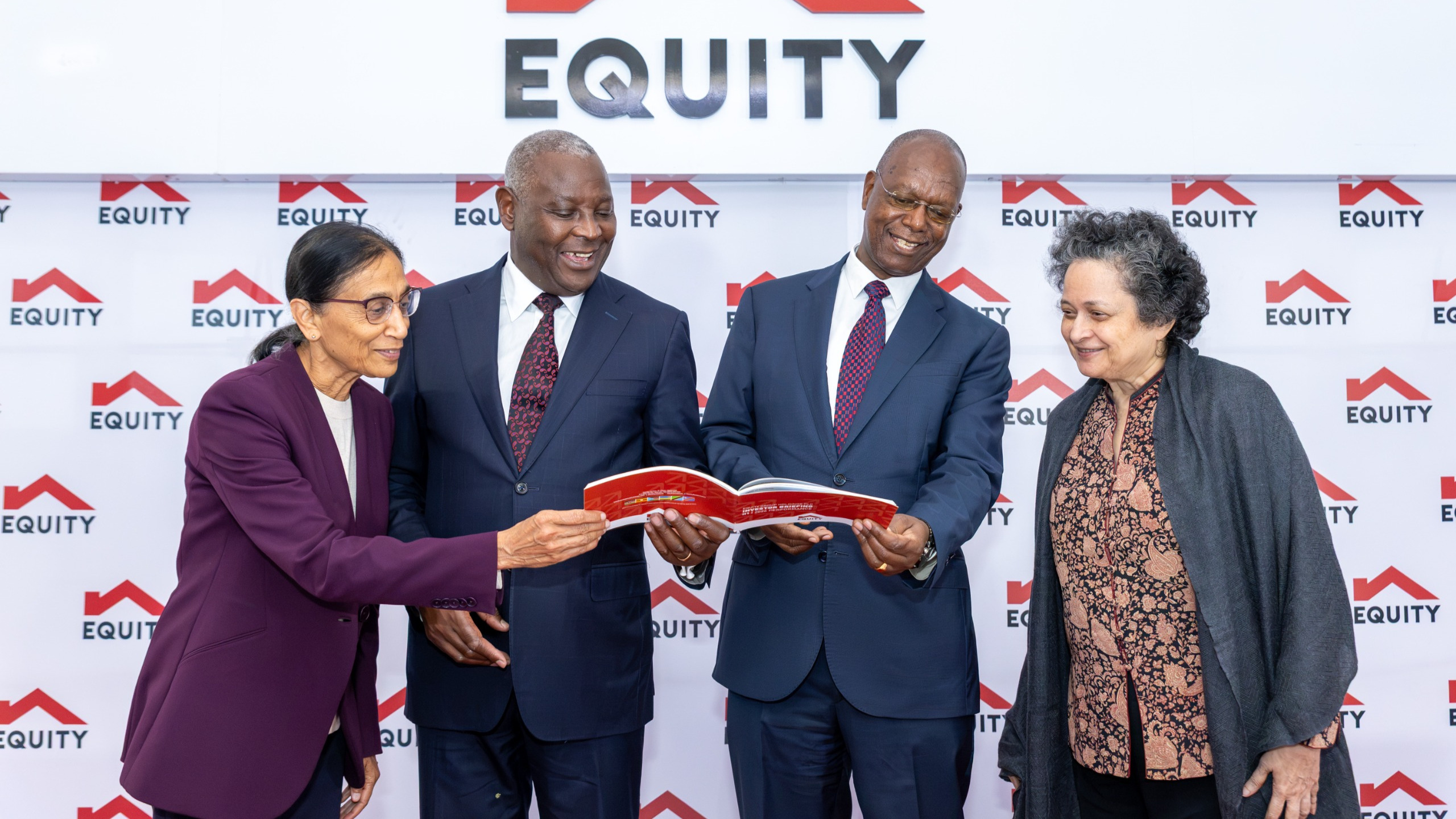
Group CEO James Mwangi put the scale of that growth in plain terms: “So, if you look at the expansion from last year, it is from KES 1.8T to almost KES 2.2T. It is nearly KES 400B being built in one year. That is a Tier 1 bank being built in that momentum.”
Regional units now shape group performance
Subsidiaries outside Kenya accounted for 52% of banking assets, 54% of loans, 51% of deposits and 47% of profit before tax in the half. Regional assets grew 36% year on year to KES 1.25 trillion, loans rose 30% to KES 533.7 billion, and profit before tax jumped 42% to KES 26.2 billion.
The Democratic Republic of Congo remained the top regional earnings contributor, with EquityBCDC posting KES 11.8 billion in profit after tax, up 30%. Rwanda followed at KES 2.9 billion, up 12%, and Tanzania posted the biggest percentage gain in the group, with profit after tax up 82% to KES 2 billion.
Kenya still leads on returns. Equity Bank Kenya posted a return on average equity of 34.7%, versus 22.6% across the regional subsidiaries combined. Scale abroad has not yet caught up with the returns the Group generates at home.
H1 2026 results at a glance
| Metric | H1 2025 | H1 2026 | Change |
|---|---|---|---|
| Total assets | KES 1,798.9B | KES 2,155.5B | +20% |
| Net loans | KES 825.1B | KES 981.0B | +19% |
| Customer deposits | KES 1,309.3B | KES 1,589.4B | +21% |
| Borrowed funds | KES 113.6B | KES 88.0B | -23% |
| Shareholders’ funds | KES 276.1B | KES 350.3B | +27% |
| Net interest income | KES 59.3B | KES 69.3B | +17% |
| Fee and other income | KES 40.9B | KES 55.6B | +36% |
| Total income | KES 100.2B | KES 124.9B | +25% |
| Total costs | KES 58.7B | KES 67.1B | +14% |
| Profit before tax | KES 41.5B | KES 57.8B | +39% |
| Profit after tax | KES 34.6B | KES 45.5B | +32% |
| Earnings per share | KES 8.82 | KES 11.61 | +32% |
The bottom line
Every major line item moved in the same direction this half: lending, fees, deposits, costs and credit quality all improved together. Equity Group is proving it can grow across markets and business lines without loosening its grip on risk, and that combination puts this half among the region’s best banking results this year.
