



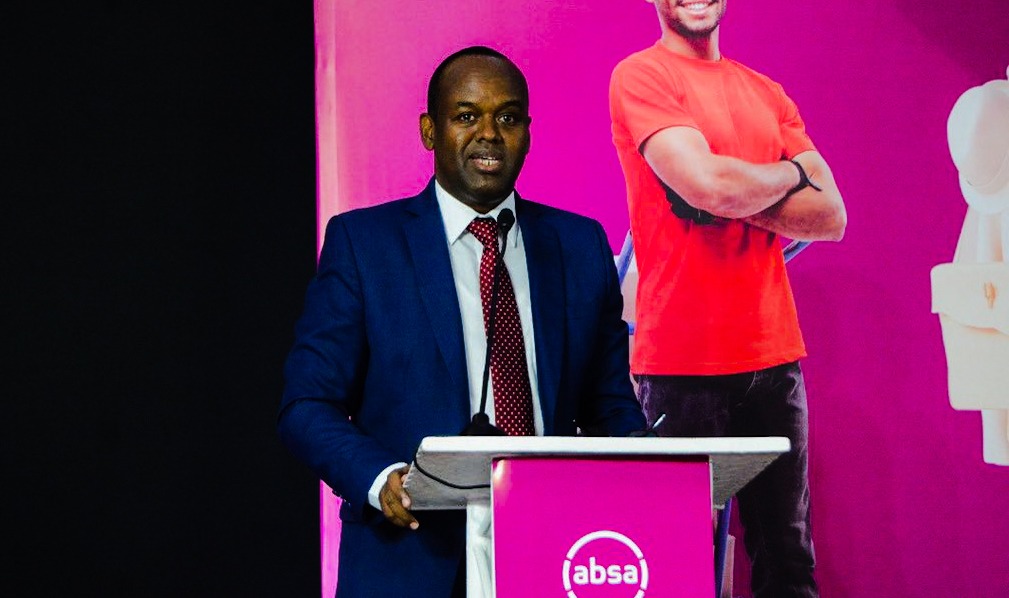
Abdi Mohamed has stepped down as Chief Executive Officer and Managing Director of Absa Bank Kenya, ending a three-year stint that saw the lender post consistent profit growth and deepen its digital transformation, even as macroeconomic headwinds tested the broader sector in his final months.
The Business Daily first reported the departure. Sources familiar with the matter indicate that Mohamed is set to take up a senior leadership role at another bank within the Kenyan market, with his name linked to regional lender I&M Bank — although that appointment had not been officially confirmed at the time of writing. Absa Bank Kenya had not made a public statement on the transition.
Long-serving Chief Financial Officer Yusuf Omari is expected to serve in an acting capacity at the helm, a role he also held in October 2022 following the exit of then-CEO Jeremy Awori, who went on to lead Ecobank Transnational.

From Garissa to the Corner Office
Mohamed’s banking story begins not in a boardroom but in a small branch in Garissa, where he started his career with the institution in 1994 — then Barclays Bank of Kenya. Over three decades, he rose through roles in Kenya, Zambia, Tanzania, and London, building a reputation as a numbers-driven, operationally precise executive with a flair for brand transformation.
He arrived at Absa Bank Kenya’s top seat on 1 May 2023, having most recently led Absa Bank Tanzania — where he oversaw the successful rebrand from Barclays and served as acting Managing Executive for Retail and Business Banking across Absa’s Africa Regional Operations.
His appointment was seen as a signal of continuity: an insider who understood the institution’s culture and its ongoing transformation from a colonial-era brand into a distinctly African financial services group.
The Numbers: A Tenure of Growth
The financial scorecard under Mohamed’s watch is broadly positive, particularly through 2023 and 2024.
In the first half of 2023 — his debut period as CEO — Absa Bank Kenya posted a 32 per cent year-on-year increase in profit after tax to KSh 8.3 billion, with revenue rising 31 per cent to KSh 27.4 billion. Customer assets grew 22 per cent and deposits rose 18 per cent, signalling early confidence in the new leadership.
By the close of 2023, full-year profit after tax stood at KSh 16.4 billion.
The following year delivered the standout performance of his tenure. Full-year profit after tax for 2024 climbed to KSh 20.9 billion — a KSh 4.5 billion improvement — driven by a 15 per cent expansion in net interest income to KSh 46.2 billion and 11 per cent growth in non-interest income to KSh 16.1 billion. Customer deposits reached KSh 367 billion.
In 2025, the bank maintained momentum despite a more challenging macro environment. Nine-month profit after tax grew 15 per cent year-on-year to KSh 16.9 billion, with total assets expanding 14.5 per cent to KSh 554.3 billion. Full-year results confirmed a 10 per cent rise in profit after tax to KSh 22.9 billion, with total assets at KSh 537.6 billion, return on equity holding at 22.8 per cent, and a cost-to-income ratio of 37 per cent — among the most efficient in the sector. The bank disbursed KSh 48.8 billion to SMEs, women, and youth enterprises during the year, while 94 per cent of transactions were conducted outside branches.
The board approved a total dividend per share of KSh 2.05 for 2025 — a 17 per cent increase on the prior year.

A Difficult Final Quarter
The closing chapter of Mohamed’s tenure was less smooth. In the first quarter of 2026, Absa Bank Kenya’s profit after tax contracted 13.9 per cent to KSh 5.3 billion, with net interest income declining 7.9 per cent to KSh 10.4 billion and non-interest income falling 5.2 per cent to KSh 4.3 billion. The bank attributed the softness to a complex operating environment and tighter lending conditions.
Asset quality, however, showed improvement — the non-performing loan ratio eased to 11.6 per cent from 13.1 per cent in the same period in 2025, pointing to more disciplined credit risk management.
Digital Transformation and ESG
Beyond profit lines, Mohamed’s tenure was defined by a sustained push on digital infrastructure and sustainability. The bank grew its agency banking network from under 1,000 outlets to more than 8,000 by end-2025, dramatically extending reach into underserved communities. Assets under management grew 53 per cent to KSh 46 billion. Absa Kenya ranked first in bancassurance profitability and second in foreign exchange income market share.
On sustainability, the bank channelled KSh 6.5 billion in climate-related financing in 2025 and was among the first Kenyan lenders to adopt IFRS S1 and S2 sustainability reporting standards. Mohamed was a visible champion of green finance, positioning Absa Kenya as a participant in the continent’s growing climate capital conversation.
A Sector in Transition
Mohamed’s exit is part of a broader reshaping of Kenya’s banking leadership. Since January 2026 alone, Family Bank, Commercial International Bank Kenya, Stanbic Bank Kenya, Standard Chartered Bank Kenya, and Sidian Bank have all seen CEO changes. The sector is navigating rising capital requirements from the Central Bank of Kenya, competitive pressure from fintech, and a tightening interest rate environment.
At Absa Group level, the parent company is in the midst of a KSh 31 billion offer to raise its stake in the Kenyan unit from 68.5 per cent to 85 per cent — a move that signals confidence in Kenya’s long-term growth trajectory even as the corner office changes hands.
