



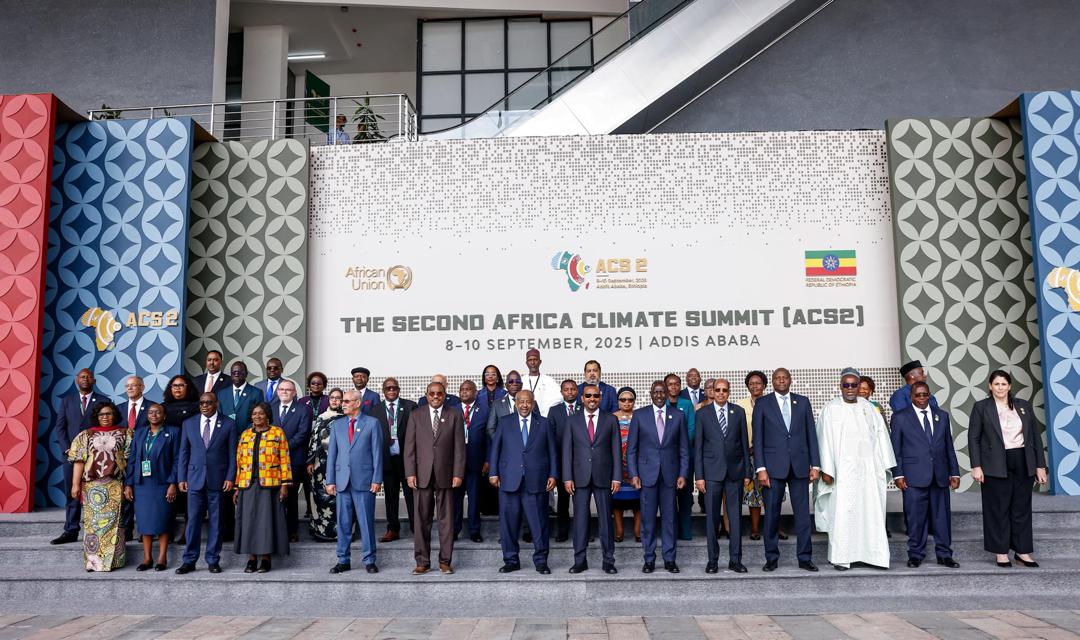
At the Second Africa Climate Summit (ACS2) held in Addis Ababa from 8–10 September 2025, African leaders made a unified statement: Africa is not a passive recipient of climate aid—it is a global hub for climate solutions.
The Addis Ababa Declaration, adopted at the summit’s close, sets out a transformative agenda for climate finance, adaptation, and innovation.
Key Commitments from the Declaration
- $50 Billion Annual Climate Finance Push
Through the Africa Climate Innovation Compact (ACIC) and African Climate Facility (ACF), leaders pledged to mobilise $50 billion annually to scale 1,000 African climate solutions by 2030. These span energy, agriculture, water, transport, and resilience. - Adaptation Finance as Grants, Not Loans
African states demanded that adaptation finance from developed nations be delivered as grants to avoid deepening debt burdens. This marks a shift from charity framing to justice-based climate financing. - Reform of Global Financial Institutions
Heads of State called for urgent reforms to multilateral lenders—lowering borrowing costs and expanding African representation in global financial governance. - Carbon Markets with Integrity
The Africa Action Plan on Carbon Markets (AAPCM) aims to ensure African participation in Article 6 of the Paris Agreement, with safeguards, transparency, and community benefit. - Africa Just Resilience Framework (JRF)
Launched alongside the Climate Justice Impact Fund for Africa (CJIFA), which has already disbursed 64 grants across 17 countries, this framework supports grassroots climate initiatives. - Green Minerals Strategy Activation
Leaders committed to leveraging Africa’s critical minerals for both global clean energy supply chains and local industrial growth. - Renewable Energy Equity
Africa’s share of global renewable energy investment—currently just 2%—must rise to at least 20% by 2030. This is vital to close the energy access gap affecting over 600 million Africans. - Climate-Health Financing
Dedicated mechanisms will be established to tackle climate-related health threats, including heatwaves and vector-borne diseases. - Youth and Women-Led Innovation
The AU Climate Action Innovation Hub will spotlight solutions from African youth and women, reinforcing inclusive climate leadership.
Nairobi Declaration: African Leaders Call for Global Taxes to Combat Climate Change
Why It Matters
The Addis Ababa Declaration reframes Africa’s climate narrative—from crisis to opportunity, from investment aid. For East African economies, this means:
- Greater access to catalytic finance for homegrown innovations.
- Stronger bargaining power in global climate negotiations.
- A pathway to industrialise through green minerals and renewable energy.
- Enhanced visibility for youth, women, and community-led climate action.
From Mombasa to AI Hubs: Japan’s $5.5B Vision for Africa’s Future
