


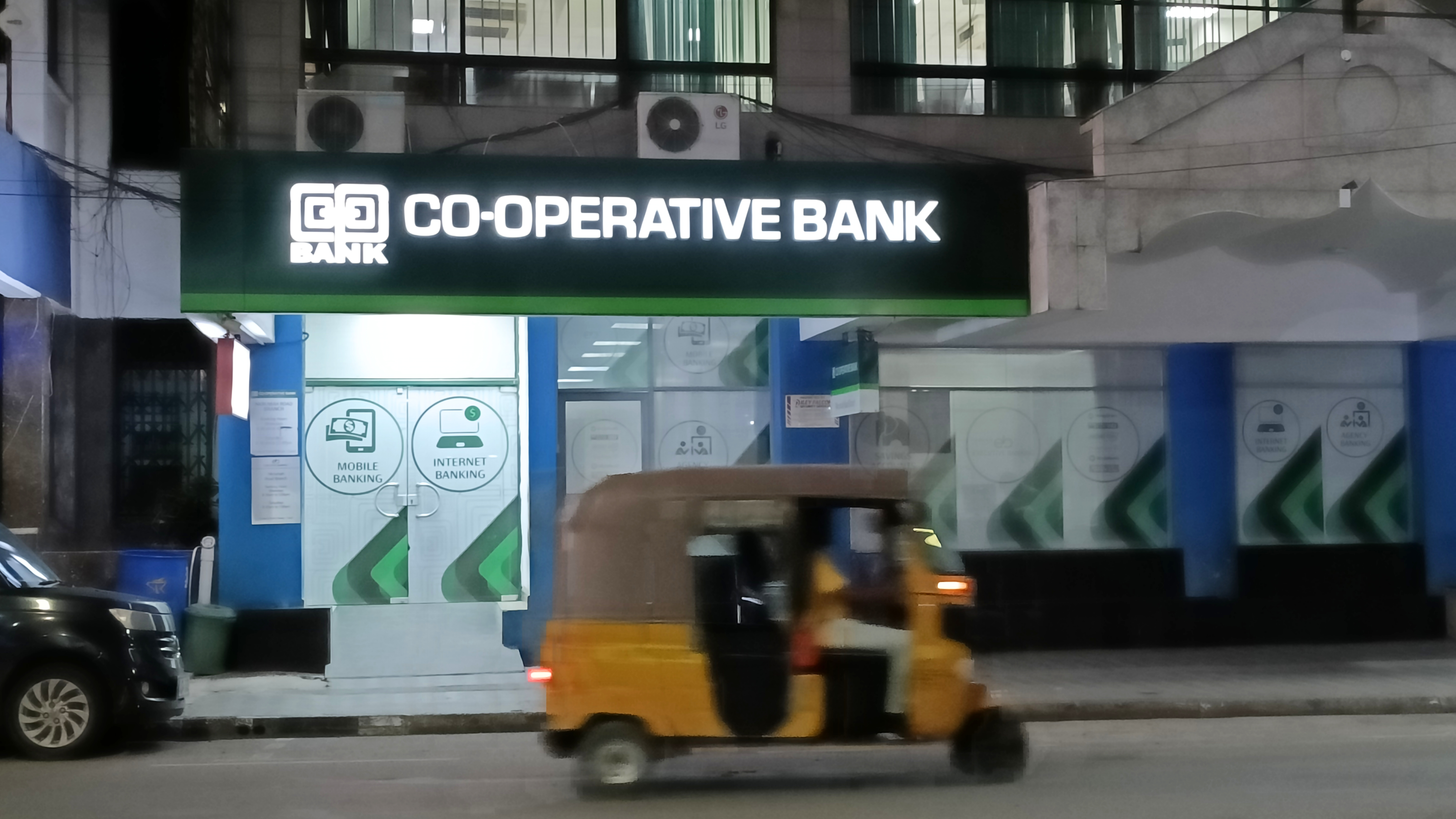
Co-operative Bank of Kenya delivered a 16.9% rise in profit after tax to KSh 29.8 billion for the full year ended 31 December 2025, extending a run of consecutive profit growth as the bank expanded its loan book, deepened its deposit base, and pushed net interest income to a record high.
The board rewarded shareholders with a final dividend of KSh 1.50 per share, bringing total dividends declared for the year to KSh 2.50 per share, a 66.7% increase on the KSh 1.50 paid in FY2024.
FY2025 Results at a Glance
| Metric | FY2025 | YoY Change |
| Net Interest Income | KSh 62.9bn | +22.0% |
| Non-Interest Income | KSh 29.0bn | −0.3% |
| Total Operating Income | KSh 91.9bn | +13.9% |
| Profit Before Tax | KSh 40.3bn | +15.8% |
| Profit After Tax | KSh 29.8bn | +16.9% |
| Total Assets | KSh 827.4bn | +11.3% |
| Net Loans and Advances | KSh 421.0bn | +12.6% |
| Customer Deposits | KSh 574.2bn | +13.4% |
| Loan Loss Provisions | KSh 9.5bn | +9.2% |
| Investment Securities | KSh 246.4bn | +12.6% |
| Earnings Per Share | KSh 5.04 | +16.4% |
| Dividend Per Share (Total) | KSh 2.50 | +66.7% |
Net Interest Income Carries the Year
The headline story inside the results is the 22.0% surge in net interest income to KSh 62.9 billion. That single line drove the profit expansion, compensating for flat non-interest income and absorbing a 9.2% rise in loan loss provisions. In a year when many Kenyan banks faced margin compression from falling interest rates, Co-op Bank’s ability to grow net interest income at this pace points to disciplined asset repricing and strong volume expansion rather than rate tailwinds doing the heavy lifting.
Non-interest income, by contrast, was essentially flat, declining 0.3% to KSh 29.0 billion. Fee income, transaction revenues, and other non-funded lines failed to grow in any meaningful way. That stagnation is worth watching. As Kenya’s rate cycle continues to ease, banks that have not built scalable non-funded revenue streams will face growing pressure on total income. Co-op Bank’s non-interest income at KSh 29.0 billion represents 31.6% of total operating income.
The Loan Book Grows and Provisions Grow With It
Net loans and advances expanded 12.6% to KSh 421.0 billion, the fastest rate of balance sheet growth in the results. The bank put that credit to work selectively, loan loss provisions rose 9.2% to KSh 9.5 billion, a rate well below loan book growth, which implies improving or stable asset quality rather than deterioration. Provisions growing slower than the loan book is the signature of a bank adding credit at manageable risk levels rather than chasing volume at the expense of quality.
Investment securities grew in parallel, rising 12.6% to KSh 246.4 billion. The bank is running a dual-track balance sheet strategy: deploying capital into both loans and government securities simultaneously. In an environment where the Central Bank of Kenya has been cutting rates, locking in securities at current yields while still growing the loan book represents a considered positioning for the rate cycle ahead.
Customer Deposits Fund the Growth
Customer deposits grew 13.4% to KSh 574.2 billion — the funding engine behind the loan book expansion. The growth rate marginally outpaces net loan growth, which means the bank’s loan-to-deposit ratio has held steady or tightened slightly. That is a conservative funding posture, and in the current environment it is the right one. A bank that funds rapid loan growth with expensive wholesale borrowing takes on liquidity risk; a bank that funds it with sticky retail deposits does not.
Total assets crossed KSh 800 billion for the first time, reaching KSh 827.4 billion — an 11.3% expansion that cements Co-op Bank’s position among Kenya’s top-tier banks by balance sheet size.
Dividend Nearly Doubles as Payout Policy Shifts
The 66.7% increase in dividend per share to KSh 2.50 demands attention. Total dividends declared more than doubled from the KSh 1.50 declared in FY2024, a signal that the board sees the FY2025 earnings as sustainable rather than exceptional, and that it is prepared to share a meaningfully larger portion of profits with shareholders.
The final dividend of KSh 1.50 per share is subject to shareholder approval. The total KSh 2.50 per share includes any interim payment made earlier in the year.
Earnings per share rose 16.4% to KSh 5.04, broadly in line with the profit growth rate.
