


Africa’s public relations industry no longer treats artificial intelligence as a horizon. It has arrived, settled in, and begun rewriting the rules of influence, storytelling, and reputation management across the continent.
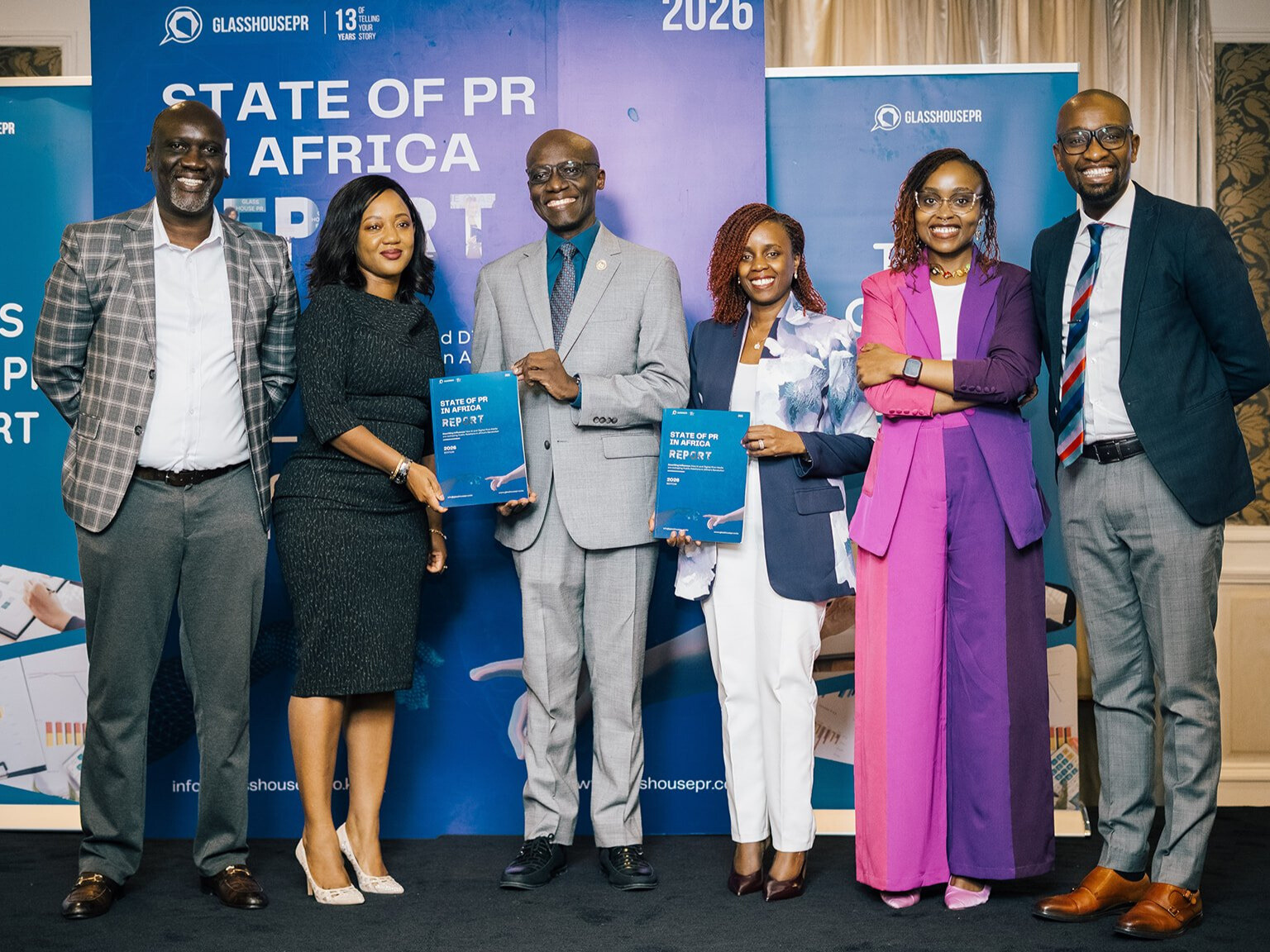
The Glass House PR Report 2026: The State of PR in Africa, the most comprehensive pan-African study of its kind — makes one thing unmistakably clear: the age of AI-powered communications is not coming. It is already here.
Speaking at the report’s launch in Nairobi, Ambassador Phillip Thigo, Kenya’s Special Envoy on Technology, put it directly: “AI is fundamentally disruptive, especially in an era where conversational technologies have become highly precise.”
He added that the profession now sits at the centre of a wider, unresolved debate about responsible AI — one with real consequences for credibility and public trust.
“People are using artificial intelligence to enhance reputations, whether through online presence or digital engagement with communities. But there is also a challenge around misinformation and the misuse of AI-generated information that can damage reputations.”
Compiled by Glass House PR, a Nairobi-based communications, the report surveyed 54 agencies across 16 African countries, capturing the views of an estimated 6,500 to 7,800 professionals. It spans firms like Weber Shandwick, Global Media Alliance and DNA Brand Architects, alongside other consultancies. It also surveyed 80 university students from seven Kenyan institutions to reveal where the profession is headed, not merely where it stands.
What emerges is a portrait of an industry in confident, if occasionally anxious, transformation.
AI Is No Longer a Tool. It Is the Operating System.
The headline number is stark: 81.5% of senior PR professionals describe themselves as “very familiar” with AI tools and actively use them in daily work. Only 3.7% remain aware but unused. This is not the cautious adoption curve of an industry hedging its bets. This is a sector that has made its choice.
Among the next generation, the numbers border on absolute. 97.5% of Gen Z students use AI tools, with 90% relying on ChatGPT as their primary assistant. For this cohort, AI is not an emerging differentiator — it is the baseline. The question is no longer whether to use it, but how intelligently.
The most widely adopted tools tell the story of where value is being generated. AI writing assistants — ChatGPT, Jasper, Copilot — dominate at 90.7% adoption among professionals. AI design tools such as Midjourney and Canva AI follow at 81.5%. Media monitoring systems with AI capability reach 63%, while social listening tools clock in at 55.6%. Across every functional layer of the profession — from content creation to crisis management — AI has embedded itself as standard operating infrastructure.
Content creation leads all categories as the single most transformed area, cited by 85.2% of respondents. Campaign planning follows at 64.8%. The implication is significant: AI has not merely automated the mechanical edges of PR work. It has restructured the creative core.
Glass House PR Founder and CEO Mary Njoki frames the shift in terms of amplification rather than replacement.
“AI is not replacing public relations professionals. It is amplifying them,” she said at the report’s launch. “What will differentiate African PR in this new era is not who uses AI fastest, but who uses it responsibly, creatively and with sound judgment.”
The Generational Fault Line Running Through African PR
Dig beneath the aggregate numbers and a sharp generational divide fractures the landscape — one that defines not just tool preference but worldview.
Seasoned practitioners gravitate toward LinkedIn (92.6%), brand-owned websites and blogs (70.4%), and Instagram (83.3%) — a professional-first, owned-media strategy that prioritises thought leadership and corporate reputation over viral reach. Gen Z tells a different story. Their platforms are Instagram (dominant), TikTok (76.3%), WhatsApp (58.8%), and Twitter/X (55%). They build for community and conversation. They film before they write.
This is not simply a demographic preference split. It signals a structural tension that African PR firms must actively manage. Senior strategists control budgets and client relationships; Gen Z practitioners are native to the digital environments where audiences actually live. The firms that bridge this gap most effectively — deploying veterans’ strategic depth with young talent’s platform fluency, will likely define the industry’s next decade.
Meanwhile, AI adoption is advancing faster than formal education can keep up. A striking 99.3% of practitioners report self-directed AI learning, having acquired their skills independently rather than through formal training. Gen Z mirrors this DIY ethos. Education, the report concludes, is playing catch-up with industry. Yet every proposed AI integration in PR curricula drew endorsement from at least 61% of students, signalling genuine appetite for institutional alignment with professional reality.
“Hyper-Localization” and the Promise of African-Centred Storytelling
One of the report’s most compelling forward projections concerns cultural relevance at scale. 40.7% of respondentspredict that AI will enable “hyper-localization” — the capacity to tailor content across Africa’s extraordinary diversity of languages, cultural contexts, and regional sensibilities more efficiently than any human team could manage alone.
A Tanzanian agency captured the aspiration vividly: “We weave in Tanzanian culture, think Swahili slang, local humour, or tales of everyday heroes like a mama in Dodoma running her own business.”
This is both an opportunity and a warning. The promise of hyper-localization assumes access to robust, Africa-centred datasets. Without that infrastructure, AI risks amplifying the biases baked into Western-trained models, deepening the digital divide rather than closing it. The report is candid about the emerging risks: deepfakes, cultural misrepresentation, data privacy gaps, and the structural danger of an AI ecosystem built on data that does not reflect African realities. The continent’s youthful, innovation-ready population positions Africa as a driver of the next wave of global communications, but only if it can own the data and the tools that power it.
Njoki anchored the cultural stakes in a challenge to the industry: “Our stories are deeply cultural and community-driven. AI must serve that reality, not erase it.”
How Digital Storytelling Dismantled the Press Release
The report documents what many have long sensed but rarely quantified: digital storytelling has not simply extended traditional PR into new channels. It has replaced its fundamental philosophy.
Traditional PR, practitioners say, operated as a monologue. You drafted the press release, sent it to journalists, and waited. Today, that model strikes most professionals as not just outdated but strategically incoherent.
“The shift from traditional PR to digital storytelling represents a move from a monologue to a dialogue,” one respondent noted. Another was blunter: “Old-school PR is a one-way street — send out a press release and call it a day. We’re all about conversation now.”
The new model centres on authenticity, emotional resonance, and real-time agility. One practitioner distilled their philosophy to its essence: “I build for emotion first, platform purpose second, and format last.” Another described their team as having “shifted from announcing brand stories to co-creating them with audiences.”
This participatory turn also demands multimedia fluency. Short-form video, infographics, interactive polls, and platform-specific content formats have displaced the static press release as the primary vehicle of narrative. “Every message is designed to work on social media, news sites, and mobile — before thinking about print,” one agency stated flatly.
At the data layer, digital storytelling introduces a discipline that traditional PR lacked: measurability. Practitioners now track engagement rates, click-throughs, and sentiment in real time, adjusting campaigns mid-flight rather than waiting for post-campaign reports. One Tanzanian professional noted with satisfaction: “With over 50 million mobile users in Tanzania, we’ve got a goldmine of insights.”
Algorithm Volatility and the Rented Land Problem
For all its advantages, digital-first PR carries a structural risk that the report identifies with unusual candour. 70.4% of respondents report that algorithm changes and shifting platform policies — from Meta’s feed adjustments to Google’s search pivots — disrupted campaign outcomes in the past year. Nearly one in three (29.6%) described that disruption as significant.
The underlying vulnerability is conceptual. When a firm builds its communications strategy on social platforms it does not own — what practitioners call “rented land” — it remains permanently exposed to decisions made in Silicon Valley boardrooms. A single algorithmic shift can erase months of audience-building overnight.
The report points toward owned media, brand websites, newsletters, owned communities, as the logical hedge. Gen Z students, notably, flag this same concern: 58.8% spotlight ethical risks tied to misinformation and algorithmic bias, reinforcing the case for platform diversification.
Alongside algorithm volatility, the industry faces a broader strategic shift: the move from SEO to GEO. As audiences increasingly turn to AI tools for answers rather than traditional search engines, PR strategies must now optimise not for “clicks” but for “citations” in AI-generated responses.
The Ethics Question That Nobody Can Ignore
Here is the industry’s central tension, stated plainly: the professionals most aggressively adopting AI are also the ones most worried about what it could do to the profession’s integrity.
Ambassador Thigo named the challenge at the report’s launch.
“Like any other sector, public relations must understand the trends, the challenges and the opportunities presented by AI,” he said. “The question is how professionals use these tools to enhance their work while also helping shape the future of responsible communication.”
70.4% of PR professionals — drawn predominantly from a cohort with more than a decade of experience — believe AI threatens ethical standards in public relations, specifically around misinformation, authorship, and bias. Only 16.7% dismiss the concern. Yet these same professionals report near-universal AI adoption in their daily work.
This is not hypocrisy. It reflects a mature, eyes-open engagement with a powerful and genuinely double-edged technology. The response across organisations has been practical: 48.1% have instituted mandatory human oversight policies, ensuring AI-generated content always receives expert human review before publication. 42.6% mandate transparency and disclosure, informing clients and audiences when AI has shaped content. 38.9% require fact-checking of all AI outputs. 35.2% enforce data privacy protections, prohibiting client-sensitive information from entering open AI systems.
Representative of the sector’s tone: “Every AI-generated output is reviewed, fact-checked and aligned with our brand values before being used publicly.” And from another agency: “Transparency — disclose when AI is used in content creation. We’re open about using AI for drafting or data analysis on X or Instagram. Clients know.”
A notable 44.4% have not yet formalised any policy, a figure the report frames not as negligence but as emerging adoption, acknowledging the pace of change that firms are navigating. The overall picture, the report concludes, reflects “mature, values-driven adoption, balancing innovation with accountability, integrity, and the preservation of human creativity.”
What the Next Generation of PR Professionals Must Know
When asked to identify the most critical skills for future practitioners, the industry’s answer is unambiguous. AI literacy tops the list at 74.1%, a clear signal that proficiency in using, understanding, and ethically managing AI tools is now considered foundational, not optional. Data analysis and insights follow at 70.4%, reflecting the growing premium on evidence-based strategy.
Third place belongs to ethics and crisis sensitivity (55.6%), a ranking that speaks directly to the profession’s awareness of its own vulnerabilities. Rounding out the priorities: content and narrative design (50%), visual storytelling (44.4%), and stakeholder engagement (25.9%), the latter treated less as a new skill than as a timeless baseline.
The picture that emerges is of a profession demanding what might be called a “hybrid professional” — technically fluent in AI and data, creatively strong in storytelling and visual communication, and ethically grounded in a landscape where the stakes of getting it wrong have never been higher.
Trust in the Age of Automation: Quality Over Quantity
Brand trust, the report argues, has become the definitive currency of modern public relations. Not reach. Not impressions. Not follower counts. Trust.
As AI generates content at industrial scale, the metrics that once served as proxies for credibility — likes, shares, aggregate engagements — no longer reliably distinguish genuine connection from algorithmic noise. 33.3% of professionals now prioritise sentiment analysis as their primary trust metric, examining the tone and sincerity of online conversations rather than their volume. 27.8% focus on engagement quality — the depth of comments, save rates, repeat interaction. 24.1% rely on direct feedback mechanisms: surveys, NPS scores, brand lift studies.
“Practitioners are redefining credibility, moving away from vanity metrics to measure what truly sustains reputation,” the report observes. Gen Z students reinforce the shift: for them, trust is non-negotiable, and authenticity, originality, and ethical safeguards constitute the only viable defence for brand integrity in an AI-saturated landscape.
