


Kenya has exited the COMESA Sugar Safeguard regime, ending a 24-year protection framework that shielded the domestic sugar industry from unrestricted regional imports.
The safeguard, which lapsed on November 30, 2025, was initially enacted under Article 61 of the COMESA Treaty to allow Kenya time to restructure its sugar sector and improve competitiveness.
A Reform Cycle Completed, Not Abandoned
The Kenya Sugar Board (KSB), under the Ministry of Agriculture, Livestock Development, confirmed the exit in a January 4, 2026, statement, describing it as “the successful completion of a reform cycle, not its abandonment.” CEO Jude Chesire emphasised that Kenya is now entering a new phase defined by “competitiveness, value addition, regional integration, and sustainable growth.”
“Kenya has fully exited the COMESA sugar safeguard regime and will now trade sugar freely within the region,” Chesire said. “The government remains fully committed to safeguarding farmer livelihoods, supporting miller viability, and ensuring food security and price stability.”
Cane Deliveries Show Mixed Signals
According to the Kenya National Bureau of Statistics (KNBS), Leading Economic Indicators (LEI), October 2025 Report:
- Cane deliveries rose from 382.5 thousand metric tonnes in September to 565.4 thousand metric tonnes in October 2025, reflecting short-term gains in farm output.
- However, cumulative deliveries for the first ten months of 2025 stood at 5.5 million metric tonnes, a 30% decline from the 7.9 million metric tonnes recorded in the same period of 2024.
This signals ongoing climatic sensitivity and transitional challenges, even as miller capacity and farm productivity continue to improve.
Sector Gains: Productivity, Acreage, and Diversification
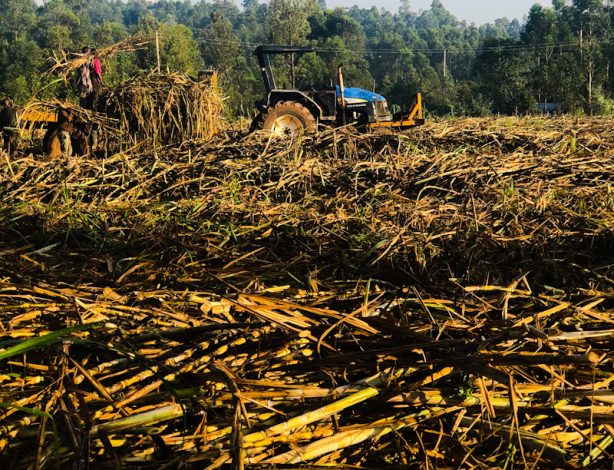
Kenya’s sugar production surged by 76%, rising from 472,773 metric tonnes in 2022 to 815,454 metric tonnes in 2025, driven by improved farm productivity, factory efficiencies, and targeted fertiliser subsidies. Sugarcane acreage also expanded by 19.4%, from 242,508 hectares to 289,631 hectares, aided by favourable rainfall and access to certified seed.
The sector’s transformation includes:
- Privatisation of state-owned mills through long-term leasing
- Diversification of sugarcane by-products, such as ethanol, bagasse, and molasses
- Integrated processing models that reduce production costs and enhance competitiveness
Strategic Imports and Regional Trade Alignment
Despite production gains, Kenya’s annual sugar demand stands at 1.1 million metric tonnes, necessitating continued imports. The government has committed to a balanced sourcing framework, allowing duty-free imports from COMESA and approved non-COMESA origins to stabilise prices and ensure food security.
This shift aligns Kenya with standard COMESA free trade rules, removing tariff-rate quotas and volume restrictions that previously governed sugar imports. The move is expected to:
- Increase market certainty for producers
- Enhance regional export competitiveness
- Reinforce policy predictability for investors
Safeguard Legacy and Future Outlook
Kenya first invoked the safeguard in 2001, citing the need for structured protection to undertake reforms. Over eight extensions, the regime enabled big structural changes, including miller rehabilitation, infrastructure development, and performance monitoring.
Looking ahead, the Kenya Sugar Board will continue regulatory oversight and market coordination to ensure an orderly transition. The medium-term outlook projects self-sufficiency and surplus production, positioning Kenya as a competitive sugar exporter within COMESA.
