



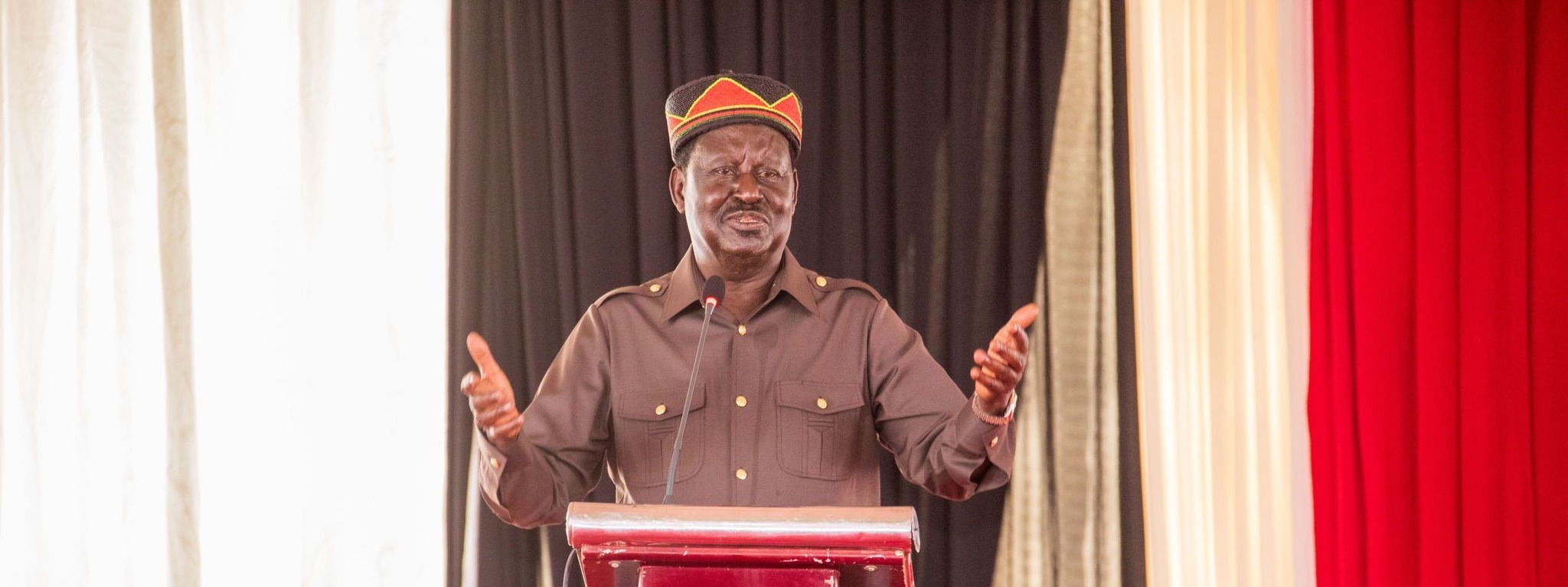
“The struggle is eternal. I may not reach the summit, but others will climb higher because we dared to begin.” Raila Amolo Odinga.
From the depths of detention to the steps of State House, from political exile to global diplomacy, Raila Amolo Odinga’s life has been a relentless contest between conviction and circumstance.
For more than five decades, the man Kenyans call Agwambo “the unpredictable one” has defined, defied, and reshaped the country’s politics.
To understand Kenya’s democracy, one must walk through Raila’s story: one of pain and perseverance, vision and vindication, loss and lasting legacy.
Raila Amolo Odinga was born on January 7, 1945, at the Anglican mission hospital in Maseno, Kisumu County, into a family steeped in leadership and struggle.
He was the son of Jaramogi Oginga Odinga, Kenya’s first Vice President, and Mary Juma Odinga, a devoted Anglican teacher.
Growing up among 18 siblings in a polygamous household, Raila learned early that leadership demands patience and persuasion.
He attended Kisumu Union Primary, Maranda Primary, and later Maranda High School, where his sharp intellect and love for mathematics stood out. In 1962, he earned a scholarship to East Germany, joining the Technical University of Magdeburg.
Eight years later, he graduated with a Diplom in Mechanical Engineering, equivalent to a Master’s degree.
He returned home in 1970 to teach at the University of Nairobi before joining the Kenya Bureau of Standards (KEBS), rising to Deputy Director. But while his career thrived, Kenya was choking under one-party rule and the young engineer’s conscience stirred.
Detention, Solitary Confinement, and Exile
In the 1980s, under President Daniel arap Moi, Kenya’s political landscape was ruled by fear. Dissent was punishable by disappearance, torture, or death.
Raila Odinga like his father before him refused to be silenced.
In 1982, following an attempted coup, Raila was arrested and accused of treason. He was held without trial for six years, much of it in solitary confinement.
The walls of Nyayo House became both his prison and his proving ground.
Upon release in 1988, he was re-arrested two more times in 1989 and 1990 for pushing multi-party democracy. Fearing for his life, he fled to Norway in 1991, where he continued mobilizing support for reform abroad.
Return of a Freedom Fighter
Those years of exile and endurance hardened him. When Kenya finally repealed Section 2A to allow multi-party politics, Raila returned home a hero of freedom.
Raila re-entered politics through FORD, the opposition party his father co-founded. In the 1992 elections, he won the Lang’ata parliamentary seat, beginning a three-decade career in elective politics.
He broke away to form the National Development Party (NDP), ran for president in 1997, and finished third. A few years later, he merged NDP with KANU, becoming Minister for Energy in 2001.
His reforms in that ministry especially expanding rural electrification and refining petroleum laws earned praise even from critics.
But when the old guard in KANU resisted change, he walked out, once again choosing principle over privilege.
Raila’s political genius came alive in 2002. Amid national fatigue with the KANU regime, he rallied the opposition under the National Rainbow Coalition (NARC) and famously declared, “Kibaki Tosha!” endorsing Mwai Kibaki for president.
That single phrase united a fragmented opposition and ended KANU’s 39-year rule. But within months, disillusionment set in. Promised constitutional reforms stalled, and corruption re-emerged. The alliance collapsed.
In the 2005 referendum, Raila led the victorious “Orange” campaign that defeated the government’s draft constitution and from that triumph, the Orange Democratic Movement (ODM) was born.
2007 Elections and Kenya’s Darkest Hour
The 2007 General Election marked both Raila’s closest shot at the presidency and Kenya’s darkest hour.
When the Electoral Commission declared Kibaki the winner, Raila’s supporters protested, claiming massive rigging. Violence engulfed the country, killing over 1,100 people and displacing more than half a million.
Global mediation led by Kofi Annan birthed a grand coalition. Raila accepted the role of Prime Minister in 2008 a move many called self-sacrifice for the sake of national peace.
Between 2008 and 2013, Raila co-governed Kenya in an uneasy coalition. Yet, the government achieved one of the most transformative milestones in Kenya’s history the 2010 Constitution.
The new charter decentralized power through devolution, strengthened the judiciary, and introduced a Bill of Rights.
Raila also championed infrastructure projects, affordable housing, and education reforms.
Despite bureaucratic friction, he emerged as a global statesman a leader able to transform turbulence into policy.
When the coalition dissolved in 2013, Raila faced Uhuru Kenyatta at the ballot. He lost narrowly, accepted the Supreme Court verdict, and called for peace.
In 2017, history repeated itself but with a twist. After a contested election, the Supreme Court nullified the results, citing irregularities a first in Africa.
Raila boycotted the rerun, arguing that promised reforms had not been implemented.
Five years later, in 2022, he ran once again this time against William Ruto. He lost by a razor-thin margin, again contesting the results in court. The petition was dismissed.
Defeat after defeat would have crushed most men. But for Raila, every setback became fuel for his next stand.As he told supporters after the 2022 ruling:
“The cause of freedom never dies. It only changes hands.”
In March 2018, Kenya watched in disbelief as President Uhuru Kenyatta and Raila Odinga shook hands on the steps of Harambee House.
The Handshake ended months of political hostility and set the stage for the Building Bridges Initiative (BBI) a blueprint to reform governance and heal ethnic divisions.
Though the courts later annulled BBI, the handshake calmed tensions and repositioned Kenya toward reconciliation.
To supporters, it was statesmanship. To critics, surrender.
Either way, it redefined Raila’s legacy as a man who could make peace even with his fiercest rivals.
Faith, Family, and the Man Behind the Myth
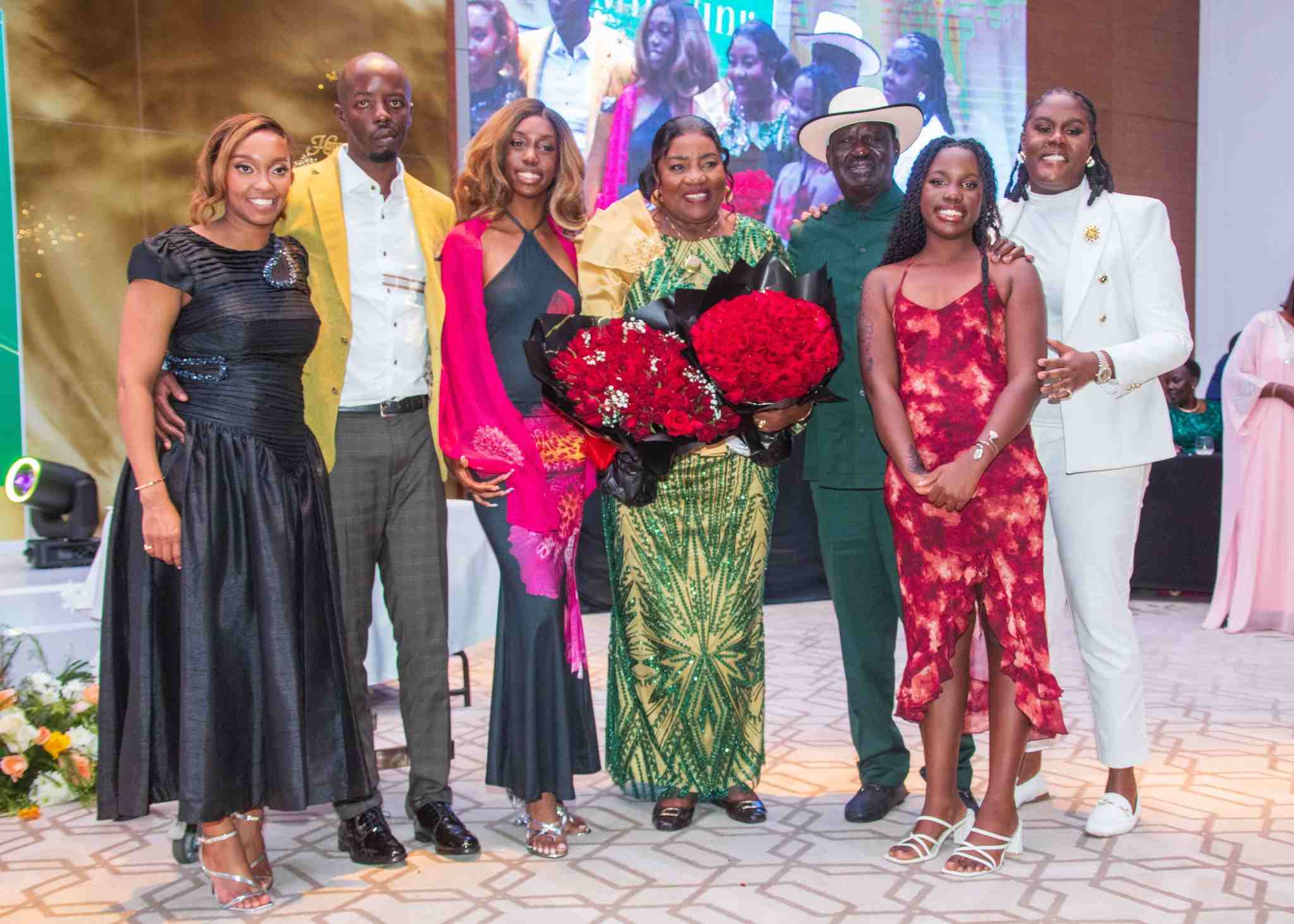
Beyond politics, Raila Odinga is grounded by faith and family.He is a devout Christian, baptized by immersion in 2014, and often references Galatians 6:9 “Let us not become weary in doing good.”
Married to Ida Betty Odinga since 1973, he is father to Fidel (late), Rosemary, Raila Jr., and Winnie Odinga. His love for football, his humility with ordinary Kenyans, and his enduring marriage have humanized a man often mythologized by politics.
Continental Statesman and AU Aspirations
In 2018, the African Union appointed Raila Odinga as High Representative for Infrastructure Development.
He advocated for continental integration envisioning a railway from Lagos to Mombasa and an African energy grid.
In 2024, he announced his candidacy for Chairman of the African Union Commission, seeking to reform the AU into a more people-driven body.
Though he did not clinch the role, his bid underscored continental respect for his leadership In 2025, Kenya deployed him to mediate peace in South Sudan, reaffirming his stature as a regional peacemaker.
Field Contribution Impact Democracy & Pluralism Fought for multi-party system; endured multiple detentions Opened political space and ended single-party rule Constitutional Reform Architect of 2010 Constitution Introduced devolution and stronger institutions Peace & Reconciliation 2008 power-sharing, 2018 handshake Restored national stability after crises.
Infrastructure & Integration AU High Representative Promoted cross-border transport and energy linkages
Pan-African Vision AU Commission bid, regional diplomacy Advocated African unity and home-grown solutions.
Raila’s career has not been without blemish.
Detractors call him a perpetual oppositionist, unwilling to accept loss. Others accuse him of political opportunism, citing shifting alliances. Yet, even critics concede that no single Kenyan leader has done more to expand the boundaries of democratic expression. Where others sought power, Raila sought principle.
“Democracy is not a gift from the powerful it is the right of the people.”
“I was born in struggle, baptized in struggle, and I will rest only when Africa is free.”
“Peace is not weakness. It is the strength to forgive.”
At 80, Raila shows no sign of retreat. He continues to speak for youth, reform, and regional unity. His speeches blend nostalgia and urgency a reminder that the work of liberation is never complete.
Whether in Kibra’s narrow lanes or Addis Ababa’s diplomatic corridors, his message remains the same
“Africa must rise on her own feet. Our unity is our new revolution.
Raila Odinga’s life is a lesson in courage and conviction. He has lost more elections than most politicians will ever contest, yet he remains the moral compass of Kenyan politics.
He has been detained, exiled, ridiculed, and revered but never defeated in spirit.
When historians write the story of Kenya’s democratic journey, Raila Odinga will stand not as the president who was denied, but as the patriot who refused to give up.
By Jesse Chenge | Nairobi
